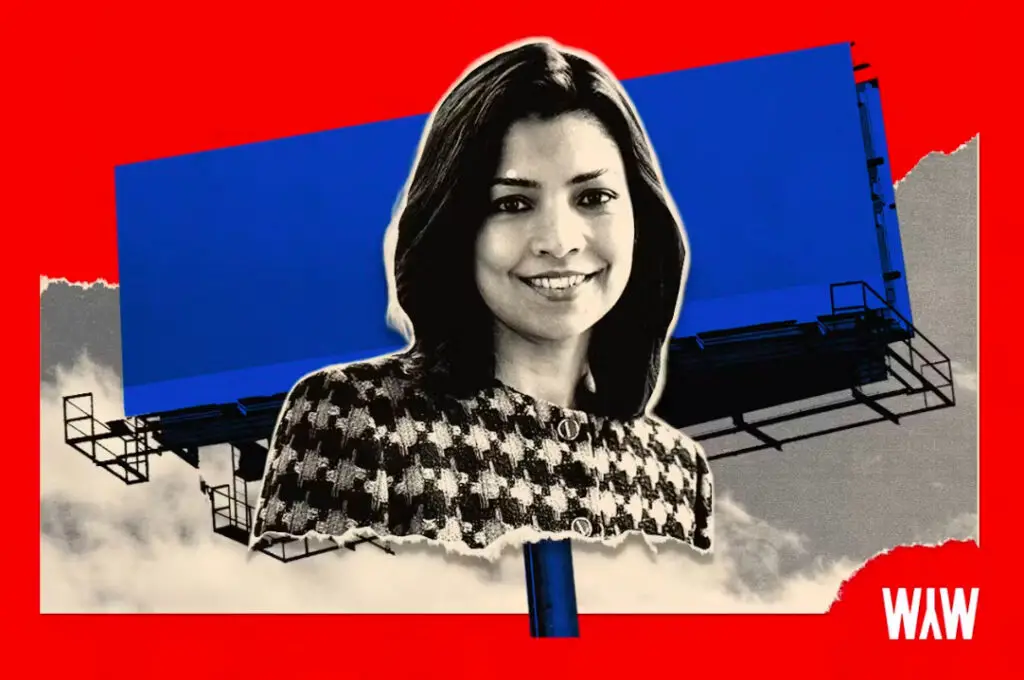
The former Google, Facebook and SpaceX communications leader tells Tim Healey why narrow specialism won’t survive AI, why marketing can’t be reduced to optimization and what he learned from Mark Zuckerberg about ruthlessly testing every new tool.
From speechwriting for Eric Schmidt at Google to leading communications for Mark Zuckerberg and Elon Musk at Facebook and SpaceX, your career has placed you at the heart of some of the defining tech shifts of our time. Now you sit on the board of HM Treasury and are focused on AI and society. Walk us through that journey.
I started my career very focused on one mission: how do you fix a bunch of global systems that are not working well? My dad was a refugee and my mom was an immigrant from Malaysia, who came to the UK in the 1970s. I always thought about myself – unironically – as ‘a citizen of the world’.
I went to work at the United Nations at the start of my career. Very quickly, I realized that the challenges we face are more enormous than anything international organizations are typically able to solve. I also realized that technology is a key vector for driving change.
It was a pretty easy leap for me to go on to work at Google. Next, I went to work for Mark Zuckerberg at Facebook before the IPO. I was brought in to work on communications there and managed a bunch of those public challenges that the company faced during that formative period for the business. After that, I went to work for Elon Musk at SpaceX.
Recently, I stepped back from my career in big tech. Now I’m very, very focused on how we prepare societies for the next generation of technological development, which I think will be vastly challenging.
In your opinion, what would be the top three challenges that the world is facing?
All the biggest ones are deeply interconnected. I think about it in four dimensions. First, I think about it in terms of the impact on economies, jobs and businesses. Technology is going to create vast economic disruption over the next decade.
Next, you have the decline of our present international system. It’s a planetary age: the idea that anything that takes place domestically doesn’t end up having huge ripple effects internationally and vice versa is fanciful. We’ve got an international order that is collapsing more and more by the day.
Third: you’ve got everything that’s happening in society – from the large pocket of problems that we now face (from the humanitarian catastrophes in the world that are showing up on our shores to the kinds of challenges we face with democracy); there is the rise of political populism; a huge epidemic of loneliness in societies and also the way that we think about the next generation, how they’re learning and processing information about the world.
Finally, you have climate change, which is twinned with sustainability. People don’t like to talk about it, they think it’s too controversial, to which I say: ‘You don’t have to take it seriously, but it takes you seriously.’
Antonio Gramsci said: “The old world is dying, and the new world struggles to be born: now is the time of monsters.” That’s the moment we’re in. AI and a load of other things that come with AI are all showing up. They are calling into question our social, economic and political model for our societies and for the world.
What might you suggest we do from here?
I believe that if you have an addiction, in order to cure yourself, you first need to admit you’ve got a problem. We are addicted to a way of life and a set of models for our societies all over the world. These are not sustainable anymore.
This is more than an industrial revolution. This is AI, fusion, quantum computing, and the vast flows of economic and political power moving around the world.
I think a lot of marketers actually absolutely recognize these problems. Exceptional marketers are storytellers and communicators. By delivering great work, they have a thesis about how to move societies. They know what is resonating. They are experts on the terrain and the texture of a changing world.
I genuinely believe that if you’re any sort of serious organization these days, you need to have marketing folks at the table because they’ve got an amazing lens on the world that is rapidly changing.
How are the best marketing teams structured?
A future-facing team must include what I call ‘Renaissance thinkers.’ The problems of the future are so multidimensional that we need to get out of the model that sees leaders as ‘one-dimensional specialists’.
The late industrial economy taught us that to be credible, you only have to be an expert in a tinier and tinier niche. Within that model, the narrowness of your specialism was how you could own it. I don’t think that’s true at all now.
The best thinkers are multi-domain experts who are competitive across challenges that have five or 10 different heads at a time. You don’t have to be solving all of those pieces, but you need to be viewing the challenge through a lens that recognizes that these things are all multifaceted. This way you can bring together different capabilities and interrogate the problems on any number of axes at one time.
How do you manage to surf the tidal wave of marketing technology?
I use almost everything. I will register for everything and try everything if I can. That’s a tactic I picked up from my time working with Mark Zuckerberg. He would download every single app and try it for five seconds and then move on to the next one.
There’s no discipline other than marketing that better demonstrates how tiny differences in execution can radically change the nature of success for services and for product delivery. So you’ve got to be trying all these new things and constantly figuring out: ‘How can I put together a set of different tools and capabilities that might allow me to level up in as many parts of my work and my life as possible?’
There’s no single tool which is going to do everything for you. It’s probably going to be a large set of tools. I believe we’re all going to end up using a vast constellation of different things, but the actual interface might end up consolidated to make it easy. Everyone should be in a phase of ruthless experimentation – what do you like? What fits your model of working?
Drawing on your leadership expertise, what has your career taught you that helps to make a great team?
Great teams often include skillsets and perspectives that are very different. Most teams fail dramatically at that. The classic way to do this would be to hire a bunch of people with exceptional resumes and qualifications in content production. That way you have great designers and filmmakers – enough technical skill to deliver the work.
But to end up with people who’ve got the depth of imagination to deliver exceptional work, you need to be looking for people with interesting life experiences.
One of the best speechwriters I ever hired had a background in medieval history. Because of that, he had a great interest in the cultural terrain and backstory that went into explaining how big moments in history were delivered. That fueled his competitive edge in figuring out what made for an interesting story in the 21st century, which in many cases actually bears more of a resemblance to earlier chapters of history than we would like to think.
One common factor in running a good team is ensuring that it can respond quickly to changing circumstances and reinvent itself. I don’t subscribe to the notion that all teams just have to be broken down into these very, very nimble, tiny things in order to work.
But on the other hand, you have teams that are absolutely tiny, who can deliver much more than larger organizations. They’ve been structured in the best way and with the right talent. They can achieve huge things very quickly, especially as AI is allowing small teams to have massive impacts.
What myth about marketing would you most like to bust?
It’s probably the idea that marketers are your shallow counterparts in business. Without marketing, your business is finished. People who think the product speaks for itself are mistaken.
The product literally does not speak for itself – that is why you need marketing. You can have a genius and superior product, but you will fail because you have not invested in being able to connect with the people who have that view – who are your customers.
Could you describe a moment where your instincts and the data pointed in different directions? How did you decide what to do and what was your takeaway from the experience?
When I was working at Facebook, there was a set of folks who were really trying to hammer a specific narrative using a set of surface-level academic research that essentially said that the company was ‘toast’. They believed that they could prove that everyone was deserting the platform. The natural instinct of many of my colleagues was to simply not engage with the argument.
They felt that attacking the research would legitimize it. I disagree with that approach. More is lost – in terms of brand building and reputational equity – by not standing up for what you believe in, rather than getting involved in the fight. I don’t believe that if you are involved in shaping story and reputation, your job is to stay out of the fight. Instead, your job is to win it.
I figured out the weaknesses in the research and openly challenged it with humor, too. Everything that matters, in terms of reputation, is being driven mainly through social, and on those platforms need to be able ‘to speak human’. It turned out that the research was based on a set of bad ideas, which were quite flimsy. The moment you leaned on them, they all fell over.
I see it all the time: companies trying to remain dignified above the fray: they feel that they can’t do anything about claims against them – they can, they haven’t even tried.
Social media is becoming ‘less social and more media’ – what is your view?
A lot of social media has become increasingly less social. There’s a lot of information, and a relatively small number of people are producing the content that drives the most engagement.
A lot of brands make a big mistake thinking that they can shape reputation by relying on a fairly narrow sliver of mega-scale influencers. In fact, it’s the micro and the nano-scale influencers – the ones that you’ve got very strong personal relationships with – who really move the needle.
Social media is not a series of platforms and environments which are able to deliver the kinds of real, large-scale cohesive stories that one may have relied upon them to do even as recently as five years ago. As a brand, you need to be much more multifaceted now.
There are people working for brands in social media who think: ‘I’m running a campaign and it’s got this massive architecture and it will reach one million people.’ Well, that’s not how it works any more. To get that level of valuable engagement, you’re going to need to run 20 different campaigns, at a much smaller scale, which are all part of a coherent whole.
What question would you like me to ask the next senior marketer that I interview?
What are you changing in your own life or work as a result of AI? I’m always interested in what people are doing after their initial dabbling with ChatGPT, for example. For me, AI has challenged me to rethink a whole bunch of assumptions. I’m especially interested in how people are approaching this as individuals.
Your question from the last senior marketer that I interviewed is this: what is the biggest revelation you have witnessed in the last year that you think will affect the next 10 years of marketing?
That would be the post-transformer AI architectures that are being developed right now. The last three years of the generative AI boom has mostly been based on Transformers.
If you have a role or a skill set that is mostly based on knowing a specific set of things that might be objectively true, then you’re gonna have a really, really bad time in the next five years. That stuff is just so vulnerable now to disruption. You are going to need to be able to expand your skillset to include wider knowledge from a different set of sources, which is something humans do really well.
Being a domain expert with knowledge is simply not enough.
You used the terminology ‘transformer’ – would you be able to just explain a little bit more about that?
Transformers in AI essentially mean where AI takes given information and transform it – one set of inputs leads to a different set of outputs. That is the value we get from generative AI.
It’s amazing how many products today refer to themselves as agents but are not AI agents at all. They’re not doing anything autonomously. In essence, they are just clever wrappers for things that are pretty ‘old school’.
Agentic AI solutions that operate with a human level of sophistication, problem solving and autonomy are the next generation of AI products that will use real agentic intelligence.
I have been shown products that claim to provide AI-powered end-to-end solutions for advert creation, for example, and if I understand correctly, you are saying these are not as agentic as they could be? You’re suggesting that the next stage of AI is when AI can make better decisions than that?
100%. For a lot of marketing, there isn’t an objective answer. To suggest: ‘I’ve crunched all the data and I can show that this shade of blue is the right one’ – that’s absurd. That’s not how it works.
Marketing should be treated much more as an art than a science. We may have over-indexed towards thinking there’s a data-driven optimization for things that are really profound and thoroughly subjective.
Marketing is not a thing where ultimately a machine can just pick the right output. There are choices. We have to be experts on making the right choice. It’s an opportunity for all of us because it keeps the magic in the creativity.
If there’s one thing you know about marketing, it is…?
Marketing is all about being an expert on the texture and terrain of society. It’s not mainly about the tools and the operational elements. Those are all important, you can learn them. The world is very, very complex. The tools are easy by comparison – we just need to understand them.
You might die tomorrow so make it worth your while. Worth Your While is an independent creative agency helping brands do spectacular stuff people like to talk about. wyw.agency.
This interview has already appeared in The Drum. Discover the best campaigns, industry insights and interviews from world-leading marketers, creatives and more.