Tim Healey speaks to Revolut’s global chief growth and marketing officer, Antoine Le Nel, about how a background in physics and engineering helped him turn marketing into what he calls a commercial equation.
You have worked as a strategy consultant, spent five years working at King and, most recently, spent more than five years at Revolut, where you have moved from vice-president of growth to global chief growth and marketing officer. What are the key points in your career that have led you to your role today?
I never set out to be a marketer.
My background is actually in physics and engineering. From the very beginning, I approached marketing not as a creative exercise, but as a commercial equation. As a strategy consultant, my focus was heavily on pricing, lifetime value modelling and driving top-line impact.
That analytical foundation naturally led me to King, the maker of Candy Crush. In the gaming world, performance marketing is the absolute engine of growth. It was there that I expanded into CRM and learned how to build and operate massive performance marketing engines at scale. Understanding how to engineer that kind of high-velocity growth is exactly what brought me to Revolut. I didn’t just want to bring performance marketing to fintech; I wanted to build a global growth machine from scratch.

Antoine in keynote mode.
What is the offer at Revolut?
Our ambition at Revolut is to build a unique global bank. We want to serve hundreds of millions of customers in 100 countries. We will do that by offering the best banking services and more. One of our distinguishing features as a business is that our services go beyond banking and into lifestyle, from eSIMs and loyalty programmes to travel perks.
At the end of the day, Revolut is building the new, definitive benchmark for all of your financial services.
Revolut’s revenue for 2025 was $6bn, and the business delivered its fifth consecutive year of profitability. With such strong growth across all its business segments, what is coming up for you and your team in 2026?
In November 2025, our valuation was announced at $75bn. That made us the biggest private tech company in Europe. But valuation only tells half the story; hitting $2.3bn in profit is what proves the engineering actually works. Even on the global stage, that puts us alongside OpenAI, SpaceX, TikTok, Anthropic and Stripe. This is something we take great pride in: we are a true European success story and the only European tech company even to appear in that ranking.
In 2026, there are three main areas of focus. First, we will keep accelerating in our current markets and grow our market share in private banking. From a marketing strategy perspective, we want Revolut to be the primary bank for our customers, not just the secondary bank. To achieve that, we need to earn trust and build the reputation that means people can trust us with their savings, salaries and bills. This initiative will be mostly focused on Europe, and we will really put a lot of effort into that.
Our second objective is business-to-business (B2B). We are famous for our business-to-consumer (B2C) product, but we also have an amazing B2B product. Revolut Business isn’t just an accounting tool; it’s a growth weapon for founders. Companies don’t just die from bad products; they die from friction. We want to give businesses the exact same financial velocity and global reach as a Fortune 500 company. We want to accelerate this infrastructure and win more global customers, like Booking.com, which added RevPay to its checkout, enabled by its integration of Revolut Business.
The third pillar for 2026 is expansion. How do we expand Revolut’s reach to new countries? Recently, we launched in Mexico. In each territory, you have to show that you deserve to be awarded your banking licence. Once you have that, you can start to onboard your first customers.

Revolut’s global headquarters in Canary Wharf, London.
How is your marketing team structured?
If you look at legacy banks, they build massive, bureaucratic marketing departments. We are structurally opposed to that. We run our global marketing organization much like a high-performance software engineering team, operating in decentralized, highly specialized units.
The secret to this structure isn’t just being lean; it is extreme autonomy paired with ruthless accountability. These teams don’t wait for layered corporate approvals. We give them absolute ownership over their goals. They are backed by a centralized growth engine, a combination of our automated tech stack, rigorous analytics, precise measurement and streamlined processes, which allows them to execute with unprecedented velocity.
To give you an idea of how this works in practice, we have exactly three marketing managers driving the entire UK market. You cannot achieve that level of scale with a traditional model; you only do it by replacing corporate hierarchy with ultimate accountability.
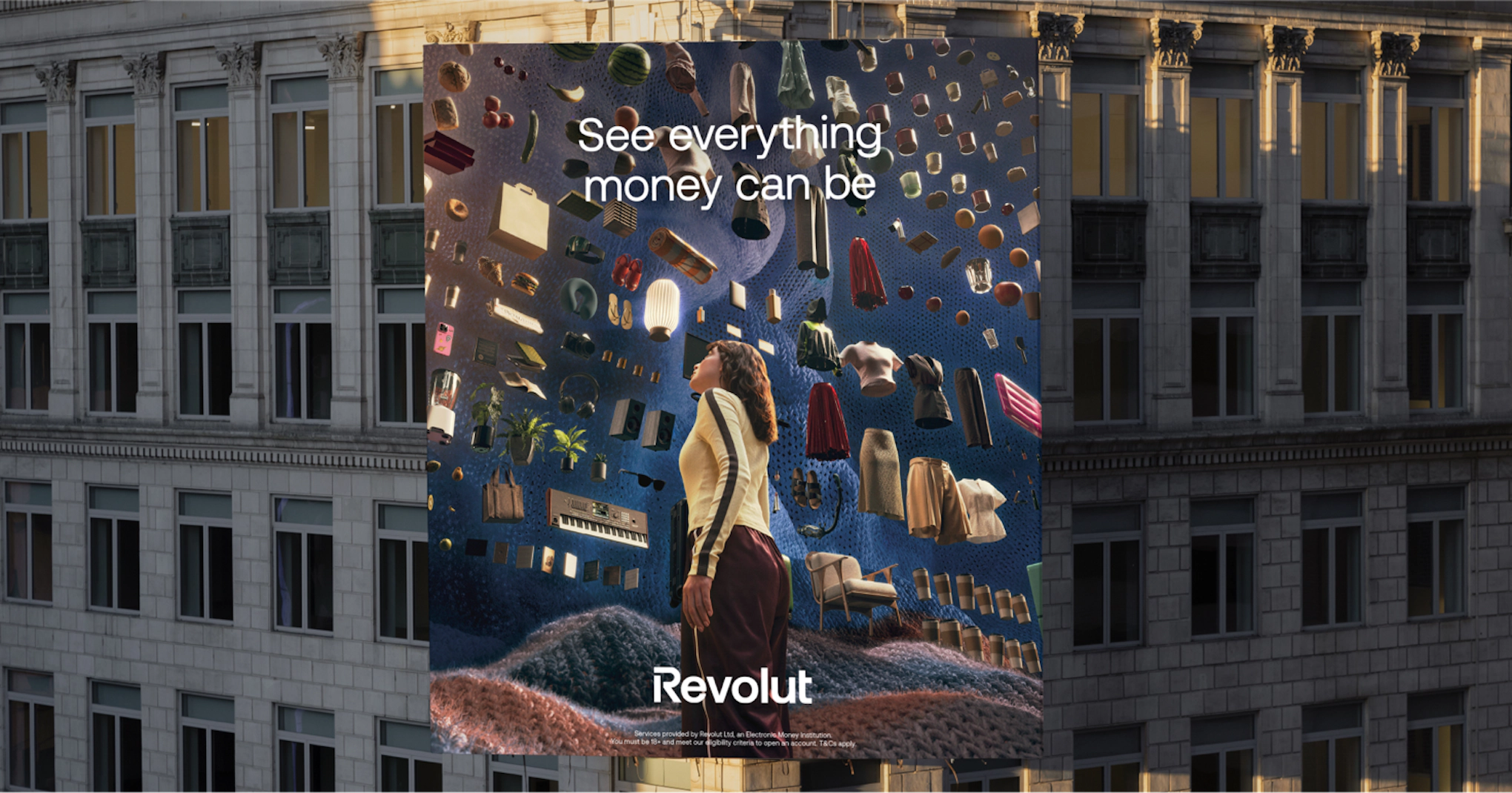
Revolut’s campaign ‘Money Possibilities’ used dreamlike visuals to show users entering their own pockets to manage money.
Drawing on your leadership expertise, what has your career taught you that helps to make a great marketing team?
Marketing is a combination of art and science. It is essential that you keep them in balance and make sure that you always dance on both feet. But beyond that balance, the most important thing to consider is the expertise of your marketing team. I think you need to be very careful not to have too many generalist marketers in your team, marketers who can do a little bit of everything.
I believe in specialization. I believe in depth of knowledge. I’m a strong advocate of high levels of specialization for each team member within the marketing organization.
The world of marketing today is more and more complex, and it’s only when you have the ability to go deep that you can beat your competitors in the market.
How do you manage to surf the tidal wave of marketing technology?
I don’t surf the wave, we make it. Whether I was in gaming or here at Revolut, I believe we are creating “the wave” that you refer to. Look at our recent Overtake TV campaign. That wasn’t just a media buy; it was a cultural declaration of intent. We are literally and unapologetically overtaking the legacy banking system.
I don’t think Revolut or King are, or were, following any benchmark. I think both businesses operate at a level where they are defining what marketing is. When you view marketing through this lens, you have a greater sense of ownership. We are big enough to do marketing the way we feel that we should do it and not be swayed by trends.

In 2025, Revolut announced its partnership with the Audi Formula 1 team.
What myth about marketing would you most like to bust?
The first myth is that you can’t run a global growth engine yourself. I think you can. At Revolut, we keep our core marketing functions highly internal. External partners and agencies are absolutely brilliant for massive cultural brand moments or highly specialized creative executions, but for our daily growth engine, keeping things internal ensures ultimate velocity. When you operate at our speed, the brief can change in hours; managing that internally keeps the idea agile and consistent.
I’ve heard senior marketers say: “If I brief an agency today, then literally hours later, that brief might have changed. But to get another meeting with the agency, I would need to wait two weeks.”
Exactly. I change my opinion all the time. And I don’t feel bad about it. I like to be agile and not locked into an agreement that signs off on one idea, but where the end result will not be realized for several months. It is inevitable that things are going to change, and we need to be OK with that.
Could you describe a moment when your instincts and the data pointed in different directions? How did you decide, and what was your takeaway from the experience?
My view has changed because I saw the data. Today, product features are a commodity; anyone can copy an app feature in three months. Brand marketing is our uncopiable moat. You can see that you are shifting metrics and building a much healthier foundation to enable accelerated growth.
You just need to change your time horizon, as the impact is over a longer period of time than with performance marketing. Ultimately, elevating our brand experience from a utility to a premium lifestyle asset will drive the business. It allows you to build institutional trust and be much more aspirational.
Could you tell me one significant activity you’ve deliberately stopped? What capacity did it release and what did the results teach you?
I’ve stopped a lot of affiliate marketing. Some affiliates are still working, but when you are a big brand, I don’t think you need affiliate marketing. As you scale, there is a moment where you’re big enough to be in control of your distribution channels. Running affiliates can be seen as sourcing new customers. But you’re not in control of the messaging or the narrative, so, on balance, I don’t think it’s a good thing.
Rather than affiliate marketing, I am more interested in price comparison websites, as they can build trust just as well. In contrast, some affiliates can be damaging to your reputation and your brand, and are best avoided.
If you had one piece of advice for a mid-weight marketer looking to become a marketing leader, what might that be?
Don’t try to know everything “too early”. One of the biggest risks anyone faces in their career is the temptation to try to be a great all-rounder and do a little bit of everything. For marketing, I think this is a big mistake because, in my opinion, your expertise will ultimately remain super-shallow. It’s not going to work. Instead, I would advise you to deepen your expertise and then build on it.
I came from marketing analytics and performance. I’ll always keep that as a strength, but that doesn’t prevent me from adding new things, even quite late in my career. I know that I have this foundation that I can always use, and then I can add to that.
What question would you like me to ask the next senior marketer that I interview?
What do you think Revolut is doing wrong?

The Revolut NBA co-branded payment cards were launched in partnership with the National Basketball Association.
Your question from the last senior marketer I interviewed: how do you ensure that your marketing team is staying culturally relevant in an ever-changing market?
This is a considerable challenge for Revolut because we operate in 39 markets. We are the only global player in our sector, but to gain market share in each market, we find that with fintech or banks, all of our competitors are local.
We find ourselves in a unique situation: our competitors in each country are completely different. In France, we have different competitors to the UK, Germany, Sweden and Japan. The challenge we face is to build a marketing strategy that makes Revolut relevant when competing with financial services that are so much more local than we are.
My approach was to view this as two different layers. The first layer is to simply acknowledge the fact that Revolut is global. That alone will help us to position ourselves against our competitors. Let’s not hide it. Let’s not be shy: let’s “be global”.
As a global business, we can consider big partnerships, as we’ve done with the Audi Revolut F1 Team, or our presence in airports around the world, whether that’s card vending machines or our branding on jet bridges. These create a consistent, international perception of the brand.
Our second layer, in contrast, focuses on building ultra-local partnerships, like the team sponsorships with Manchester City men’s and women’s teams and Stade Toulousain in France.
We find that partnering with local cultural ambassadors and digital creators is a very strong platform to help Revolut remain culturally relevant. Of course, how you build this creator ecosystem is key. You can’t just put your product out there; it has to be integrated with the content, not only in a specific video but over a longer duration.
We find people are very loyal to their channels on social media. As such, if you get it right, you can become part of your customers’ lives. Social media is quite unique in creating that connection with your customers. We really leverage local influencers to build our cultural relevance.
How does the Audi Revolut F1 partnership fit into your strategy?
Motorsport is one of the very few platforms that is truly global by design. But we didn’t just buy a sticker on a wing; we secured the naming rights. Becoming the Audi Revolut F1 Team changes the paradigm from being a mere sponsor to being a co-owner of a global cultural narrative.
It gives us immediate reach across multiple key markets, but more importantly, it gives us unapologetic, premium consistency. Instead of building perception country by country, we can create a single, strong signal at an international level.
Where it becomes interesting is in how we activate it. It’s not just about being visible on the car, it’s about what we build around it: the fan experience, the activations during race weekends and the way we connect it back to our product.
That’s how we turn a global partnership into something tangible. Otherwise, it’s just sponsorship.
You’ve just launched your first campaign as a bank with Graham Norton. Why him?
With our UK banking licence, the challenge changes. Growth is no longer just about acquisition; it’s about trust.
We’re asking customers to move their salary, their savings and their financial life to Revolut. That requires a different level of credibility, and the way you communicate needs to reflect that.
Graham Norton brings something very specific: he is widely recognized, trusted and relatable across the UK. He has the ability to make complex things feel simple and accessible, which is exactly what we want to do as a bank.
For us, it wasn’t about finding a celebrity; it was about finding the right voice. Someone who can communicate that Revolut is not only innovative, but also secure, established and ready to be your primary bank.
If there’s one thing you know about marketing, it is…?
One thing I know about marketing is that it changes every year. The truth of today is not the truth of tomorrow. My business growth engine in 2025 looks nothing like the one I had in 2024. And the one I will have in 2026 will be very different again.
In my experience, there is no single truth for marketing and growth. As marketers, we need to adapt to each situation: to the competition, to your product and so on. Great marketing is about being fluid and agile by adapting to the situation.
This interview is brought to you in partnership with Worth Your While, an independent creative agency based in Copenhagen, working globally. Named one of The Drum’s Indie Agency Top 100, WYW exists on the belief that time is humanity’s most valuable resource, and that the only ideas worth making are ones that earn it. You might die tomorrow. Make today worth your while.
Tim Healey listens, learns and synthesises real-world best practices from hundreds of marketing professionals and serves them up in his weekly interviews for The Drum. Tim’s Little Grey Cells Club is a trusted, no-sales, peer-driven network where senior-level marketing directors unite to exchange authentic insights, confront challenges and drive leadership forward.
You might die tomorrow so make it worth your while. Worth Your While is an independent creative agency helping brands do spectacular stuff people like to talk about. wyw.agency.
This interview has already appeared in The Drum. Discover the best campaigns, industry insights and interviews from world-leading marketers, creatives and more.