I’ve been delivering leadership mentoring for 25 years, and recently, having also spent a significant
amount of time in conversation with exceptional leaders as research for my book, I found myself
returning to the same eight observations I have been considering for most of my career.
They are not new, but they are still true, largely unaddressed and still quietly costing senior leaders
and teams more than they realise.
What struck me most is how consistently the same gaps appear regardless of sector, seniority or the
size of the organisation. The faces change, the patterns don’t.
So, in this article, and in the spirit of giving back, I am sharing them with you.
The 8 Principles of High Performance
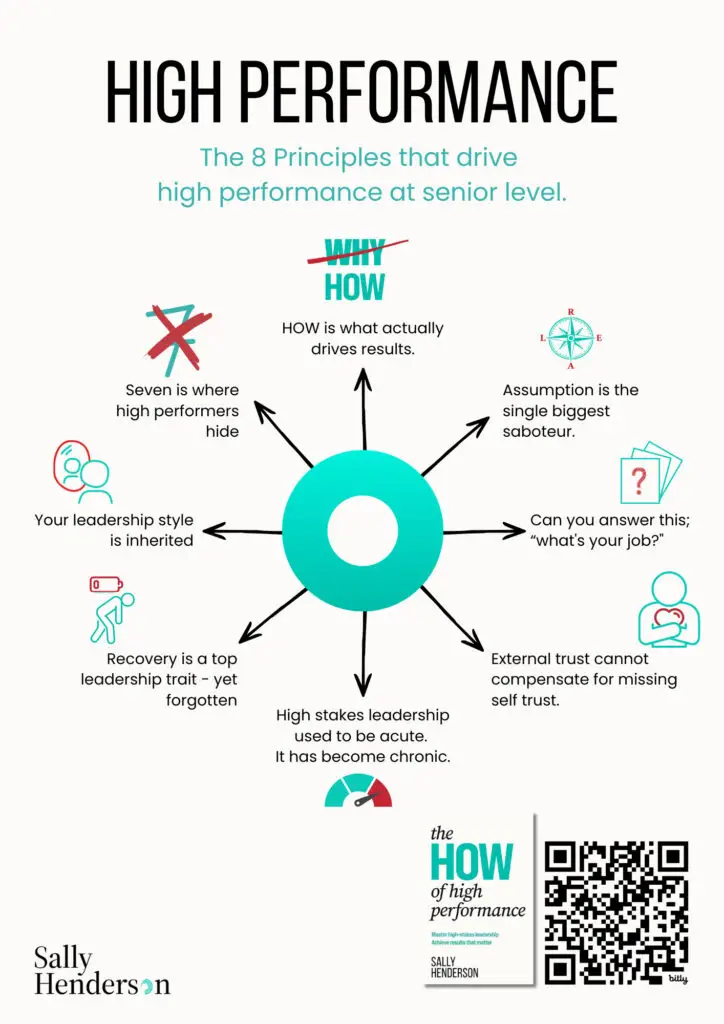
These eight principles sit underneath everything when it comes to success or struggle as a senior
leader. The role clarity that gets skipped, the self-trust that gets overlooked, the recovery that gets
sacrificed and the leadership identity that never quite gets deliberately built.
1. The leadership development industry is obsessed with WHY, and it is leaving HOW
unattended.
I gave a TEDx talk about this, because I was genuinely frustrated watching brilliant leaders get sold
purpose as the answer when the real gap was always in the execution. Knowing your why matters, but
I have sat across from hundreds of leaders who know their why perfectly well, and yet are still
struggling, because nobody has ever helped them get underneath HOW they actually lead.
2. Assumption is the single biggest saboteur of high performance at senior level, and nobody
talks about it.
When you reach the C-suite, everyone around you assumes the foundations are in place; Role clarity,
Emotional regulation, sustainable Energy, a deliberately defined Leadership style.
But, I am yet to meet a senior leader who has genuinely mastered all four without deliberate focus and
work. Nobody checks and the higher you climb, the less support you get to strengthen them. This is
exactly where performance quietly starts to erode without anyone quite being able to name why.
3. Most senior leaders cannot confidently answer the question “what’s your job?”
Not the title, not the vague brief from three years ago, but what they are really there to deliver, and
what rhythm genuinely serves their performance. When I ask this question (and I ask it a lot), voices
drop and body language shifts, because what comes back is something that is being constructed in the
moment or recalled rather than something that genuinely drives leaders in their jobs. Role clarity is
not a nice-to-have. It is the foundation everything else is built on.
4. External trust cannot compensate for missing self-trust.
Your Board can back you, your team can believe in you and your investors can be fully aligned, but
none of it holds if you are not solid in yourself when the pressure is relentless. The trust in ‘I’ has to be
strong first for the ‘We’ to follow.
5. High stakes leadership used to be acute. Since 2020, it has become chronic.
A crisis you move through and come out the other side is something leaders have a blue print to
access for how to handle. What leadership resilience has not been built for is the permanent operating
condition senior leadership has become. Where the pressure does not lift and the next challenge is
already waiting before the current one is resolved. Most leadership development is still offering tools
designed for a world that no longer exists, and leaders are feeling that gap.
6. Recovery appeared as a key leadership trait for high stakes in my research, and yet was
mentioned least in the top 9.
I want you to sit with that for a moment, because it tells you that capable, talented leaders burn out,
despite knowing better. Not because they lack discipline or do not care about themselves, but because
when the pressure intensifies, personal recovery is always the first thing that gets sacrificed, and the
last thing that gets rebuilt.
7. Your leadership style is most likely inherited, not designed.
The patterns absorbed from early managers – good and bad – the beliefs formed in the first decade of
your career, the version of leadership that helped you climb quickly but no longer fits where you are
leading from now, I see this running silently through senior leaders and teams all the time, shaping
decisions and relationships in ways not consciously chosen.
Making your leadership identity tangible and deliberately defined, not just the version you think you
should be, but who you are now and who you are becoming, is the difference between leading on
autopilot and leading with real authority.
8. Seven is where high performers hide, and it costs them more than they realise.
When I ask leaders to score themselves (honestly) on the foundations of their performance, seven
comes back more than any other number. It sounds acceptable. It does not demand real change. But
7/10 is where capability quietly plateaus and where the gap between what you are delivering and what
you are genuinely capable of starts to widen. Honest scoring is when you stop hiding, face into the
naked truth and take action. I call this The REAL Score Test.
None of these eight things are complicated. What they require is clarity about where you actually are,
what has been inherited rather than chosen, and what is being quietly sacrificed in the name of
keeping everything moving and everyone else happy.
Honesty backed by action and accountability is where the real work begins.
Are you ready? I am…