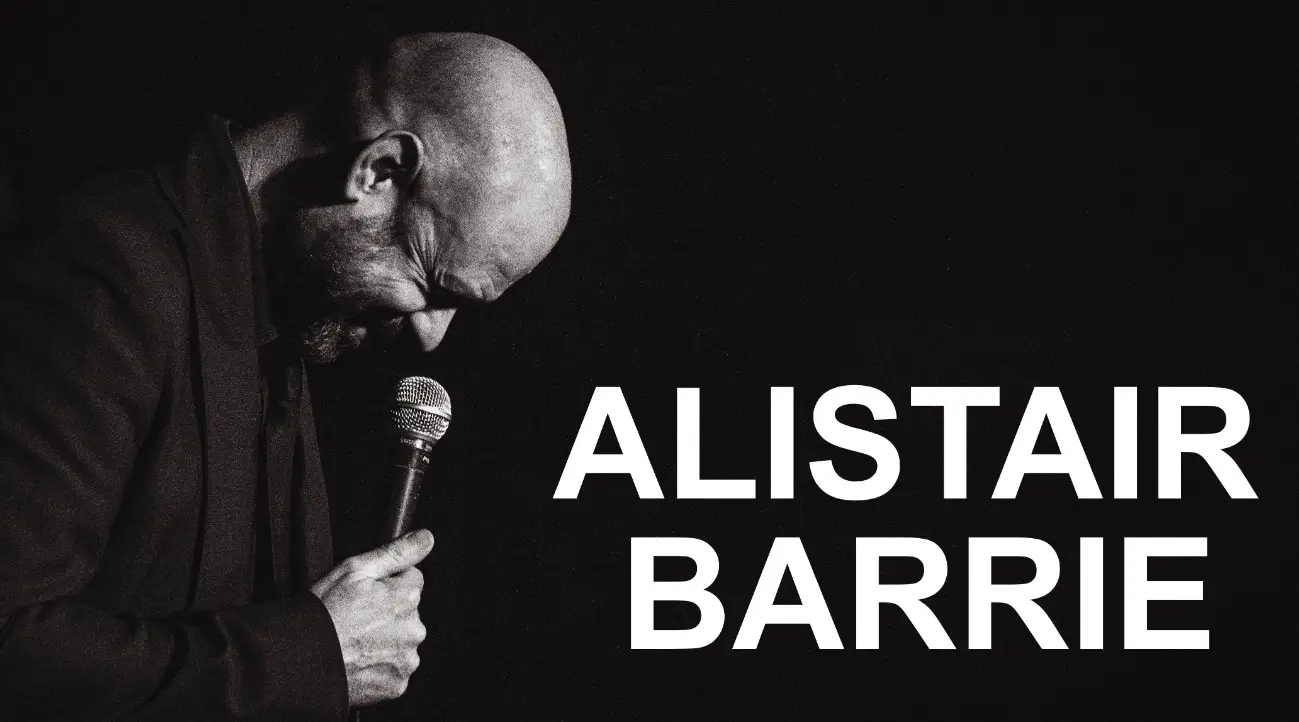
Starting in November, Little Grey Cells Club welcomes one of the UK’s top comedians – a BBC regular who has performed in over 50 countries and twice been nominated for best show at the Edinburgh Festival, Alistair Barrie as our resident comedian for our breakfast briefings and also as host for our 1 day summit. Founder Tim Healey catches up with the comic to get the inside track.
You have taken solo shows to Edinburgh year after year and been nominated twice for best show. What does the Fringe teach a performer that the circuit never could?
Ooh. That’s a very good question to kick off with, mainly because no one’s ever asked me it before. I first went up to Edinburgh as a student actor in the early nineties. I fell in love with it then, and even on a brief run this year over thirty years later realised I still do. In many ways it’s like a comedy trade show (other art forms are available,) and the social aspect is wonderful. But my days of falling out of bars at ludicrous o’clock are thankfully well behind me.
There is a wonderful feeling of bustle, creativity and camaraderie, as well as a permanent chance of the unexpected. As a comic, I think the main way to view it is as an intensive refresher course. You are forced into long form comedy night after night, interspersed with shorter sets, jumping on and off stages all over the place. When you are new, it’s a great way to improve because you are essentially being put though a boot camp. I always say to newer comics the best way to improve is simply stage time, and Edinburgh provides a month long burst of that. Now I’m a bit older, I’m not so sure I want a month long burst of anything, but the ability to get out there and concentrate on formulating an hour show – rather than the usual circuit twenty minute spots – will never stop being challenging, fun and (as long as you get it vaguely right) rewarding.
On the Comedy Store’s Cutting Edge and BBC Scotland’s Breaking the News, you are writing to the news cycle. How do you find the joke in a story before everyone else has?
Well sadly The Cutting Edge is no more as it fell victim to Covid, but it was a very fun twenty years! But yes, still trotting out topical stuff for BTN, Times Radio and whoever else will have me. I’m not sure I find the joke before anyone else, I’m just asked to tell it first.
Social media is a very useful way of seeing both original takes, as well as identifying the more mundane. Having said that, never underestimate the kudos you receive for referencing something new simply because it’s clearly freshly minted – for instance I have got a lot of laughs this weekend from throwing ‘stabbing a dinghy’ into an old routine, which is a lot more than you can say for the poor bloke from the RNLI.
As always, it’s a case of trying to find something new – often in old subjects as the news is cyclical. As The Edge was a live show, this could mean crowbarring in an old bit that was relevant, but I think the main thing is to have a defined attitude to a story and to essentially subvert the audience’s idea of where you go with it. And sometimes both. Describing Donald Trump as orange is always going to have diminishing returns, but if you can get him to speak Mandarin you may be on to something.
You are the only comedian to have played both the Labour and Conservative conferences. What did working both teach you about winning over an audience whose worldview you may not share, without flattering them and without selling yourself out?
Ha! Well, I did the Labour one for free then the Conservatives paid me, so that was the opening joke there! The thing is, I did roughly similar sets for both gigs (they were within a year of each other.) The bottom line is funny is funny. Of course you can sneak a worldview in, but I have always been very careful to make sure there is a logical consistency to my routines which makes them quite hard to disagree with. I do think comedy is important, but are you going to change party allegiances? I doubt it. If you are trying to force a point of view across, you’re not a comedian, you’re a polemicist, and no one goes to their shows for a giggle. Far better to elicit a laugh while smuggling in some illicit attitudes behind it.
You have gigged on a mountaintop in France and for troops in Afghanistan. For Little Grey Cells Club – some might think it’s a tough gig: 9:50am on a Thursday, 100 top-tier marketers from the UK’s biggest brands – no alcohol… have you done tougher? Tell us about a night that went badly wrong, and what it taught you that the easy gigs never could?
I think at this stage I can cut my cloth to any environment, but it’s usually the simple things that are problematic. When you’ve done a gig to 300 squaddies on the back of a flatbed truck in Afghanistan, I think (hope) 100 top-tier marketers hold little fear. Whenever you get to a gig and notice problems with the set up, the organisers invariably say ‘You’ll be fine!’ and you have to point out you’re not worried about your ability to do the gig, you’re worried about their ability to run it properly. I had an awful time at Birmingham ICC where I was meant to walk on to a floating stage obscured by wooden palm trees. I struggled through twenty minutes to the diplomats’ wives in Athens when it turned out most of them couldn’t speak English and the microphone was broken. But hey – no one died. Except me.
I will probably arrive at Little Grey Cells Club slightly early just to check the staging and the microphone.
You have written for Frankie Boyle, Jason Manford and Jack Whitehall, three very different voices. What is the trick to disappearing into someone else’s way of speaking?
I’m not sure there is a trick. If I’m helping someone with their stand up, I do like to make it collaborative, because they have to put the funny idea into their own voice when they deliver it. It does depend if you’re writing routines or gags. Simple one liners for Mock the Week can usually be delivered by anyone, but if you’re working on a longer piece or it requires a more narrative arc, I find it’s much more satisfactory for both parties if you work together. It very much depends on the brief and whether you’re being asked to provide a set of gags based on a subject, or something more personality driven.
What can a marketer learn from a career in comedy that they will not pick up from another marketer?
Blimey. No idea. I could probably do with a marketer to market my answer to this one. The thing is, people in the careers arena always say comedians have a huge amount of transferable skills. Meanwhile, comedians spend most of their working lives actively trying to avoid having a career. But the ability to think on your feet, tailor your approach to your environment and essentially team lead a room of disparate strangers has to count for something. (We are also excellent at navigating late night traffic diversions, coping with massive job insecurity and have an encyclopaedic knowledge of service stations.)
Contact Alistair’s agent Jacob at [email protected] to book