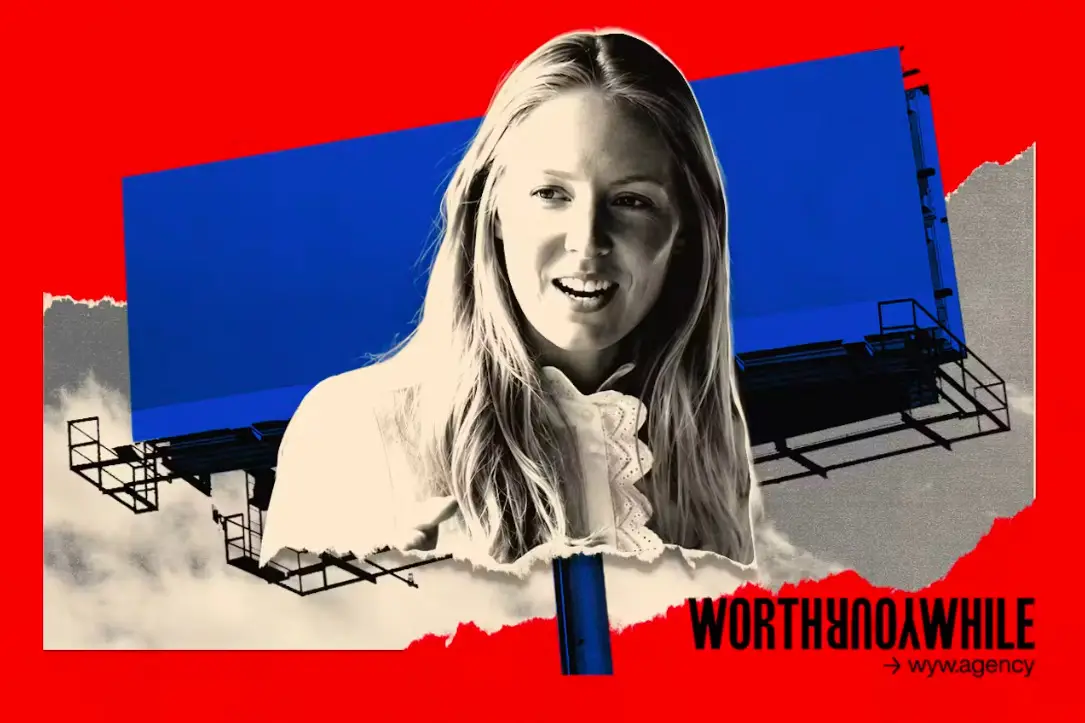
The head of global brand direction and strategy tells Tim Healey why consumer research has its limits, how fintech brands can build trust and why AI should sharpen thinking rather than simply speed up output.
You once wanted to be an actress. How did you end up in advertising – and ultimately at Klarna?
I always had a love for the creative side of things, but equally I’m also quite a ‘type A’ personality. At one point, I wanted to become an actress, but I didn’t love the idea that I couldn’t actually control my own fate. Instead, I moved towards an industry that was a hybrid of creativity, but also being more on the front foot of your destiny.
I was always interested in business and discovered advertising, so where better to go than the Mecca of that industry: New York. It was my dream to head there, and I worked at top agencies like Grey and BBDO. That’s where I got my foundation in using storytelling and creativity as a business lever.
But when you’re agency-side, you always feel like you’re being held at arm’s length from the actual business you’re working for.
I got keen on the idea of working brand-side and client-side – using creativity from the inside to grow a business, versus just being part of the output. So I joined Chobani, where its founder Hamdi Ulukaya had built a company that trusted you to run with things, and I got to be involved in how creativity can transform a brand.
We took Chobani, a yoghurt company, and transformed it into a wellness brand.
Next I moved to Klarna, because I wanted to explore different categories. Klarna presented the opportunity to move from a tangible to a more intangible product: to use creativity in the narrative, and then to use the narrative to scale up.

What’s the offer at Klarna?
The offer at Klarna has evolved. When it launched, Klarna gave people the opportunity to pay in a flexible way. It was the dawn of online shopping, so people found the concept of paying online quite a gamble. We launched in Europe, which isn’t a super credit-heavy landscape.
We solved a problem: we let people control how money leaves their account, especially when buying online – we give them that protective layer. Today Klarna has evolved into an overall money app that helps people build a better relationship with their money, making sure they’re getting the most value out of every penny they spend.
We’re really helping the everyday money manager stay in control of how they spend overall – whether that’s paying flexibly or paying in a way that earns extra value in the background. That might be cashback, interest earned on your balance, and spending insights about how you’re managing your weekly budget – but it’s also the smaller, more helpful elements of everyday spending, like fast returns, delivery tracking, and a full 360 view of how your money is being spent. We also offer a big security layer, a bit like what PayPal has become known for.

What’s coming up for Klarna over the next 12 months?
The next 12 months are about deepening the shift we’ve been making from a payments brand to an everyday money partner – and the clearest expression of that is our new global brand campaign, ‘Shower Thoughts’.
The thinking behind it is simple. Money is the number one source of stress in people’s lives – nine in 10 people feel financially anxious right now, more than about health, work or relationships. It’s rooted in the insight that w hen you feel confident about your money, you actually think about it less. Shower Thoughts plays with exactly that. When you use Klarna to stay on top of your money, it frees up the mental space for everything else – the random, funny, brilliant thoughts you only have room for when you’re not worrying about a bill. ‘Do fish ever get thirsty?’ instead of ‘have I paid that off yet?’
It’s the first campaign built entirely around our narrative, ‘Money on your side,’ and it runs across TV, out-of-home, social and partnerships. For me it’s the proof point of everything we’ve been building: a brand that is hopeful and supportive. Beyond the campaign, you’ll see us keep evolving Klarna into the place where money actually lives, not just where payments happen.
How is your marketing team organized?
Marketing at Klarna covers brand, communications, go-to-market with our merchant partners, growth and consumer rewards. Our closest partnership is with the product team, who own the actual experience of using Klarna. The two teams overlap regularly. A pricing change is a product decision, but it’s also a brand moment. A new feature needs an experience and a story at the same time. So rather than one team briefing the other after the fact, we tend to work through things together as they’re being built.
You’ve positioned Klarna more as a lifestyle brand, and less as a fintech company. How does the team convince leadership that cultural relevance, not financial authority, is the path to consumer trust?
David Sandström, our CMO, already understands the importance of a brand sitting between culture and commerce in order to stand out. We understood very quickly that we needed to be self-aware. Yes, we’re a financial platform, but if we start to look like every other financial platform, we’re adopting the same approach as other financial institutions. W e know people don’t trust those businesses.
When you set yourself apart in how you speak, how you look, and how you behave, it makes clear that you have a distinct point of view, away from a category that’s often seen as an industry that ‘takes advantage’ and always seems to end up on top.
Klarna kickstarted this trend of owning a color that goes against the grain. In Klarna’s earlier days, when we launched in 2005, our colors were all blue, with a lot of stock imagery of people ‘looking like they were having a great time’ standing over a desk, talking and holding a phone.
We made a decision to adopt pink. It was part of positioning ourselves to deliberately do everything a traditional bank wouldn’t do.
Klarna is in 26 markets now. As you look at marketing across all of those territories, what has stayed consistent, and where are there times when you need to deviate from that to be more relevant to a specific territory?
What has stayed consistent is our brand look and feel: the way we speak and show up is human, inviting and warm. We also always show up in a way that’s slightly quirky, and that earns attention. That’s stayed the same.
Our visual approach is strong and consistent, and we make sure every message ladders up to the same narrative. Locally, the messaging can always be specific to that market and its way of speaking.
I think of the narrative and messaging as a promise or a lens, not necessarily a tagline. Throughout everything we do, we make sure we’re being helpful, supportive and fair, and that we’re on the side of the customer. Y ou can then flex the messaging to suit the local nuance.
Hyper-growth makes it harder to balance global consistency with local relevance. We entered the category as ‘buy now, pay later,’ where the strategy was simply to be first to market, and when you’re moving that fast, there are always a few clunky moments.
Sometimes you adopt a certain way of speaking to go to market for the first time in a market, and then you take the moments in the business to recalibrate and say: it’s great that we’re showing up in all these places, now let’s fine-tune what we’re saying.
We now have the highest distribution of any payment provider, which gives us the privilege to re-examine everything and make sure it all ladders up to one narrative.

Drawing on your leadership expertise, what has your career taught you that helps to make a great team?
Two things. Firstly, make sure you have a range of diverse perspectives. It’s so important to create an environment where challenging each other’s thinking is seen as a positive. You can only build that if you’re bringing in different types of thinking. E veryone in the room should bring a slightly different take.
Secondly, I’m quite influenced by Emma Grede, the founding partner of Skims and co-founder of Good American. She said something I thought was really poignant: ‘take one moment to do something for someone else every day’ – whether that’s helping someone show off their work, or, outside of work, taking 15 minutes to talk to somebody trying to get into your industry.
For my team, making sure you’re thinking about someone else’s success at least once a day is a great goal.
I’ve read that you’ve embedded mentoring into the various roles that you’ve held, and that’s an important part of what you do. So why teach and not just climb?
Teaching is probably the best way of learning, too. It’s one of those magical things that helps the teacher as much as the student, and I think that if you can teach something, you’re refining your own skill set at the same time.
Obviously it helps to pass on skills, but it also humbles you to understand what you know, and where the gaps are that you then need to fill. There’s this circular effect – I don’t think you can really grow without teaching.
Could you tell us about a challenge you’re facing within marketing? And then please share your advice for other marketers that might be facing that challenge.
One challenge is the speed at which everything needs to move right now. AI is both horrifying and incredible. Too often it’s used purely to accelerate output, and as a strategist that’s a trap. S peed isn’t the same as thinking.
It can be difficult to speed up your thinking. But increasingly I use AI as a way to imagine better and test better. I heard strategist Zoe Scaman describe using AI as a prosthetic limb – something that runs alongside you and subtly enhances your thinking.
At Klarna we’re doing a lot more now to accelerate imagination and see possible futures, versus constantly having to sell things in. In this way AI can be very powerful: it means that you bring people on a journey to help think with you versus you having to think in isolation.

What’s your first memory of a marketing success that you were part of, where you felt: ‘This is me. This is the role for me’?
It was when I was working at Chobani. It was the feeling I had moving from a rigid, process-oriented role within an agency to being brand-side.
On the agency side, working with big recognized brands, you had to learn their rulebook and operate within their restrictions. At Chobani, it was more like being an entrepreneur: you’re going to run this US college football partnership, see it through from point A to point B, and manage all of the stakeholders in between.
Working on that kind of project was when I had this moment of feeling: ‘wow, these people really trust me to deliver something.’ I’m a Brit in America running the college football partnership for Chobani, and I’m still trusted to understand local nuance, market nuance, manage stakeholders, and bring a sizeable partnership to life.
It was there that I thought: this is the company for me. This hands-on way of working is what I love, because I thrive in ambiguity, and what I love most is bringing clarity to it. One of my favorite quotes is from David Ogilvy: ‘Give me the freedom of a tight brief.’
I’ve always thought of clarity as a business lever. Agency-side work equips you to make things really clear, because everything you do is in service of the client. When you move to brand, no one’s directly paying for that exchange of work, so things aren’t often as clear. But when you’re able to put clarity around the messiness, you can deliver a ton of value.
Could you tell us about a customer research discovery you made that you found surprising?
Something that’s come up for me is that often people don’t actually know what they want. You can’t always rely on consumer testing for the consumer to give you the answer. Don’t ever expect the consumer to tell you exactly what they want.
To get there, you have to take a bit of leadership and make a few more leaps in understanding human psychology, to present something to consumers that they may not know they wanted.
Research is most useful when it’s used to present a product, service or idea, and then to help figure out which narrative or message makes it most compelling for your customers – but don’t ever expect consumers to give you ‘the answer.’

What myth about marketing would you most like to bust?
Sometimes people blur the boundaries between marketing and brand – and I believe the two are different disciplines. Marketing is what you say and where you show up. Brand is almost like the hospitality industry – it’s the little bit extra that you put around it.
Sometimes people fold brand into marketing, whereas I believe they’re two distinct jobs that need to be done. You can perhaps see with some B2B products and smaller businesses how the two might combine, but when you’re at the mass-exposure level, they need to be separated out.
I read the book ‘Unreasonable Hospitality’ by Will Guidara, and it occurred to me that if you use the analogy of a hotel, marketing is when things happen: the day-to-day service. Brand is the feeling you get when you experience those services. How do you feel as you check in? How are you greeted? How do you feel throughout your stay? That is brand.
What advice would you give your younger self if you could go back in time?
Nobody knows all of the answers, so don’t assume they do. Keep asking questions.
What is the question that you would like me to ask the next senior marketer that I interview?
What has been their biggest brand-related marketing success – and what did that teach them?
Your question from a senior marketer: CMOs and senior marketers often talk about their work, but do they really love it?
I do love it. I studied philosophy and classics at uni, and I became quite obsessed with going very deep into why everything happens. I’m also fascinated by how, when you pull together lots of different sources that maybe don’t connect, suddenly they create a clear path.
In marketing, getting to ‘why people behave the way they do’ is always very interesting. At Klarna (or in any marketing role) we need to be hyper-aware of the culture and societal issues people are living through right now. What are the problems? What are the challenges people are facing? Marketing and b rand are the only roles in business that have to absorb everything going on in the world, and how it’s affecting how people live day-to-day.
I like going deep but then coming back up and creating a simplified map that makes people’s lives easier in some way. For me that’s interesting on two levels: I love doing it where I can see real-world impact but also making other people’s lives easier with some clarity; giving them an outside-in perspective versus constantly inside-out.
If there’s one thing you know about marketing, it is…?
If there’s one thing I know about marketing, it’s this: it’s not about what you say once, it’s about what you make continued bets against.
If you continuously show up in a certain way for certain people, and you commit to doing that over time, you’re going to see the results. You can’t just say: ‘We’ve launched a campaign, and that’s our marketing mission completed.’
People don’t remember you if you show up once. You have to continuously show up. So if you’re really trying to position yourself as a differentiated product or offering in the market, you have to be willing to risk showing up consistently, over an extended period of time.
For companies used to ‘stop-start’ marketing, it’s good to sign up to a partnership: it forces you to commit to something for a series of years. A successful partnership forces internal commitment to show up consistently, to the same audience, over time – and in turn that stops companies chasing the next shiny object.
WYW exists on the belief that time is humanity’s most valuable resource, and that the only ideas worth making are ones that earn it. You might die tomorrow. Make today worth your while. https://wyw.agency/
This interview has already appeared in The Drum. Discover the best campaigns, industry insights and interviews from world-leading marketers, creatives and more.