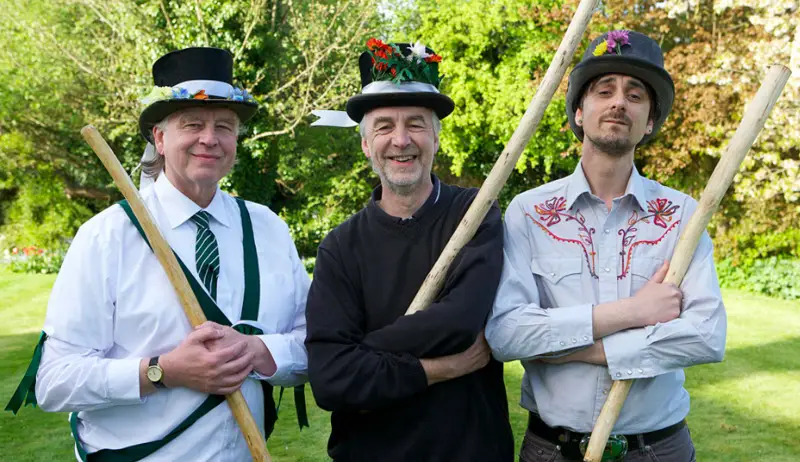
So there you are, on the last weekend of the long, long summer. Enjoying a quiet pint in the sun, outside some rural pub. And then you hear it. The sound of the bells, or the wheezy accordion and the clack of the sticks on the sticks. The beery cheers of those in the crowd tell you what’s about to loom into view: the morris dancers.
There’s something very comforting about Morris Dancing. It’s prototypically English (the other nations of these isles have their own traditions) but at the same time clearly part of a global wealth of dance-based rituals. You’ll find the morris dancers (or they’ll find you), all dressed up in matching peasant costumes, bells attached to legs (and sometimes arms). In Oxfordshire traditions, there’ll be handkerchiefs to be waved; there’ll be some complicated dance which involves the rhythmic and coordinated exchange of blows on fellow dancers’ staffs. And the accordion with its rasping rumble: in many ways, it remains most people’s least favourite instrument. But here, in the morris ‘team’, it’s the beating heart.
During the course of this long summer, I’ve stumbled over this kind of tradition a number of times – at a succession of village fetes – men dancing with men, women dancing with women and men and women dancing together. It’s the sound, the flavour and the sight of Merrie Englande. It’s like it’s been around for ever. That it’s a central part of English culture, possibly reaching back to before the Romans came. It’s the kind of thing, former PM John Major should have added to his 1993 speech to his backbenchers, wading in nostalgia for a lost country.
But is it authentically English in any obvious way? In his first big hit, Lucky Jim, novelist Kingsley Amis, launches an attack on the cult of Merrie England: the faux traditions and all those who obsessed with things like madrigals, maypoles and morris dancers. Life was hard for almost everyone, the hero Jim Dixon drunkenly rails. It was no party.
While we’d like to believe that morris dancing is an ancient tradition,, it seems to be a relatively recent thing. Archivists seem to be able to trace it only to the 16th Century (younger than some entire countries, I know but in historical terms, still very young.). As the great historian Eric Hobsbawm and colleagues point out, many things we take today as being traditional are relatively new inventions: the Highland Dress that we all assume is ancient and noble, seems to be anything but. In 1822, the romantic novelist Sir Walter Scott created a pageant in tartan to introduce the Scots to their new (German) King, George IV. Just as he’d done with his Waverly novels, Scott used scraps and offcuts of Scottish history and culture to invent a new identity, cemented in this grand parade (Gael) of the clans (much of which was previously outlawed). He gave Scotland a new uniform and a set of traditional rituals and objects to play with. and to act out their identity.
Somethings may feel like ancient traditions – partly due to its weirdness (the Alpine Krampuslauf, the Welsh Marie LLwyd rituals and the Japanese Zao Snow Monster festival are particularly odd. and more than a little scary). They seem to be from a much earlier, darker era.
A few years ago, I got to know the brilliant Tim Plester – actor, writer, director and folklorist. You’ll recognise his face from any number of shows and movies (he played the junkie in Ricky Gervais’ Afterlife – as is often the way for Tim, the character only lasted a few episoes). Tim has a very personal connection to the Way of The Morris (as his film of the same name reveals). As a child in 1970s Oxfordshire, he was a first hand witness to the attempts to revive the lost tradition of the morris dance. It had been a very lively tradition up until 1914: of the 12 young men of his home village of Adderbury, all but one were killed in the early days of the First World War. In the 1970s, inspired by the folk rock boom, local villagers – including his parents – deliberately reinvented the tradition. Tim’s movie delicately explores his – and his neighbours’ – relationship with not just the dance but the history of it, including its reboot. What’s so delicate and engaging about the film is the delicate ambivalence Tim reveals about his own feelings on this “tradition”.
In researching that film, Tim got to know David “Doc” Rowe, probably the most important archivist of British Folklore: for 6 decades, Doc has been running around the country, photographing, filming and recording all kinds of folklore rituals and traditional activities. In fact, this led to another documentary about Doc and his unique archive. Partly as an effort to raise the funds needed to store and safeguard the archive itself. (yes, it’s called “the Archive”).
It’s easy when you see these kinds of ritual behaviours to dismiss them as “folklore”. But Jim Dixon’s error – one that many of us make, from our supposed positions of sophistication – is to think that “invented” and “fake” are the same thing.
They’re clearly not. Walter Scott didn’t discover a lost Scottish Identity for his gala in 1822: he built one, out of scraps and cast-offs from stuff that already existed. And yes, he did so for a very specific purpose: to flatter a German King into loving his new country (and his country to do the same back). And yet, 2 centuries on, nobody feels a fraud at a wedding when wearing a kilt. The tartan is real now (even if most of it used in Scott’s sugary show was shipped in from the Low Countries). It does its work now: it does its work in signalling belonging, in marking the occasion as appropriate dress. It ties a room of strangers to something bigger than themselves, regardless that the inventor of the whole thing was basically a marketing man, trying to brand a nation.
Adderbury – Tim’s home village – has the same story, just a little closer to us in time. Twelve young men went to war in 1914; eleven didn’t come back. With them went whatever the dance had originally been for: nobody was left to explain or articulate the why’s and wherefores (if there were any). What the later villagers did – Tim’s mum and dad, for example – wasn’t strictly speaking cultural archeology. They weren’t excavating a buried meaning and restoring it; they were doing something closer to what Walter Scott had done. They took the fragments that survived, the steps, the bells, the tunes half-remembered and decided simply: this is worth doing again. Not because it has actual magic but simply because.
I didn’t know about Doc Rowe until Tim explained his contribution to The Way of The Morris (and to the recording of our culture more generally). What fascinates Tim (and me) is that Doc Rowe didn’t just hunt for the authentic versions of things: those rituals untainted by revival and reinvention – the pure sources, if you like. The Ur-rituals. Doc recorded what people were doing, the songs they sang, the words they used, the dances they danced and so on. How they stay the same and how they change.
But what’s it for, you might ask. What is all this dress-up and Olde Worlde nonsense really all about? What function does it serve?
Maybe these aren’t the right questions here. Anthropologist Ray Rappaport established that continuation of rituals depends neither on their efficacy (whatever this ritual performance was originally supposed to do, like ensure a good harvest or safety on an ocean voyage) or any belief in the theology or cosmology that lies behind the ritual. All that matters is that people turn up and take part. You don’t have to believe anything, you don’t even have to know why you’re doing it. Just turning up and doing it is enough for it to survive.
Clearly, these kinds of rituals (did I mention Cheese Rolling?) could well be post-rationalised as having religious root. Fertility rites, seasonal marker or initiation rite: while the Victorians loved to paper over unchristian roots of the traditions they idealised, our modern world would like to know for sure where these rituals come from. But this is decidedly unhelpful.
Surely it’s far simpler to say that we get huge personal and social benefits from doing things together, dancing in time together, singing old songs together, just being close together.1 Together. This is what Tim Plester and the Doc teach us: watch what we do and how happily we do it, together. Don’t worry so much about what it means, just watch and admire.
So the next time, an emphysemic accordion coughs up outside that pub on the summer evening, with the rattling bells, the clattering sticks and all the brouhaha of the dance crew shuffle into view, don’t be Jim Dixon.
Don’t be clever and superior and smirking.
Nobody in the dance is claiming an unbroken line back to some imagined Druidic priests performing a religious rite that nobody can document properly.2
What their behaviour is claiming is something else: something smaller and something much more worthwhile.
Here, now, by us – this is worth doing. Together.
It’s a ritual. And that’s so very human.
Watch Way of the Morris (2011) Tim’s own film, tracing the Adderbury revival back to its roots in the WWI generation. Also worth seeking out: The Archivist / The Island of Doc Rowe (2026), the documentary on Doc Rowe and the race to preserve his archive.
Listen to the way the participants in Tim’s films talk about what they do and how it shapes their sense of who they are.
Reflect what’s the “morris dancing” in your own organisation or in your community: the thing everyone still does, half-embarrassed, whose original purpose nobody could actually explain if pressed? How is it transmitted over generations? Why do new players play?
References
- Amis, K. (1954). Lucky Jim.
- Hobsbawm, E. & Ranger, T. (eds.) (1983). The Invention of Tradition.
- Rappaport, R. (1999). Ritual and Religion in the Making of Humanity.
- Way of the Morris (2011), dir. Rob Curry & Tim Plester, Fifth Column Films.
- The Archivist / The Island of Doc Rowe (2026), dir. Rob Curry & Tim Plester, Fifth Column Films.
See previous discussions on the physical benefits of singing and dancing together.
That’s the Eisteddfod, wuss.