In conversation with Tim Healey, the Marks & Spencer marketing director explains why colleagues, clear goals and calculated risks matter more than advertising alone.
You’re the marketing director at Marks & Spencer. What have been the key career stepping stones that have led you to the role you’re in today?
I started off as a brand manager in FMCG. I was working for Kraft Foods in Cheltenham. I was a brand manager for Dairylea. I loved it. Next, I went to Tesco to get some retail experience.
Initially, at Tesco, I was pretty shocked at the fast pace of retail, but I got the retail bug. I love the dynamism of retail, but even more, I love how close you are to your customers. I moved through various roles at Tesco – leading marketing as part of the team at Tesco Bank and I was marketing and commercial director of Tesco Mobile. My last role at Tesco was group marketing director, where I looked after marketing across all of our markets, including all of our own brands globally.
I was then approached by a headhunter. The huge retailer Coles, in Australia, was going through a transformation. I was very happy at Tesco and had just had my second child, but I went to the interview, met Archie Norman, who was very persuasive, so I moved to Australia. There, I led all brand/marketing as part of the Coles turnaround and transformation.
That has since been noted as being the biggest retail turnaround in global retail history. It was a complete transformation. I found leading big, transformational change an amazing experience and actually quite addictive.
I then went to America to work on a big retail transformation based in Florida. We had four different retail banners across the southern states. Then Archie Norman joined M&S in September 2017 and he asked me to join him, so in January 2018 I joined M&S – and I am still here today.
What is the offer at Marks & Spencer?
It’s a much-loved business that started in 1884 and is still going strong today, with an offer that spans Food, Fashion, Home, Beauty and Financial Services. The love for M&S is unsurpassed. It’s a real privilege to be working here now as part of an end-to-end transformation of the business.
What I’m most proud of is that M&S is now the most loved and trusted brand in Britain – and we’ve had that accolade for the last five years. I describe our transformation as going from being ‘a brand that people have always lived with’ to ‘a brand they cannot live without.’

What’s coming up for Marks & Spencer in the next 12 months?
Our CEO, Stuart Machin, has been very clear about our strategy. We’re committed to doubling the size of our food business and we also want to double the size of fashion, home and beauty online too.
In marketing, we’re building long-term brand platforms that we can become famous for. We have ‘This is not just…’ in Food and now ‘Love That’ in fashion. Many marketers, because we’re all a very creative bunch, want to move on to the new shiny thing before customers have really had a chance to get used to them, but we are committed to building these long-term brand platforms at M&S.
Food is much loved and talked about and is seen as the most innovative, best quality offer. In Fashion, we are already number one for style, value, quality, trust, consideration and brand buzz. You can expect the whole nation to be buzzing about M&S through the whole of next year too!
What have you learned during your career that makes for the best marketing team?
For me, it comes back to being really, really clear on your goals as a team. It’s important that everyone is pulling in the same direction. We’re very clear about our goals at M&S, because if we haven’t got a goal, how can we score?
There was a study done at Harvard University where they got a graduating year group from all the courses and asked them to put their hands up if they had goals. 5% put their hand up. Then they asked them to keep their hands up if they had their goals written down. Only 1% kept their hand up. They came back to the same group 20 years later. The 1% with written down goals were happier and wealthier than the 99% added together.
When you have clear goals as a team, you stay really focused – even during trying times. I use the metaphor of sailboats: we’re sailing across the ocean and we know where we’re headed, because we know where our goals are. And in that ocean, just like in life, and just like in business, stormy times are going to come and you get buffeted around.
But in the ocean, just like in life and just like in business, the stormy times are going to pass. And what happens to the little sailboats when the stormy times pass? If the sailboats have a goal or a destination in mind, they just right themselves in the direction of the goal and they keep going. If they didn’t have a goal or a clear destination, then they would just go in whatever direction the storm left them.
We have to make sure the entire organization is lined up on clear goals. I was once given the advice that your team needs to be so clear on their goals that you could run the whole team successfully even if you had been sent to prison and were only allowed a single two-hour meeting each month with your direct reports – and no other contact in between. That’s how clear you have to be.
I found that such good advice. I moved from having weekly shorter check-ins with my team to a monthly two-hour session where we really get into the details and the clarity around the goals, and we work together on the issues and how we’re going to achieve them. Of course, we are talking every day too, but carving out the quality time monthly makes a real difference. That’s great advice for anyone, regardless of whether you’re in a marketing team or indeed any team.
What also contributes to making a great team is the leader. Leaders bring the energy, set the tone for the team and effectively, they ‘bring the weather’ with them. If I came in to work a little bit stormy, I would put a black cloud over the whole team and that’s not how people are going to do their best work.
But if I come in, regardless of the weather, with a sunny disposition, then everyone just feels a little bit more positive and a bit more energetic and has a bit more of a ‘can-do’ attitude. So the leader really can set the tone for the whole team, too.

Could you tell us about your first marketing success? One where you felt, ‘This is me. This is the role for me.’
At Kraft, working on Dairylea, my first big launch was Dairylea Dunkers. I remember first seeing it on shelves and then the nation enjoying it. I got such a buzz that something that ‘little old me’ had done was now being seen and enjoyed by millions. We had invented something from scratch and brought it to market. It felt like a massive privilege.
Later in my career, leading brand and marketing at Coles and being part of the biggest transformation in global retail history was formative too. Being able to look back and see that the business was unrecognizable from how it was when you joined and that you are leaving a bit of a legacy behind, too.

What advice might you have for business leaders to put an end to ‘siloed’ teams in marketing?
Sharing goals. I have quite different teams reporting in to me, from customer insight to loyalty, advertising to PR, social media and planning and also transformation. We all shared our goals with each other so that everyone knows what everyone else is working on – but also where the overlap is.
We have what we call ‘blue pins’ in our department. Imagine a pinboard, where the blue pins show the cadence needed to ensure that we’re all coming together to deliver this goal well. As a leader, you have to work out what your blue pins are going to be on all of the goals, and make sure that everyone is very, very clear.
As leaders, we all have different buckets of activities. Bucket one: where the stuff happens – it’s all the ‘doing’ and it’s very tempting as a leader, to spend a lot of your time in that bucket because it’s magnetic – we all love getting in there and doing stuff! But we have to allow time for the other buckets too!
Bucket two is ‘managing/leading the doing’. This is where you work out how you are going put the right cadence in place to help and support the team who are doing the tasks. As a leader, we should be spending more time leading than we are in ‘the bucket of the doing,’ even though we all love being there!
And bucket number three is where we set the goals. We set the vision, we set the direction.
As a leader, you must map out how much time you’re going to spend in each of these buckets. We have to make sure that we’re spending the appropriate amount of time as leaders in all three buckets. And to me, balancing my time on all of that makes sure that we don’t have siloed projects where we’re not communicating properly within our function, but also within the entire organization.

Could you tell us about a time when you’ve conducted some customer research and the results were surprising?
I’ve got a great example of that, but I should say first off, though, at M&S, we’re always listening to our customers every single day, so we don’t often get surprised as such.
During Covid, as marketers, we were wondering what marketing messages customers were going to want to hear in among all of Covid news. We asked our customers. There was only three things that they wanted to know. They wanted to know when the local store got a delivery of toilet rolls. Secondly, when the local store was going to get a new delivery of pasta. Finally, they also wanted to know how long the queues were – because, remember, we all had to queue outside and be a meter apart from each other!
After speaking with our CEO, Stuart, we decided that we’re going to ask every single one of our stores to set up their own social media accounts on Facebook and TikTok and then invite their local customers to follow them. This way, each store could independently communicate: ‘It’s quiet this morning. There aren’t so many queues. We’ve just had pasta deliveries in etc.’
We still run these local social media accounts. We reach millions of people every single week through this channel. It’s very important for us. The store could be communicating a charity initiative, something new on service, a new food or new fashion range – we leave the creativity completely up to them, because our colleagues in our stores live in the same communities as our customers and they know the right way to communicate locally.
So word of mouth through store social is a really powerful form of marketing for us. The research had surprised us and we took action – and it serves us really well today.
Many people often ask me if we approve all of the stores’ posts before they go out. We 100% do not. We trust our store colleagues every single day to speak to our customers face-to-face. And so we also trust them to communicate with our customers through social media too.

How do you surf the tsunami of marketing technology?
We have a brilliant internal team who live very digital lives ourselves and are always curious and always looking globally. I’ve worked all over the world, so I’m always looking at what’s happening in all the markets that I’ve worked in and many that I haven’t – what’s happening in South Korea, China, India, Australia or America.
At M&S, we’re very lucky that we have strategic partnerships with other global, non-competing retailers where we share learnings. And these sessions are very important. We also have great agency partners. Mother, our agency, has a global network. Our media partner, Mindshare, has a global network. We often have sessions with them, with Meta, with TikTok, with Google, so that we’re learning all the time.
We also have an amazing new colleague who’s joined a business called Di. She gets called ‘AI Di’ and she looks after digital and technology and many more things, but she’s very much an expert on AI. AI Di very much keeps us right!

What myth about marketing would you most like to bust?
There’s a myth that marketing is all about big campaigns. Campaigns are less than 10% of marketing. There are three big jobs that marketing is here to do. Number one: be commercial and drive the business forward. To ensure it is a brilliant business for customers, and for our shareholders too.
Number two: build the brand and differentiate our brand from others. I go around this business and I say: “M&S is the only national retailer who…” I am looking to tell the stories that are unique in our organization that build our brand, that give people real reasons to choose M&S over others
There are also so many different ways that we can tell these stories. One example is that I created a series of advertising-funded programs for television: eg I created the cooking show Cooking with the Stars’ where all the ingredients on the show are from M&S.
This demonstrated that we’re not just brilliant for your freshly prepared meals or your lunchtime sandwiches. If you’re cooking from scratch, you can come to M&S too. Cooking With The Stars is now the number one cooking show in the country. It’s in its sixth season. I also created Tom Kerridge Cooks Britain, where chef Tom goes up and down the country to our supplier partners and our farms and talks about the lengths that we go to.

And then the third role of marketing is to engage colleagues. Colleagues are your army. Customers will never truly love an organization until they feel that colleagues do too. And you want that love to bleed out of every single thing that every colleague does – whether that’s colleagues in store or in a call center interacting with customers, or even the words that are on your carrots packaging. Colleagues’ passion for the business and the products needs to show up everywhere!
We take this very, very seriously at M&S. Colleagues can opt to be an M&S Insider. We create an M&S Insider account for them and we help them to work on their posts every single week.
Our colleagues in the food business at Christmas time have a badge where they write their favorite M&S food product and it strikes up so many conversations in-store. In our email signatures, we put our favorite M&S products.
We have filming studios in the office where any colleague can jump in and talk about their favorite product and no one has to worry about, ’Is this going to be OK to post this?’ We encourage everyone to be really passionate.
Every single year, ITV shadows our colleagues as we’re getting ready for Christmas because Christmas is so important in retail. ITV documents how our colleagues are working all year to create the Christmas ranges.
I would say to everybody that my myth about marketing is that it starts and stops with doing an advertising campaign – that’s an important part of the role for sure, but it’s just one very small part of being a true marketing leader today.

What advice might you have for your younger self if you could whizz back in time?
I grew up in a very low-income family in central Scotland. Aged 11, I was starting secondary school. My family couldn’t afford to buy the uniform. My mum and I went round the second-hand shops and we found the blazer. Fantastic. On my first day of school, I went to my best friend’s house, knocked on the door, she opened the door and the first thing she said to me was: “Oh, do you know you’re in the wrong color?”
The school had updated the uniform – still blue, but a totally different shade of blue. I felt like running home crying to my mum, but I didn’t, because I knew that would spoil her day. Instead, I said, ‘Yes, I do know, but I actually prefer this color.’ And my friend accepted my answer.
I felt like all 300 students at my school that day said to me, ‘Do you know in the wrong color?’ And to each I said, ‘Yes, I do know, but I prefer this color.’ And they all accepted my answer. On my way home from school at the end of that first day, I looked at my blazer and I thought: I actually do prefer this color.
I became fascinated at a very young age with what had happened in my brain, from it being mortified at the news that the blazer color wasn’t right, to genuinely preferring it.
I spent a lot of time in the library growing up. I was always a very, very big reader. I started reading about pathways in the brain and neuro-linguistic programming and the power of goal setting. I started reading it all as I truly wanted to understand what had happened in my brain that day, from being aghast at being in the wrong color blazer to genuinely preferring it!
I believe that my superpower is actually growing up poor and getting that experience and learning this at a young age. And one of the reasons I’ve just written a book called ‘The Healthy Thinking Diet’ is because I’m so passionate at helping other people to realize at as young an age as possible that they can have different outcomes in life if they just think differently. There were three things that I learned that day that stuck with me for life.
Number one: it’s nice to be nice. In business, building emotional loyalty is key. As a more senior leader, you have to try to influence across the organization and not just within your team.
Number two: be careful what you tell yourself, because whatever you repeat, either said out loud or in your head over and over again, will become your truth. You might think ‘I’m in the wrong color blazer’ or more negative thoughts like ‘I’m useless’ or ‘I’m scared.’ So you have to be careful what you repeatedly think or say.
In my book, I talk about ways you can work on these negative thoughts. We all have negative thoughts. I probably have more negative thoughts than anyone, but I’ve become very, very good at not staying in a negative state. And there are lots of tips in the book on that, too.
The third thing I learned that day, which I think has really helped me in marketing too, is that it’s OK to be different. It’s not just OK, it is vital to be different – whether that’s you personally and your personal brand, or your organization.
For me, your personal brand is very simply how people are talking about you when you’re not in the room. That’s your personal brand. So I’m passionate about sharing everything that I have learned.
That was a bit of a long answer to your question on what advice I would give my younger self: I actually started using these three principles from a very young age – which is why I’ve managed to go from a very rundown council estate to leading marketing teams all over the world and why I was fortunate enough to be awarded ‘the most inspirational marketing leader globally’ accolade by The Marketing Society recently. So rather than what advice I would give my younger self, I am just glad that I had the wrong color blazer and I learned all this stuff so early in ife!
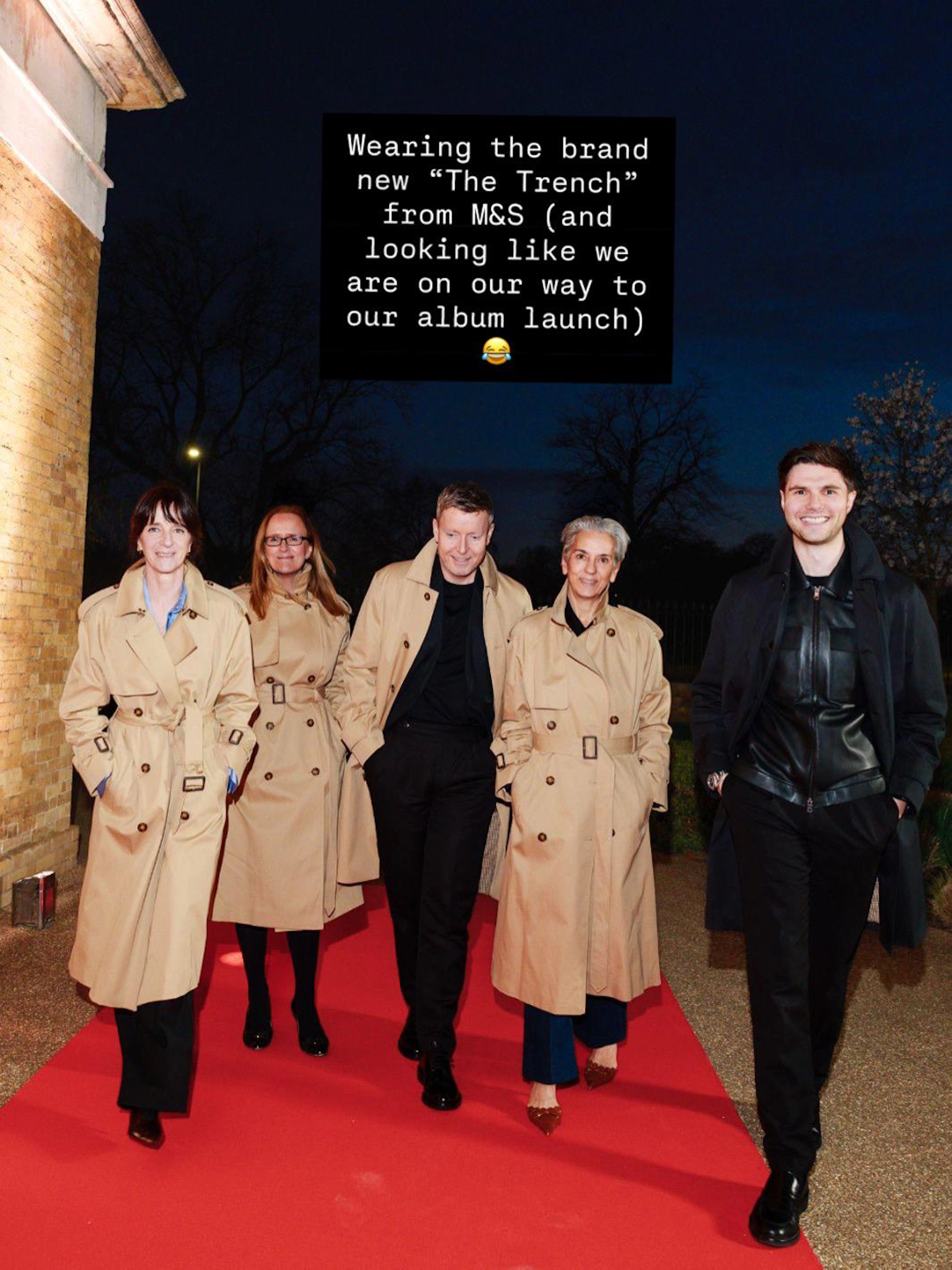
What question would you like to ask the next senior marketer that I interview?
What’s your favorite M&S product and why? Because everyone has one!
Can you tell us about a time you took a risk in marketing? Did it pay off and what did you learn from the experience?
We should always be taking risks in marketing? As marketers, if you are not taking risks every single day, I would challenge – are you being bold enough? Some risks are small and some risks are bigger and they don’t always work.
I don’t have highs and lows. I have highs and grows. Because if something isn’t working, then you know what? We’re learning. When Edison created the light bulb, he first discovered 1,000 different ways that didn’t invent the light bulb!
How many of us would have kept going after version 192? But he kept going. We recently launched our campaign where we appointed Gillian Anderson to be our ‘chief compliments officer.’ ‘I love that – where’s it from?’ is a phrase that’s mainly said woman to woman about an item of clothing. More often than not these days, the answer is ’It’s from M&S.’
The world needs more compliments right now, and we know that a compliment can completely change someone’s day. So we decided to appoint a chief compliments officer for M&S.
We chose Gillian Anderson. She’s uber-cool. She’s loved by everyone. My daughter loves her from the Netflix series Sex Education. I’m an OG fan from The X-Files. She’s so loved.
The risk we took is that we decided to launch the campaign on LinkedIn. Now I have never seen a brand ever launching a campaign on LinkedIn before. We worked with LinkedIn, who were brilliant, by the way. And what we did was create Gillian Anderson’s first-ever LinkedIn account, with her role defined as a global Hollywood superstar and chief compliments officer for M&S.
Next, Gillian started posting on LinkedIn. People were asking, ‘Hold on, is Gillian Anderson on LinkedIn?’ And then people would try and connect with her. She would accept their connection request, which very much made their day in the biggest compliment ever! The buzz was tremendous. The whole country was talking about it.
You could say that was a risk and it very, very much paid off. But whether you’re taking, you know, little risks or big risks, you should be taking risks every single day. We’ve got to be bold. I often say to the team, 0% of our customers are saying, ‘I was going to go out tonight, but I think I’ll just stay home in case M&S has got any marketing messages for me.’
We’ve got to find really disruptive ways to communicate with them and make sure that our messages cut through in their busy, busy lives.

If there’s one thing you know about marketing, it is:
Marketing is fun. We’ve got to enjoy it. We are hardly digging ditches. My granddad had a very tough job. He was a coal miner and he used to leave the house every single day to go down into the pits of the earth. He left the house every single day whistling. I remember one day saying to him, ‘Granddad, why are you always whistling when you leave the house to go down into the pits every day?’
He said, ‘Sharry, I’ve got to go down the pits, so I can either go down whistling or I can go down miserable. But which of the two do you think is going to give me the better day?’
If he could go down the pits whistling every day, I can come into my job in this office, metaphorically whistling every single day too. Yes, our jobs are tough, but even on our toughest days, our jobs are someone else’s ‘dream life.’ And we must never forget that.
I’ve worked all over the world and every single person that I have met lights up a room. It’s just that some people light it up on the way in and some people light it up on the way out. I never, ever, ever want to be someone who lights it up on the way out.
This interview is brought to you in partnership with Worth Your While – an independent creative agency based in Copenhagen, working globally. Named one of The Drum’s Indie Agency Top 100, WYW exists on the belief that time is humanity’s most valuable resource, and that the only ideas worth making are those that earn it. You might die tomorrow. Make today worth your while. https://wyw.agency/