HERDspotting in the press pack
Yes, you have seen the movie before. You really have. And that’s the point.
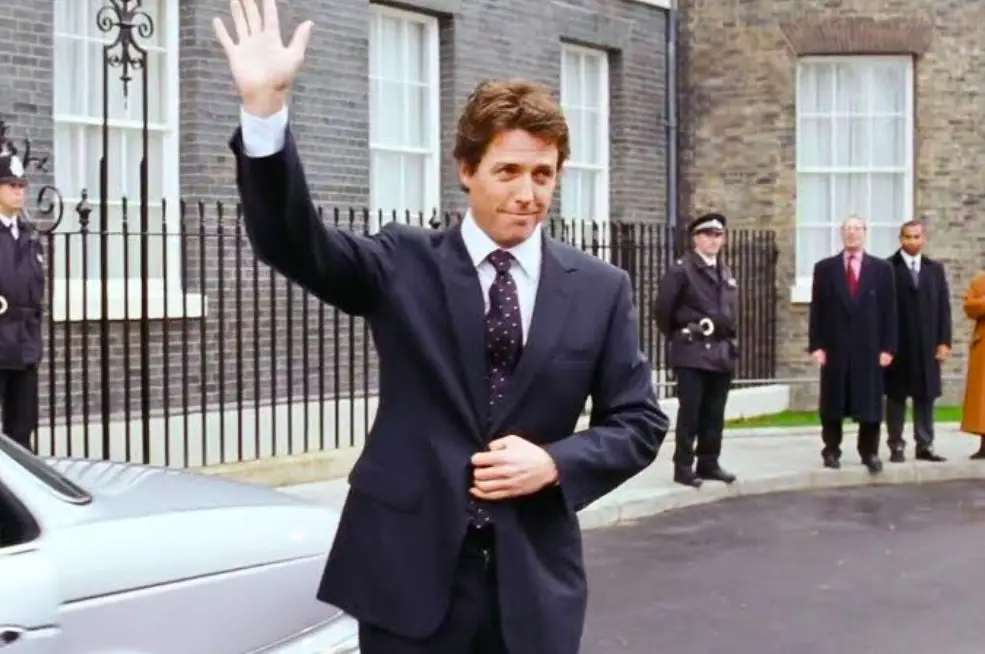
The car pulls up in front of the black door on the narrow street. A man in a smart, formal suit gets out, straightens his jacket and looks just for a second like a man who hasn’t quite believed this would really happen until this exact moment.
There’s a small crowd. There are cameras. He looks up, smiles, waves. Somebody cheers. Others applaud. The man turns to the gathered news crews to say a few hopeful words about duty and change. Then he goes inside, to “make a start.” The coppers keep a stern eye on the street he leaves behind.
This could be Andy Burnham, Britain’s new Prime Minister, installed on Monday. It could be his predecessor, Sir Keir Starmer, just two short years ago. It could be almost anyone in the long line of Prime Ministers installed in 10 Downing Street over the last decade: Sunak, Truss, Johnson, May, Cameron, Brown. Most initially, at least, without a popular vote, but on the preference of their peers.
The hero in this scene could equally be Hugh Grant: David, the dancing Prime Minister in Richard Curtis’s romcom Love Actually.
Whoever plays the role, the public nature of the ritual is essential to the safe transition to a new government.
In public not in private
The legal and constitutional business happens elsewhere: in committee rooms, offices and well-sheltered bars; and, finally, in the traditional visit to “the Palace” to receive the King or Queen’s invitation to form a government. The monarch’s appointment makes the new Prime Minister constitutionally real.
But the scene in front of the big black door makes the new Prime Minister real in a more important sense.
It has to be public. It has to be visible. This is where the new Prime Minister walks into the role before us.
It allows one slightly startled human being to begin experiencing themself as Prime Minister and permits their family, friends and camp-followers to do the same.
It also works for those who maintain the structures of power: the civil servants, ministers, police officers and officials who must transfer their attention, loyalty and behaviour from one office-holder to another. The familiar choreography tells them: from now on, this person.
But most importantly, it works for the rest of us.
We see the enthroning and yes, there are old ideas about king-making here playing out, as the Victorian Anthropologist EB Tyler would observe. They help us know this is the beginning of something new. We see who now sits atop the pile: who we should project our shared hopes and fears onto; who we will blame for all that doesn’t happen.And we see each other seeing it.
This scene, right at the heart of our politics and political life, is a reminder that rituals are a fundamentally a social technology. It is a means by which we align ourselves with one another. A way of agreeing how our world is now organised or, at the very least, of assenting to how things are and recognising when they have changed.
The group does not simply receive the information that it has a new leader. It recognises the new leader together.
Ritual or Routine?
Contemporary culture, in the self-help and marketing aisles, has, I fear, watered down the notion of “ritual” to mean something more like a routine that feels personally important. My morning coffee ritual. My skincare ritual. My Sunday-night ritual.
Sometimes the things we do repeatedly and knowingly can certainly be ritual-like. They can help us feel more confident in times of uncertainty because the familiar can be reassuring. Useful, but little more than Linus from Peanuts had in his comfort blanket.
It’s when they make us feel that we are not alone, we are doing what other people like us do, that ritual starts to do its work. Repeating these practices alone can also make us to feel part of a larger group: a faithful Catholic saying the rosary when no one else is present is still “in communion” with other Catholics; anyone of any other faith praying quietly and privately in a world of non-believers can feel the same.
In The Elementary Forms of Religious Life, the great French sociologist Émile Durkheim argues that what religion and religious practice actually venerates is that society itself, rather than whatever person, deity or object appears to be the focus of its rituals and prayers. It’s us. We’re conjuring us with ritual practice.
And ritual is the mechanism through which a group periodically re-experiences its own cohesion, particularly in times of change: its own continuing existence, is own abiding identity. “Collective effervescence” is the term Durkheim uses to describe the heightened emotional state produced when a crowd assembles, synchronises its attention and performs or witnesses a shared act. The magic is in us and between us.
Yes, ritual works partly through recognition, as the Downing Street crew know all too well. We recognise the gestures because we have seen them before. More importantly, we know that everyone else has seen them before too. And we all know what we now know. I know who the new Prime Minister is. I know that you know. I know that the civil service, the police, the markets, foreign governments and his opponents know too. From this point onwards, we can all proceed on the same assumption.
So when Andy Burnham waves, smiles and turns towards the cameras outside the big black door, remember: you have seen this before. As has everyone else.
That is precisely why he does it. This is how his predecessors did it. And it is how his successors will do it. So long as they do.
The office-holder changes, but the group must continue.
Ritual is how the herd crosses the threshold safely and in one piece.
HERDspotting tips
Watch what happens when someone takes over a new job – a new England coach, a new CEO or a new police chief. Who stands where? Which doors, clothes, journeys, objects and gestures make the transition visible? Notice who must be present for the change to feel complete.
Listen for those familiar words and phrases: “It is an honour,” “a new chapter,” “continuity and change,” “the work begins.” The words may sound formulaic, but that is their purpose. What matters is not their originality but their recognisability.
Reflect on a transition you have witnessed: a new leader, a wedding, a funeral, a graduation, a first day or a farewell. Who was the ritual for the person crossing the threshold, those maintaining the group’s structures, or everyone else? What might have felt uncertain, incomplete or unsafe without the very public ritual?
References
Durkheim, Émile. The Elementary Forms of Religious Life (1912; trans. Karen E. Fields, Free Press, 1995)
Tylor, Edward B. Primitive Culture: Researches into the Development of Mythology, Philosophy, Religion, Language, Art, and Custom (John Murray, 1871)
Love Actually, dir. Richard Curtis (Working Title Films, 2003)