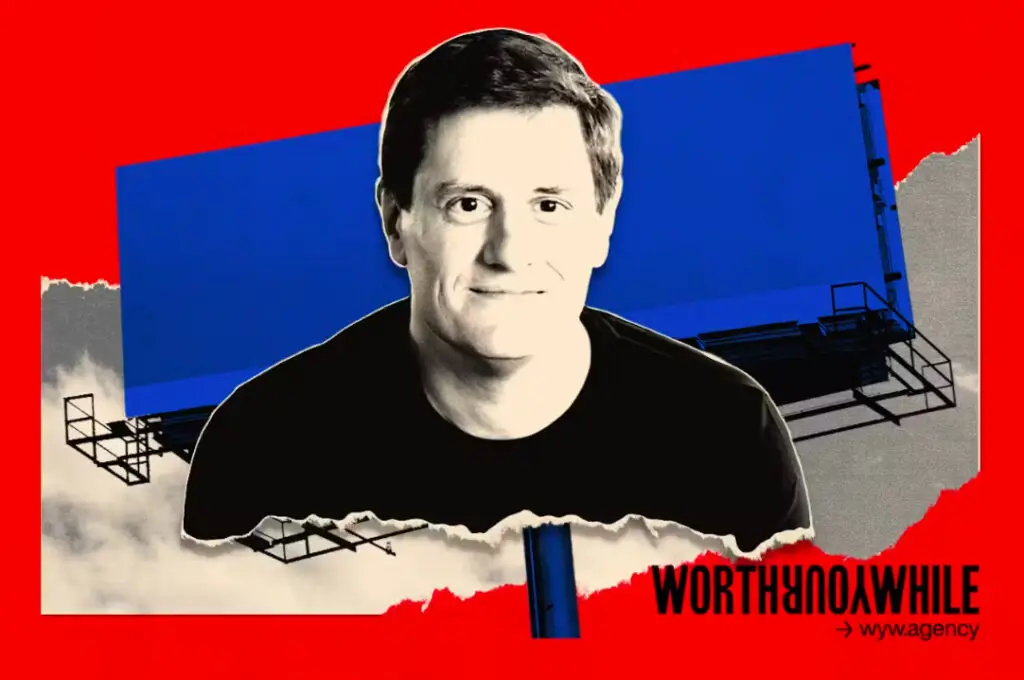
From Oscar-winning content to building a brand creatives love, Damian Bradfield reflects with Tim Healey on why scarcity, not spend, drove WeTransfer’s success, and why today’s digital marketing playbook might need tearing up.
You’ve held roles at Gucci Group, Stella McCartney, AMV, JWT and moved from chief creative officer to president at WeTransfer before stepping away last year. What shaped that career path?
I went to Oxford Brookes University and dropped out. I spent a year trying to figure out what I wanted to do and ended up in South Africa. I applied to London School of Economics (LSE) and got accepted to study geography. Having dropped out and moved to a different country, I was hit with this crazy bill for studying at LSE so I had to find a way of trying to pay my fees.
I ended up getting a job working for Gucci Group part-time. That ended up being very much full-time, partly because I loved it, but also driven by the fact that I needed to pay the rent, was trying to pay tuition fees and living in London at the time. My goal was to get into advertising.
I worked for Stella McCartney. We were really a small team, and it was very exciting. But the thing that really caught my eye was the marketing: the PR, comms, advertising… the billboards that Gucci was famous for back back in the day.
I applied to the ad agency Delaney’s for its graduate program. I got in and began work at what was probably the end of the good years of advertising. There was still money and respect. I moved to Abbot Mead Vickers, which was an agency that trained and groomed people to stay with the business for their whole career.
I worked with some incredible brands – the BBC and Famous Grouse – and I loved it. Meanwhile, I married a Dutch woman, and she wanted to move home. Begrudgingly, I moved with her to Holland, which at that time was not like London and New York, these epicenters of advertising. I worked for JWT there but I wasn’t particularly happy.
Serendipity plays a big role in life. I met somebody who had just started this thing called WeTransfer. It was just getting going: it didn’t have any money, but it did have massive potential. He asked if I would consider joining. I thought, ‘God, it’s got to be anything better than what I’m doing right now.’ I left JWT, joined WeTransfer and, at the same time, set up a design agency called Present Plus, and that did really well.
We were in the middle of the recession, and we found a lot of clients who wanted to work with a cheaper, smaller digital business that could help bigger companies understand the web, which was our offer at Present Plus. I had an interest in fashion, so we did loads of website builds and redesigns for companies like Christie’s and lots of Savile Row tailors and this helped us pay the bills for WeTransfer.
WeTransfer just kept growing and growing. At a certain point, the seesaw tipped from me spending all my time in design at Present Plus to being wholly focused on WeTransfer. In 2015, I sold Present Plus so that I could focus on one thing.
It was the first time in my life when I wasn’t dealing with 20 jobs. In the advertising world, there’s always multiple clients, you’re always pitching, and then there’s running the agency itself. To be honest you were always doing 20 things badly. So for the last 15 years, I’ve done pretty much one thing. I’ve always had side projects, but most of my time went into WeTransfer, and I loved it. I really enjoyed the brand that we built.
WeTransfer is a file-sharing business. It’s the least sexy category in the world. But we managed to change that. We built a platform WePresent which still is really successful. Winning an Oscar in 2022 for our short film, ‘The Long Goodbye’ with Riz Ahmed, was a proof point that others felt we had taste and also that we were good at curating stuff and putting stuff out in the world that people really wanted to watch.
WeTransfer was an incredible journey. It came to an end for me last year when we sold it. I didn’t realize that selling and leaving WeTransfer would be quite as emotional as it was going to be. In response to that, I spent the last six months writing a book called ‘This Is Not A Playbook.’ The book is about the principles that WeTransfer had in terms of how we balanced creativity, respect for the customer and design and the way that we tried to conduct ourselves.
It addresses the question: how did we turn a simple file sharing service into something that people actually really love? It’s a cathartic exercise in breaking down with my co-writer and journalist Andreas, who really helped by digging into it: “You talk about all of this content as if it is like normal but you’re a file-sharing business – why would you do it?”
The logic behind it was that most of users are creative types involved in the creative industries. They’re producing a lot of good work. But they also want to be entertained as they’re constantly seeing and experiencing music, TV and film and they’re highly critical.
So we couldn’t put something up there that looks crappy. We had to show them something that looked really good. If that doesn’t already exist, then we have to create it. That’s the logic.

Damian in conversation about the rise and rise of We Transfer.
Looking at some of the numbers that I could find online, WeTransfer’s revenue doubled between 2023 and 2024, which is pretty impressive. What are the key factors behind this growth?
Covid. I know it doesn’t sound nice to have benefited from the effects of a pandemic, but everyone was stuck at home and suddenly more things were being done digitally and sent via the internet than ever, especially as people were not able to meet up in person.
Our traffic and usage during the pandemic grew exponentially. I would love to say that it was because we were running an incredible marketing campaign and saw the fruits of all of our hard work, but in fact, this was as a result of our heavy investment in our brand – but pre-Covid, and any correlation between our work and the sales was hard to quantify.
The Covid uptick was a clear response to our increased brand awareness. Suddenly everyone was at home and they think: “Shit, I’ve got to send something. What am I going to use?” Their default options for file sharing on the internet were: Google Drive, Dropbox, WeTransfer. Suddenly, people were using us because they knew us. I’m sure Drive and Dropbox did really well off the back of Covid too but here was real evidence that our brand work has delivered increased awareness.

‘Not A Playbook’ by Damian Bradfield is out now and unpacks how We Transfer became the success it is today.
You mentioned that you also have a children’s book coming out?
Caro Carrowack, published by Fupe, the world’s smallest publishing company. Caro is a young girl who’s raised by horrible parents. She makes an incredible amount of money at a very young age, but unlike a lot of billionaires currently on the planet, she decides to do something good with it.
If you look at projects that I’ve done over the years, a lot of them have been based around this idea of philanthropy and power. I had a game two years ago called Megalomaniacs, which ranked the world’s most powerful people and then tried to highlight those that are doing good with the money that they’ve raised, and those that aren’t.
My book, The Trust Manifesto, was published in 2018. It was quite a heavy read, and it tackled what we need to do to make a better internet. A lot of people said it was too serious, that they just want to use the internet, and that we’re going to ignore everything that we know anyway.
In response to this feedback, I made a graphic novel edition of the book, which sold much better than the text version. I took this on board and as a result, Caro will come out in Dover Street Market in Tokyo at the end of March. We’ve also recorded a really beautiful audio version of it with Stephen Fry and Geraldine James as characters. The book is illustrated by this amazing artist called Louis Mendo who does these fantastic watercolor-style drawings.

Damain’s new book for children: ‘Caro Carawack.’
How was the marketing team structured at WeTransfer?
We didn’t have a marketing team until 2013. We never did any performance advertising until about 2016. We purely focused on content, or ‘storytelling,’ as we prefer to call it. Our focus was on full-screen ads. We can do anything with it that we want: the ads rotate every 40 seconds and it can be video.
We had no money in the beginning. The best thing we could do was treat our available space like a magazine and showcase people’s work which in turn showed how beautiful the service was. Next as we built up a relationship with them, we would get them to work with us and tell a story together.
That’s what we continue to do right up to the present day. Until Covid, the team was about six or seven people. Budgets increased massively after Covid into ‘single-figure millions.’ We brought in people that knew how to market FMCG products and do all the traditional analytical, performance-based stuff.
Now I’ll probably get in trouble for saying this but honestly it didn’t work. Ours was a file-sharing business. We were not selling a pair of sneakers. I can’t just push you an ad and suddenly get you to go: “Oh shit, they’re cool. I’ll buy them.” The only thing I can hope to make you do is to consider WeTransfer next time you need to share some files.
I always believed in the power of branding. Some of the marketing professionals we hired reverted to driving numbers. So all they started doing was discounts. They were thinking: “In my last company, we ran a Black Friday deal, and although everyone else is discounting on Black Friday too, we saw an uplift of 22%.”
When we started with WeTransfer, we understood the principles of design and quality and advertising branding quite well, unlike a lot of our colleagues, who understood data really well, so we were ahead of the game early on by understanding the importance of brand. Hence, we gained a lot of ground on everybody else.
Eventually, my partners left and we brought in more hires and their experience was different. The meeting room suddenly switched from being brand/design conversations into data/analytics/finance. What we saw were some short-term gains but they didn’t have any long-term effect on brand reputation.

Working with artists like celebrated Icelandic-Danish artist Olafur Eliasson, WeTransfer wow their users.
As Ana Andjelic said to me in an interview last year, “Brand is the emotion that you feel that separates a product from being a commodity.” You created an emotion around the decision of sharing data through a file-sharing platform.
I think there’s a key difference between marketers who want to create emotions around a brand and people who only want to drive sales, especially if you use the discounting technique. To find out someone bought the same product as you, but they only paid a fraction of what you paid for it because they caught a special offer or sale is upsetting.
If I’m having that conversation with someone who is in the second category of marketer, we are never going to be on the same page. But the same could be said for me talking about finance. They might be rightly obsessed by the position of a decimal point but I don’t care that much. I’m not that bothered about finance. When it comes to brand and quality and craftsmanship and that sort of thing, I care immensely.
Increasingly, best practice looks like this: you go into a sneaker store. You pick up a pair of sneakers. You love them but you are not sure so you put them back and leave the store. Imagine that a salesman now follows you down the street, with those same sneakers. He taps you on the shoulder and tries to sell them to you again. Then he follows you into your home and tries to sell them to you a further time.
If this actually happened in the real world, you would be livid. It would be considered so unacceptable. But on the internet, we have decided that behavior is OK. In fact, it is praised and seen as best practice, even when everybody detests it. I cannot fathom why we have this sort of separation of what is and isn’t acceptable in our lives.
Why did we decide that we would change the rules and make them so heinous? Just to look at someone’s website, you have to tick boxes that say: ”You give us permission to now track you on all these fronts and send you stuff endlessly.” And yet, the marketers and the digital people that create these things use ad blockers. They don’t like it. It is like working for Marlborough (the cigarette company) while telling our kids not to smoke.

Collaborating with musicians Jungle, WeTransfer offered an interactive video.
What’s your first memory of a marketing success that you were part of where you felt this is the role for me?
When I worked at Delaney’s, we worked on a project around teenage pregnancy. The UK town of Hastings was the teenage pregnancy capital of Europe. You had a higher chance of contracting an STI than ever winning the lottery.
We created a campaign called ‘The Sex Lottery.’ We created scratch cards that revealed whether you win chlamydia or gonorrhea. It was fascinating to see how people responded to it. There was zero knowledge that any of this stuff could happen to them so we really opened some eyes. I also loved how grassroots it was. I think it was one of the best campaigns that I ever worked on in terms of ‘fun.’
AI in marketing: what are the pros and cons?
There’s not a day any more where ChatGPT is not used by me for something or other. It’s an incredible shorthand to starting a conversation. It’s hugely powerful in helping to connect some data points. If Google made us lazy and drove us to constantly pick up our phones to fact check in middle of conversation, it’s just got 20 times worse.
It is like crack for your brain. It is creating a crutch and I do worry that it will have some massively detrimental impact on the way that we use our minds. Perhaps we will start using our brains slightly differently, and we were able to tune it to other skills that we didn’t know existed, because we’ve now freed up that space. But at the moment, I don’t think that’s the case. I worry that it’s making us lazy, and it’s making the need to retain information and to actually be able to construct independent, logical thought processes appear complex or very strenuous.
Please tell us about a mistake you’ve made in marketing and what you learned from it?
We should just focus on the positive, because that would be a lot shorter. I have had some fucking brilliant ideas that were obviously not fucking brilliant Ideas because they cost a lot of time and energy. But I don’t know that they were mistakes: I see them as ‘exercises in learning what not to do.’ I’ve made many mistakes but they compound to take you to another place, so perhaps they are not actually mistakes at all.
At one point, I got very excited and angry that we were living in the US and that President Trump was in power, first time around, and he had appointed somebody who was basically planning on destroying net neutrality. They wanted to have insight into everything that was passing through the internet. And I thought, this is just fucking so scary.
It sounds hilarious, but we created our own Wi-Fi and distributed it for free to everyone who lived in Santa Monica so that we could offer net-neutral, secure internet. I think around 10 people adopted it. At what cost? I have no idea.

WeTransfer offered the ability to sell files directly on the platform to help creative professionals to securely share and earn money from their digital content.
What myth about marketing would you most like to bust?
Most of the myths have been busted, but the thing that probably gets my knickers in a twist the most is when I feel like people feel the need to put spin on something unnecessarily and embellish it, when I really believe that powerful marketing is the simplest.
What we did well with WeTransfer was to strip the service down to the lowest common denominator and make it as simple and frictionless as we could. Everyone was always asking about our features: “What new features are you bringing in?” We had the opposite approach: we tried to take features away. We were desperately trying to remove shit.
The best marketing comes in the early stages of a company, when the people are empowered to tell the truth about the product and not to put any spin on it. What tends to happen, as the company evolves, and new people become employees, is that they need to put their mark on something. They start trying to find a reason to believe in something or try to put spin on something.
In my 30-plus years of experience, the simplest campaigns are always the best.
What advice might you give your younger self if you could go back in time?
Go further back in time, it’s much more fun.
Could you tell us something that maybe not a lot of people know about you?
Some people already know this: I love karaoke.
What question would you like me to ask the next senior art marketer when I interview them?
Is marketing a career today? My kid is 19. Should I tell him that he should pursue a career in marketing? Is that a thing?

Actor Riz Ahmed won an Oscar for his performance in ‘The Long Goodbye’ a film commissioned by and shown on the We Transfer platform.
Your question from the last senior marketer I interviewed: who inspires you most in the marketing industry?
I don’t follow the marketing industry very much. I sort of stumble across John Hegarty and Rory Sutherland stuff every now and again, but there’s a guy called Severin Matusek who runs Co-Matter and he’s based out of Berlin. He wrote a book last year with Yancy Strickler (author ‘This Could Be Our Future’ and founder of Metalabel and Kickstarter).
Severin and Yancey are similar in their thinking. Severin has this bunch of young German academics around him, and they’re always sharing stuff that I never would normally stumble across and read. He and his colleagues seem to come at stuff from a very authentic, altruistic perspective that I really respect. In my opinion, they are marketers but they don’t see themselves as marketers, and they certainly haven’t come through any formal marketing training, which makes it so much more interesting.
If there’s one thing you know about marketing, it is …?
There is this myth that you need a lot of money to do great marketing. If there’s one thing I know about marketing it is that you don’t actually need huge amounts of money. To put context around that, at WeTransfer, I think we did some of the best marketing ever with the least amount of money that we ever had.
As budgets increased, I felt like we became lazier and less creative than we were when we had none. With limited funds, we had to think on our feet, be reactive, hustle, pull in favors, build things ourselves and work out how stuff worked.
The best work, the best thinking and the most energy came from not having any money. In 2010, when we started, we didn’t need much. We didn’t need to buy Facebook ads or anything else. It was all free. Maybe it’s not so easy to do it today, but I firmly believe that the energy one gets from constraining yourself to not putting money against something, and instead trying to work out whether or not this is something someone would talk about, actually is a really good limitation.
You might die tomorrow so make it worth your while. Worth Your While is an independent creative agency helping brands do spectacular stuff people like to talk about. wyw.agency.
This interview has already appeared in The Drum. Discover the best campaigns, industry insights and interviews from world-leading marketers, creatives and more.