There’s a beautiful beach on the wild coast of Pembrokeshire: Freshwater West. It’s got all of what you’d want from the West Walian coast: huge skies, clean water (rated “excellent” by inspectors), stonking great surf, untouched wildlife and the kind of fine beach sand we learned to love as children (even if it does get everywhere). When you see it for yourself, you won’t be surprised to learn that it is a designated SSSI (Site of Special Scientific Interest).
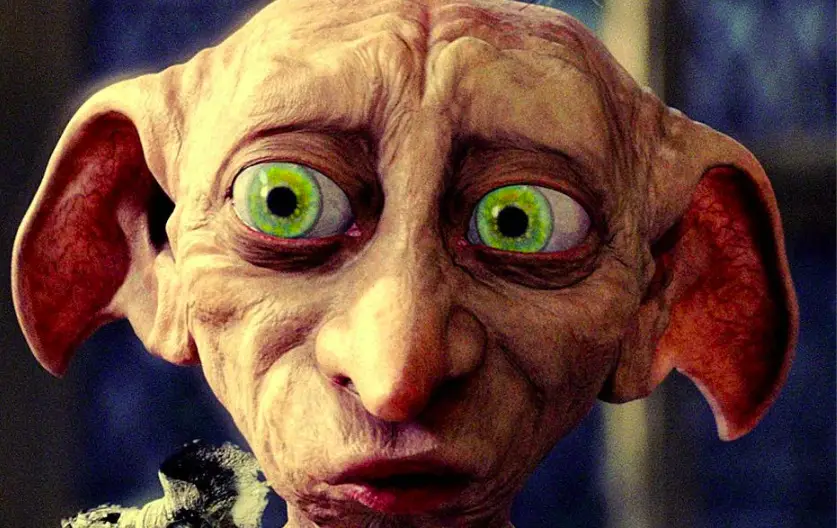
What may surprise you, though, is that this stretch of sand has become the site of a special kind of pilgrimage. Freshwater West has become a draw to Harry Potter fans from around the world as it is here, at least on film (Harry Potter and the Deathly Hallows – Part 1 – 2010), that we witnessed Dobby the house-elf’s death and burial. There’s a shrine of sorts: first, curiously, the painted pebbles (in the ritual which commemorates Dumbledore’s death in the Halfblood Prince, mourners’ teardrops are transfigured into pebbles, which are then laid on the tomb). Then, more surreally, an isolated sock or two hangs from the fence even in winter (ask a Potterfan to explain the role of the sock in Dobby gaining his freedom). All entirely fan-created. Nothing to do with the franchise or the film makers. Just what the fans choose to do to remember one of their own.
Indeed, so popular was the pilgrimage becoming that in 2022, the National Trust conducted an eight-month review into actual and potential damage pilgrims are doing to this vulnerable ecosystem. And more recently, the power of the fans’ lobbying led to a planned subsea power cable being re-routed to avoid coming ashore on the site.
WTAF?
There’s nothing particularly special about Freshwater West it’s no more special than any other beautiful beach on the wild west coast of Wales. As we pointed out in the last piece (Everywhere Is A Ritual Site), a place or an object becomes sacred thanks to us to our collective attention not because of any “sacred” property of the thing itself. A place becomes sacred when people enough people ritually behave as if it is sacred. The behaviour creates the status, not vice versa.
And the pilgrimage behaviour is not in any way new or unusual. Throughout human history and across almost every culture, we see people travelling to remote places of significance, often apparently out of respect for the dead or, more precisely, a particular dead person. Or to mark a historic event. Around the corner from where I live, Camden’s own Amy Winehouse is commemorated by visitors to a fan-made shrine and (much to the annoyance of the people who bought the house she died in) on the walls and pavements. The fact that the tree is a shrine gives further heft to the idea that this is an ancient practice. Every day of every year, there are fresh, wet-faced teenagers, performing a simulacrum of pilgrimage. Heads bowed, words hushed, eyes soaked: they stand and respect.
Parasocial grief
Both of these are examples of what you might call parasocial grief: that is, mourning for someone with whom the individuals had a largely imagined relationship: a CGI-generated movie character and a troubled popstrel, both relationships untethered by personal interaction with the other party. While you and I might think the grief these people are feeling is not real, that the feelings are just made-up adolescent ones, studies show repeatedly that parasocial relationships are just as significant as real-world ones (even if they are one-way) and the pain of loss just as great as that which real-world bereavements create. Recent studies with gamers suggest that they feel the loss of game characters in the same way.
Now in both cases, you could explain away this kind of thing as adolescent: as something that young people have to go through. Just as gender stereotype klaxon boys were thought to choose guns and war and little girls babies and kitchens in order to prepare themselves for what the world was supposed to bring them as they grew up; so here, you might say it’s important for young people to practice and play out the situations and emotions that might otherwise blindside them later in life. Maybe. (This kind of explanation is what my old collaborator, Professor Mike O’Brien used to dismiss as “evolutionary just-so stories”).
But the really important thing here is the power of collective attention to create magic in pilgrimage: only by travelling together to perform the rituals of pilgrimage (pebbles and socks for Dobby and miniatures for Amy) does the magic happen. Indeed, without other people, it is just individual weirdness.
The lure of this kind of collective travel is something the tourism industry has long known from mediaeval cathedral chapters who collected the bones and appendages of saints in order to encourage visitors, to the local authorities of Verona who today encourage visitors to trek to the house with a balcony on which Shakespeare’s tragic teen heroine, Juliet, never stood there was no Juliet and to leave letters in a postbox marked “Juliet, Verona”. The modern Japanese tourism industry benefits greatly from the desire to visit together scenes from anime (like the Suga Shrine staircase from Your Name). Indeed, one Japanese government survey has suggested that nearly 12% of inbound tourists were travelling specifically to see anime or film locations.
We could see all of this as a great example of fandom a very modern phenomenon (you’d do well to follow the thoughts of the brilliant Zoe Scaman if you are trying to get to grips with the implications for business today). But I think Dobby’s grave tells us more than that: it casts new light on us and our desire to feel things together. And our age-old desire to create significance through ritual journeys.
Watch BBC Wales’s short news report on Freshwater West, filmed when the National Trust first floated moving Dobby’s grave: a devoted fan and an unimpressed local (who calls it litter) make the whole argument of this piece in about ninety seconds, without either of them meaning to. Worth revisiting now that the argument has, for the moment, been settled by the rerouting of a £430 million subsea cable rather than by anyone’s opinion.
Listen to season three of the podcast In Defense of Fandom turns from television endings to parasocial relationships more broadly: how they form, what function they serve, and what happens to the people who hold them when the character, or the star, on the other end goes.
Reflect how organisations do this too. The original factory nobody’s allowed to touch. The original store that’s become a “brand experience”. The founder’s first desk, kept behind glass. David Ogilvy’s red braces, still hanging in the office decades after he wore them, because moving them would feel like a small act of sacrilege rather than housekeeping. What’s the object or place in your organisation that has quietly stopped being useful and started being sacred – and would anyone actually admit that’s what’s happened, or just quietly agree never to move it?
References
National Trust Cymru, public consultation and review findings on the Dobby memorial at Freshwater West, Pembrokeshire (2022).
BBC News, “Could Dobby’s grave be moved from Freshwater West?”, BBC Wales (2022).
Reporting on the rerouting of the Greenlink interconnector around Freshwater West to preserve the Dobby memorial, LBC and CP24 (August 2026).
Japan Tourism Agency, survey on inbound visitors citing anime and film locations (“seichi junrei”) as a reason for travel (2024).
Sanderson, J. and Cheong, P. H., on parasocial grief and online mourning of public figures, Bulletin of Science, Technology & Society (2010).
Wullenkord, R. et al., on parasocial grief reactions following parasocial breakups in games and fiction, Computers in Human Behavior (2025).
Durkheim, É., The Elementary Forms of Religious Life (1912), on the collective origins of the sacred.
Listen to Mark Earls on monocle radio discussing this topic here.