The vice-president of global creative tells Tim Healey why the company is encouraging people to put their phones down, how it is differentiating itself from social media and where AI fits into the creative process.
You’ve been VP of global creative at Pinterest since November 2022.Give us a stepping stone jump through your career up to that.
I fell in love with advertising at the ArtCenter College of Design in Pasadena, California, and got hired out of school to work at a little agency called Ground Zero. Then, I went to Chiat Day in LA around 2006, which was an epic era at the agency. We were winning business like crazy and the creative department was 70-strong. All the talent there blew my mind. I had a great mentorship.
After seven years, I became CCO at a small agency called Pitch. I learned what it was like to sell an agency. After that, I went freelance and then Nest called and I was super-drawn to it. It was a brand-side job. I felt like I could actually see the effect of the work that I did. There was a Black Friday thermostat sale – and we created the sexiest thermostat sale that ever existed and we actually moved the needle. It was a revelation to me that our actions actually worked to drive sales and that was really addictive. Seeing the direct effect your creative work has on the business was the hook that’s kept me brand-side ever since.
I moved to Google for five and a half years, running the creative team for Devices and Services. I loved it there, too. I see it as my MBA in creative leadership – brand side. Pinterest has been the gift at the end of a long journey where I feel like I’m in the right brand, at the right time, with the right people, and it has been a joy to build the team.

What is the offer at Pinterest?
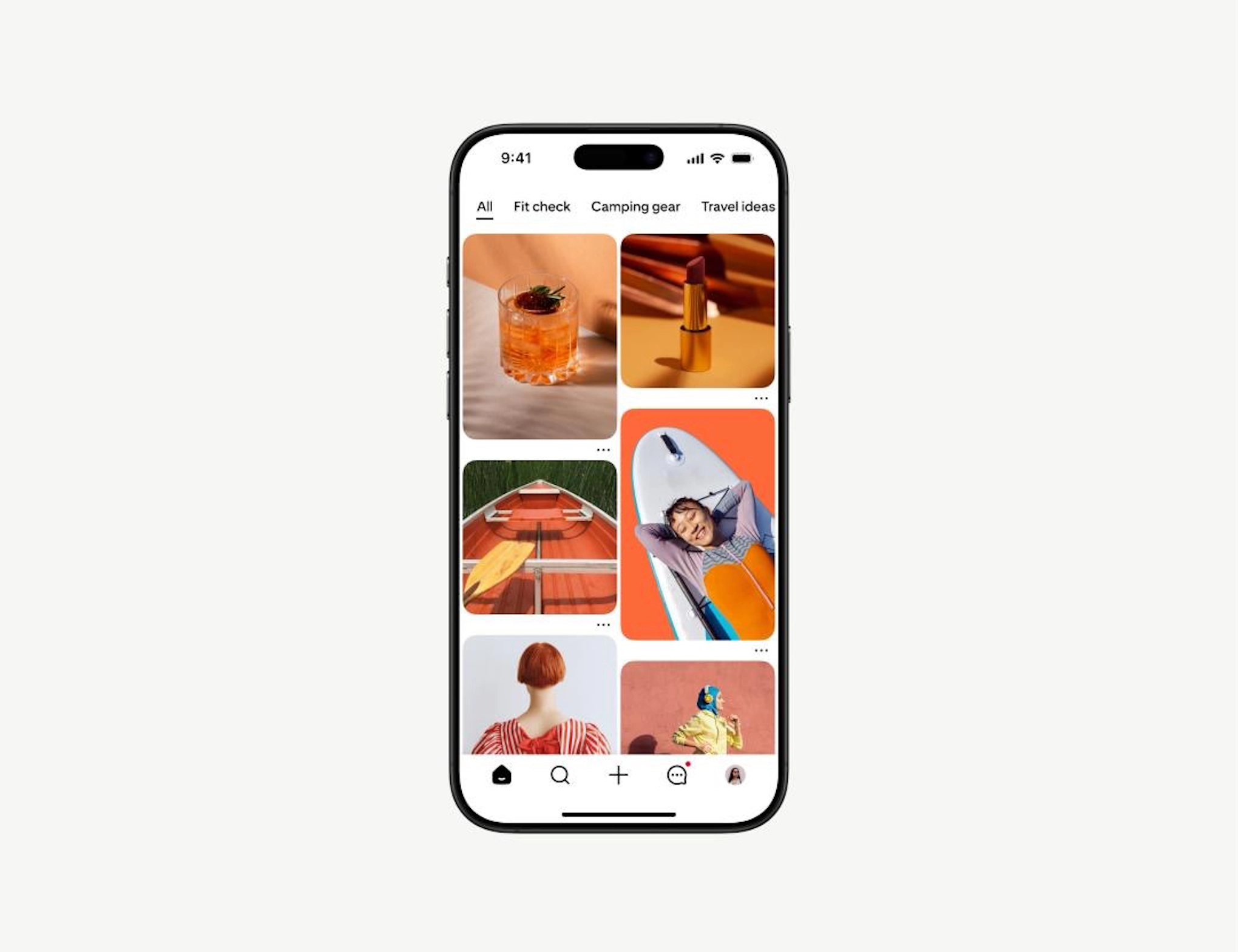
Pinterest is in a unique place right now. We have over 600 million users. Over 50% of our users are Gen Z. I believe we offer the most positive corner of the internet. It is not social media. It’s visual search.
Gen Z is flocking to Pinterest because they want to create the life they want to live, and Pinterest allows them to do that, because it’s this fully focused, immersive place where they can find and choose their own adventure, in terms of building their identity, building what they’re interested in and trying things.
We’re seeing a big shift from people who show us consistently in our data that they want to be IRL more, and Pinterest gives you the ideas to get you offline – whether that’s planning a painting night with friends or hosting a dinner party.
The business promise for Pinterest is that advertisers want to be on Pinterest because our audience has intent. People don’t come to Pinterest to lean back and scroll passively – instead, they actually want to plan something and do something IRL. They might want to plan their vacation or their outfit, so Pinterest is a really important place for advertisers to be because Pinterest ignites intention and people go from dreaming to doing.
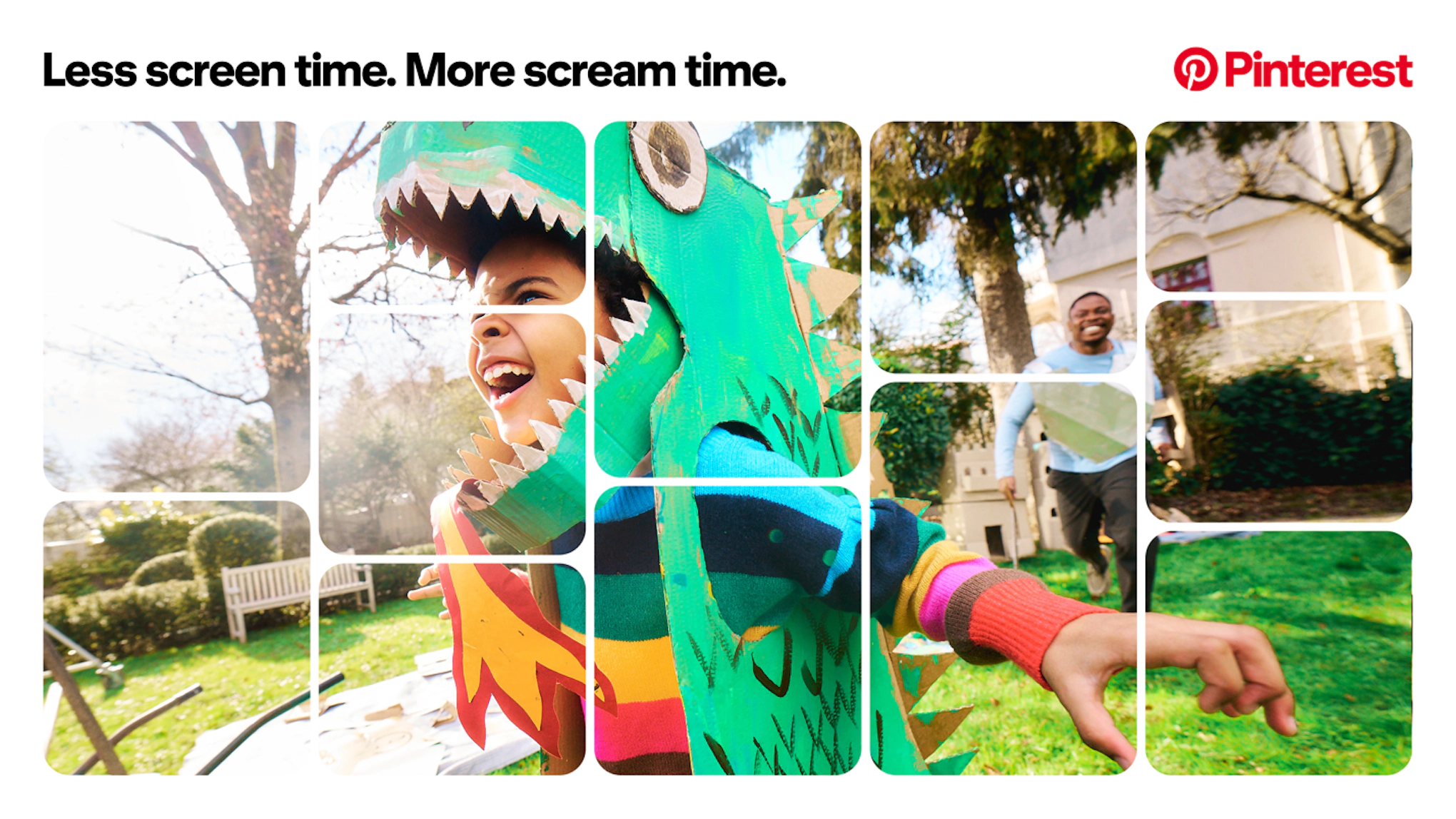
‘The Best Thing You Can Find Online Is A Reason To Go Offline’ was a ‘mic drop’ moment, an online platform saying, ‘Don’t be online.’
It has been a labor of love. We feel very strongly about the idea, as you do. About eight or nine months ago, we started working on a campaign that would make the Pinterest value proposition unequivocally clear.
We’ve been quietly doing our thing, building the most positive corner of the internet, and we’ve grown the platform tremendously. But if you asked someone a year ago what Pinterest’s unique position is, would they know? For the last nine months, we’ve been crafting this narrative that we’re now sharing.
We’re different from social media. With this work, we’ve put distance between Pinterest and the other platforms. But it’s bigger than that. Being online too much is the real enemy. It’s a life not lived. And Gen Z and Gen Alpha are realizing this. My own daughter has timers on her phone – in her apps – to remind her to get off it. People are using hacks to try to put their phones down.
What started as a strong counter-positioning narrative has just taken a broader stance. We believe that the best thing you can find online is a reason to go offline. At Pinterest, we are giving you ideas to get you offline.
We’re seeing it in our own search data. We see screen-free ideas have gone up 113% in search. Screen-free hobbies are up 20%. I was looking at the data: ‘whimsical dinner party’ is up 185% for Gen Z, trivia night snacks up 125% – these both point to themes where people are going: ‘enough. I want to live my life. I have a short life. I want to live it.’ And that’s a beautiful thing.
Pinterest is now part of the zeitgeist, and we have the confidence to say: ‘This is who we are and what we believe in’. And the time is now. 51% of Gen Z have said that having a hobby contributes to their joy. These are all really, really important stats. Our CEO has been completely behind this campaign – and has been pushing us to even go bolder. You’ll start to see even more work roll out under this banner.
What’s coming up for you over the next year?
At Coachella, we delivered a phone-free activation. That was the first beat in this narrative where we wanted people to actually see our values in real life. We did the thing that most brands wouldn’t do: We encouraged people to put their phones away and just ‘experience’ things – we didn’t care if you posted about what you just saw or did.
We’re confident that having a moment to be present, phone-free, is more important to our audience. I’ve always believed you have to do the right thing. You have to give someone something of value, and then your brand becomes important to your audience.

I have heard experts say that Pinterest is one of the last positive spaces on the internet.
We hear that from our users, too, all the time: ‘Pinterest is the last remaining bastion of goodness.’ There’s a fundamental difference. Social media is connecting people to people. Pinterest is connecting people to ideas. You’re not curious about the human who made the beaded jewelry or made the greenhouse, or their opinions. It’s irrelevant. With the visual medium, our users are simply thinking: ‘How good is this?’
How is your team structured?
I run the House of Creative, which is our internal creative team. We do 95% of our work in-house, but occasionally we’ll work with agencies like Gut on projects like our Pinterest x World of Warcraft campaign. We’ve worked with agencies in the past, but we really prefer to craft our own work. And I sit alongside the VPs of marketing – a VP of comms, a VP of consumer, VP of B2B, VP of growth – and all of us ladder into a CMO.
This structure is incredibly important: it means that creative has a seat at the table on the leadership team. I’ve worked in various corporate structures where that isn’t the case and I find that our particular alchemy is the most effective because creative is allowed to have a voice that matters.
We help shape where we’re allocating budget, often on things that are not typically the domain of creative, like how we shape our comms narratives, our growth marketing and our performance marketing.
This has allowed us to have greater brand consistency, to do even bolder work, and it’s personally really gratifying. I feel like I can do best-in-class work when I have this structure.

What has your career taught you that helps you to maintain a great team?
Being humble is the most important thing. I never assume that I know all the answers. I look to my team to help guide the work. I really mean it. I ask all the questions. I’m there to help guide and support. But I really let the team breathe. I hire for taste. I don’t hire from category experience. I hire for the enthusiastic human who has great ideas.
I believe in making the brand everyone’s job. It shouldn’t be just a few. People are the decision makers. Broadly speaking, everyone on the marketing team should influence the brand. And I think curiosity is probably the most important attribute for somebody on my team – especially in the age of AI, we need to approach things with curiosity and not fear.
I always say that it’s OK not to know. It’s OK not to have all the answers or feel like you’re behind. Openness and vulnerability are key to having a great team that does great work.
How do you use AI without losing originality, craft or cultural sharpness?
We’re very aware of this, and we’ve actually been working on our stance and our approach to this new technology. LLM chat debuted around the time that I got to Pinterest. I’ve been a very early adopter with all of this. I play with the tools. I still make stuff and I am always pushing the limits in terms of what we can do.
In terms of craft and taste, ‘start with human, end with human’ is our mantra for House of Creative. We’re very discerning in terms of what we allow out the door and AI is still not at the level where I think it’s consistently beating humans. Maybe someday it will – in fact, I am sure it will – but right now we have to take a deliberate position to ensure our work speaks to our audience.
Among Gen Z, there’s a rising tide of anti-AI sentiment. There’s a big backlash. We’ve actually gone in the opposite direction of doing everything with AI. We do a lot of stuff that’s handcrafted. For our 2025 brand campaign, so much was shot in-camera. We did visual effects that were in-camera. We had knitters on set making giant landscapes out of yarn. We do things on purpose that are hand-crafted because it shows. AI can be incorporated, but it’s not like a wash.
The leadership at Pinterest fully supports the stance that we’ve taken as a creative team, and they understand that AI can be used like a paintbrush. Sometimes you use it and sometimes you don’t.
In terms of the platform, we’re giving users a choice. We give people what they want on the platform. But we also understand that some users want to see AI-generated pins and content and some users don’t. We allow users to choose their own adventure with what they see and what they don’t, because we have a toggle switch.

The landscape artist Andrew Gifford argues that his paintings are closer to reality than a digital photograph, that a smartphone camera takes what you are seeing and it neuters it – flattening, squashing and compressing it as a digital image.
As an oil painter myself, I completely agree. The subtlety and color and the way that light interacts with surfaces are uniquely captured by the artist. It’s soulful. Seeing a little bit of cyan below someone’s nose and capturing that, it’s just like perfection.
A photograph of that is not magical. In the case of one of my favorite artists, Wayne Thiebaud, he dramatizes the blue in shadows and that decision takes you there and gives you the essence of something that you feel on a deeper level. The digital image, on the other hand, represents the same coldness that we’re seeing with AI in many cases. It’s seemingly perfect, but it’s still very shiny and it’s just surface-level. Without that imperfection and that human touch, you quickly lose interest.
The creative director who wrote the script for the most recent brand campaign, ‘How Did They Do It?’, is one of the most brilliant writers that I’ve ever worked with. He wrote it in an afternoon. He was sitting by his pool and having the sun soak in and he started asking himself, ‘What if there was a world with no posting and instead there was just life?’
That’s a human asking questions. AI could not have written that. The idea came from his children asking him what life was like before smartphones.
You’re doing great work with an in-house team. How do you make sure that you keep that creative advantage and is there ever a danger of your team becoming your own echo chamber?
I think we’re always looking to the outside. We always question things. I have learned to recognize the warning signs when you start drinking your own Kool-Aid.
Often, I’ll ask people who are totally unrelated to the industry about the work we are doing, ‘How is this resonating? Are you feeling something?’ We don’t look at other ads to see where the industry is going.
We stay deeply informed of where culture is headed and what people are talking about. That way, we stay true to learning from data and research and actual verbatim responses from our customers and our users. That will continue to inform work that resonates.
As a marketer overseeing an in-house team for a brand, how do you ensure that the agenda never becomes ‘more content, less impact’?
Build confidence in the boardroom with proof. I lead with data to back up creative decisions. What can we learn from research and culture? You also have to be willing to find the most meaningful insights and the boldest articulation of how that’s going to move the business.
As creatives, we can’t do things that are in the service of our own agendas. I see that as the most common mistake creatives make, both at agencies and on the brand side. If you use your creativity to move the business, then all else will follow. Awards, recognition, speaking opportunities and, most importantly, impact on the brand.
Sometimes creatives can get wrapped around the axle of ‘will this win a Cannes Lion?’ In truth, an award is a nice byproduct, but you’re there to move business. If you want to stay in-house and be on the brand side, you really have to commit to that. Brand-side creatives must be in service of the brand. My team does a great job prioritizing great work that will move the needle.
Could you describe a moment when your instincts and the data pointed in different directions?
With our recent campaign, we showed an early rough cut of our anthem film, ‘How Did They Do It?’, to some smaller focus groups and there was feedback that could have easily derailed it. A lot of people said they didn’t understand Pinterest’s role in the film or why we were coming out with that kind of message.
We could have pivoted, but instead, we reworked the ending and proposed a new line, ‘The best thing you can find online is a reason to go offline,’ which led to the commercial being the highest testing ad in Pinterest history. It even scored a perfect 100 on ‘desire’ and a 96 on ‘relevance’ and has over 54m views on YouTube.
The reaction to the film has been overwhelmingly positive, with audiences all over the world expressing support for Pinterest owning this message. Of all the platforms, Pinterest is in a very unique position to take this stance because eight out of 10 Pinners say that Pinterest encourages them to try new ideas offline.
It was a long, intentional process to get to that place. We didn’t give up early. I think the strongest thing you can do is to commit to working through it.
What myth about marketing would you like to bust the most?
The myth I’d like to bust is that B2B is boring. At Pinterest, our B2B marketers are trying to reach both brand marketers and performance marketing teams, whose budgets and bonuses are tied to metrics. It’s a very hard job. It’s not always sexy. It’s the boiler room. You’re trying to drive conversion. But the more serious the business, the more opportunity there is to bring levity.
Pinterest now works in the lower funnel. We ran a campaign for a couple of years called ‘The P is for Performance.’ It’s this over-the-top action movie. We had a great VP of business marketing, Stacy Malone, who always supports the creatives who want to take risks. The ‘P is for Performance’ campaign really cut through and not only did it land with our target audience, but other tech platforms loved it too.
What question would you like me to ask the next senior marketer when I interview them?
I would ask them, ‘With regard to the campaign work you’re doing, do you really feel it or like it on a human level?’ Sometimes I wonder if marketers feel like they have the tools to get to the kind of work that they want to do and, if not, what’s holding them back?
I think there are some brilliant CMOs that have the best ideas, but sometimes aren’t able to communicate in a way that an agency or an internal creative team could take their idea and run with it – and get really inspired.
Your question from the last senior marketer I interviewed is, ‘What was the last cultural experience you had that stopped you in your tracks?’
Last cultural experience? I wasn’t there, but Justin Bieber’s performance at Coachella was a real moment. It hit me on a level that I think is directly related to the approach we take with our own work, which is being real and honest.
In a world of pyrotechnic performances, I thought his show was stripped down and beautiful. I feel like I’m gonna tear up talking about it, because I think the guy has been through so much and I look at him with empathy. He captured something truly beautiful and people really enjoyed it.
Typically, people try to go bigger and bigger. Justin Bieber’s performance reminded me of the first time I saw Nirvana Unplugged. How beautiful was that? I love when culture takes a wild swing and everyone says, ‘Now that’s fresh.’

How do you surf the tsunami of rapidly evolving marketing technology?
I think by surfing it: learning, listening and trying. We’re adopting tools. We’re playing with things. We’re helping guide our own IT department with the tools we use. My team is always hungry for experimentation and play.
I don’t spend a lot of time looking at other advertising. I’m worried that if I do, I’ll end up inadvertently doing something someone’s already done.
Obviously, certain work stands out and I follow that work. Most recently, I love Anthropic’s Claude campaign delivered by Mother, London.
If there’s one thing you know about marketing, it is?
Marketers really need to earn the right to tell their story. You have to make people care. Too often, people are in broadcast mode: trying to tell people something without taking the time to figure out how they’ll feel when they receive the information and whether they’ll care.
I don’t think there’s enough empathy built into marketing. I’ve always been able to put myself in someone else’s shoes, whether it was putting myself in a client’s shoes or putting myself in a user’s shoes. As a creative director, I am easily able to shift my perspective, which informs how I guide my own teams.
We’re also at an inflection point as an industry. While AI adoption is accelerating at a frothy clip, there is also an equally powerful force at stake – a mounting desire to reclaim the simple act of being human. People want more deliberate control over how they experience life and the rise of AI has also given rise to the desire to put the phones down. I recently gave a keynote at Cairns Crocodiles called Design the Exit about how marketers can rethink how they reach their audiences by really focusing on getting them out of the feed and into life and figuring out how their brands play a meaningful role in what their audiences are craving presently – a life well-lived in the real world.
This interview is brought to you in partnership with Worth Your While – an independent creative agency based in Copenhagen, working globally. Named one of The Drum’s Indie Agency Top 100, WYW exists on the belief that time is humanity’s most valuable resource, and that the only ideas worth making are ones that earn it. You might die tomorrow. Make today worth your while. https://wyw.agency/
This interview has already appeared in The Drum. Discover the best campaigns, industry insights and interviews from world-leading marketers, creatives and more.