The ACCA marketing leader tells Tim Healey how ‘A World Without Accountants’ challenged tired perceptions of the profession, why safe B2B work is often the bigger risk and why marketing should confront business problems, not decorate them.
Your career spans time at the Probation Service, CIMA, the Design Council and J.P. Morgan, and now sees you leading marketing across UK and EEMA regions at ACCA. Please guide us through the key stepping stones in your career that have led to your role today.
I cut my teeth on the Watford advertising course under the supervision of the legendary Tony Cullingham back in the day. I chose not to go to university. I’d always wanted to work in advertising. I don’t know where that came from. I probably watched one of the classic Cinzano ads with Joan Collins and Leonard Rossiter and thought: “I want to do that!”
The Watford course gave me the foundation that still shapes how I lead and create today. I quickly realized that attention on its own isn’t enough. It had to translate into impact. That’s when I moved into strategic marketing, where I learned how to turn attention into measurable impact.
I’ve spent much of my career in traditional sectors including financial services, education, the public sector and not-for-profit, drawn to opportunities to challenge established ways of thinking. I’m not the obvious choice – I’m someone who’s comfortable pushing boundaries and finding smarter, more progressive ways to do things.
I’m drawn to organisations at moments of change, where there’s an opportunity to sharpen their story and reconnect with evolving audiences. At J.P. Morgan, I saw how fixed perceptions of investment banking careers could limit who considered them, which created a real opportunity to demystify the sector and open it up to a broader, more diverse talent pool.
During my time at J.P. Morgan, I turned that into action, developing a diversity and inclusion approach recognised in parliament, and showing how marketing can deliver meaningful social impact beyond commercial outcomes.
I joined ACCA, an organisation I’d long wanted to work for, because of its commitment to diversity and inclusion. It is built on the principle of providing open access to the accountancy profession and has long been a pioneer in advancing equity, diversity and inclusion.
Over the past seven years, I’ve held a number of roles, starting with leading marketing for the UK, its largest market, representing almost half of global membership across 180 countries. During that time, I built a high-performing team and expanded our remit to include university and employer business development.
ACCA operates across both B2B and B2C, partnering with employers and universities while also engaging directly with aspiring accountants. Alongside taking on sales, I established and scaled an early careers function.
Following a restructure four years ago, I moved into the global marketing team, where I’ve had the privilege of building the strongest team of my career, enabling us to deliver some of our most innovative and impactful work.
One of the things I’m most proud of is a campaign I spearheaded called ‘A World Without Accountants’. The ambition was to achieve cut through in B2B – to avoid getting lost in predictable messaging and instead land something truly distinctive.
Working with comedian Josh Baulf, we launched a campaign that made a bold statement about the vital role our profession plays globally. It sparked conversations, challenged perceptions, and reminded audiences just how essential accountants are to the functioning of economies and societies. The impact has been phenomenal.
That’s really my space – taking something in danger of being overlooked and making it culturally and commercially relevant again. At ACCA, I’m now doing that on a global scale.

ACCA HQ, The Adelphi, London ©Matt Chisnall
What is the offer at ACCA?
ACCA is the Association of Chartered Certified Accountants, and we’re actively redefining what it means to be an accountant.
The old stereotype of accountancy: ‘retrospective reporting and number crunching’ is stereotypically ‘stale, male and pale’. This isn’t just wrong, it was holding the profession back – and great accountants and accountancy skills are not only vital to the success of businesses, but also our economy and the world we live in.
Accountants aren’t on the sidelines anymore. They’re at the center of decision making. They’re driving businesses forward. They are not simply reporting on what’s happened in the past: they are shaping sustainable businesses. Increasingly, for accountants, driving social value and enabling new technologies is critical. We’re also all living in a world that’s constantly evolving. Accountancy is not just about profit: it is as much about people, the planet and long-term value.
These are the messages we need young people to hear. Our role is to recruit people with those broader business capabilities, not just technical knowledge: people with good judgment, the confidence to operate in a really complex environment and to help employers build teams that can keep pace with change, to drive businesses forward.
We work with employers of all sizes, from small practices right up to the global giants. As a profession if we don’t evolve, we become irrelevant. At ACCA, we’re not just protecting a profession, we’re actually driving it forward and setting the agenda.
In 2027 we will be redefining the ACCA qualification. Qualifications like ACCA are regularly updated to remain relevant and reflect what the industry needs. But this upcoming change isn’t just a tweak, it’s a complete future-focused overhaul of what it means to qualify as a global finance professional.
Because accounting has changed. The world has changed. And we’re stepping up to reflect that.
The redefined qualification puts real-world skills, digital innovation, sustainability and ethics at the heart of every learner’s journey. Because that’s what employers actually need now.
At the same time, we’re evolving how we show up as a brand. Leaving traditional corporate marketing behind in favour of a more human, social-first approach.
Our new marketing direction has captured imaginations and reassured people that the world isn’t going to burn if we add in a bit more humour and are more reflective of how actually people engage today. Because if you don’t evolve with your audience, you don’t just fall behind, you run the risk of becoming completely irrelevant.
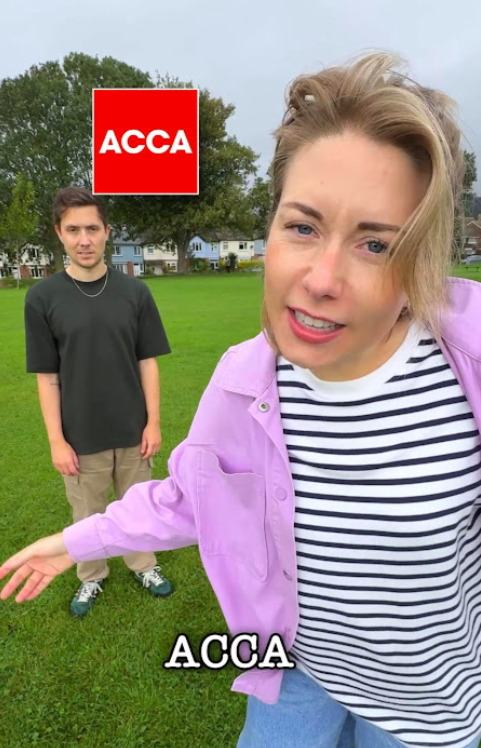
Influencer partnership with @bamcomedyuk, credit: Spin Brands’
Your campaign: ‘A world without accountants’ some might argue that was quite a bold creative bet. How did you get internal buy in for something that provocative? And what does it take to push creative work like that inside a ‘governance heavy’ institution?
‘A World Without Accountants’ was a bold creative choice, but ACCA is an organisation that supports pushing boundaries when it’s grounded in a real strategic challenge. In this case, the profession was in danger of being overlooked, and traditional, ‘safe’ B2B marketing simply wasn’t cutting through.
So the conversation was about solving that problem in a credible way. We anchored everything in a clear, universal truth: if accountants didn’t exist, things would fall apart pretty quickly. That gave us permission to be more creative, more disruptive – without losing sight of the gravity of the matter at hand.
Like any responsible organisation, ACCA encouraged a measured approach. We tested, used data alongside judgement, and built confidence through results. Working with Josh Baulf and our agency partners Blackbridge Communications, we leaned into humour and a more social-first style – something quite different for the sector.
The campaign went on to deliver millions of views, strong engagement, and, importantly, a real shift in perception. It also reinforced a key principle for me: bold work only works when it’s rooted in something real. That’s when organisations feel confident to back it – and when it truly lands.
How is your marketing team structured?
We’ve been operating a matrix model for 4 years. We have global and regional teams which gives us scale, but also keeps us very close to our markets and audiences as well. We’re digital-first and audience-first, not channel-first, and we operate across both B2B and B2C because our ecosystem is complex; we’ve got employers, students and members. Our members represent almost every type of individual in the world, and with that comes a wide variety of customer profiles. That brings a level of complexity that makes the work both challenging and rewarding. On top of that we have a large number of partners and we operate across 180 countries. At that scale we really can’t afford to think in silos.
At ACCA, marketing sits within a directorate called ‘Content, Quality and Innovation’, so we’re not just promoting what exists, we’re actively shaping what we offer, which is crucial.
Because if marketing is only brought in at the end, you’re not influencing anything, you’re just amplifying decisions that have already been made – which might be already bad for business.
But that only works with the right team. My team wear multiple hats and operate across a broad range of marketing responsibilities. Building a successful team starts with hiring for mindset over skill, then empowering people to take measured risks, learn quickly and keep moving forward.
Everyone knows what good looks like – and average isn’t it. Mediocrity is where teams stall. I expect experimentation, challenge and a willingness to push boundaries, because comfort is the enemy of performance.
For me, it’s simple: high trust, high standards, zero complacency.
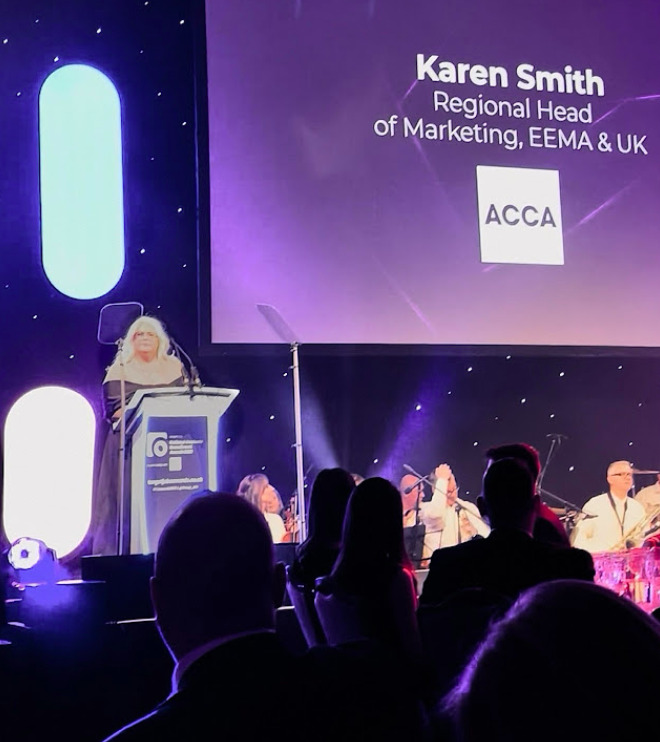
Karen presenting at the targetjobs National Graduate Recruitment Awards in Partnership with ACCA 2025’
How do you surf the tsunami of rapidly evolving marketing technology?
The biggest mistake people make with marketing technology – especially AI – is treating it as a shortcut and not as a capability.
Technology solutions can be incredibly powerful. They can speed up content, accelerate insight and decision making – but it doesn’t replace thinking. At least not yet. If all marketers are doing with technology is using it to produce more average content, faster, that’s not transformation. That’s what I call scaling mediocrity.
For me, it’s about staying curious and experimenting constantly. One also needs to be really intentional about what adds value – rather than just using something for the sake of it. The advantage doesn’t come from the technology itself: it is about how you apply it. Too often businesses spend so much time on the technology itself. Then they don’t get buy in, and don’t apply it correctly, then the initiative fails and the technology gets blamed.
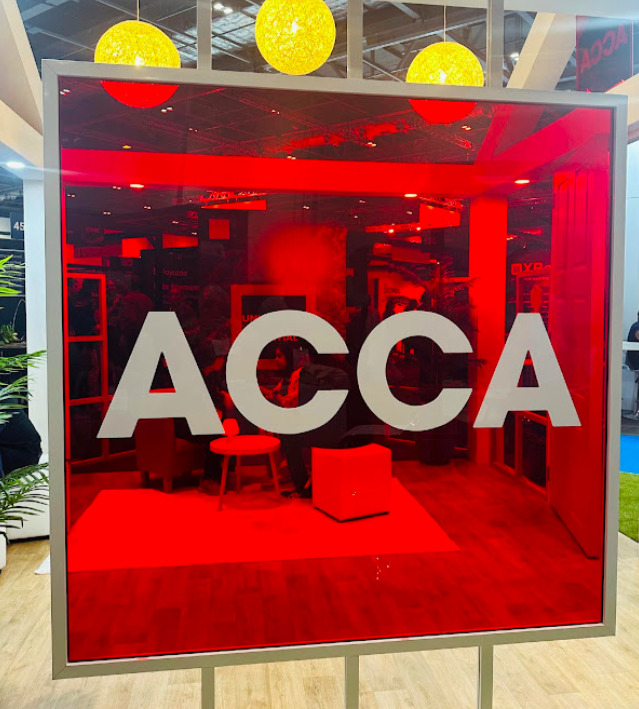
ACCA at Accountex 2025, Credit: 1World Xzibitz Ltd’
What myth about marketing would you most like to bust?
The myth I’d like to bust is that marketing’s role is ‘to make things look good’. In my experience, this is where lots of organisations have got it wrong. They treat marketing as ‘storytelling and polish after the facts’. The real function of marketing is to shape perception, challenge assumptions, drive change and shape the actual product.
The uncomfortable truth is that a lot of marketing underperforms because it’s playing it safe. Too often marketing is designed to be approved rather than be noticed. This is a particular issue in B2B marketing. There’s a belief that credibility comes from being serious and controlled. In some B2B marketing, there’s a fear of standing out – and it leads to work that’s instantly forgettable.
Successful marketing should be making organisations more relevant, visible and honest about the value they bring. If it’s not doing that, I would say it’s just decoration. I also believe that most marketing challenges are business challenges dressed up as marketing challenges.
In some organisations, if something is too hard to solve, you chuck it at the marketing team, and then you can blame them when, when it doesn’t work. Too often in businesses marketers are told: “Oh we’ve done this; now can you market it?” This needs to change.
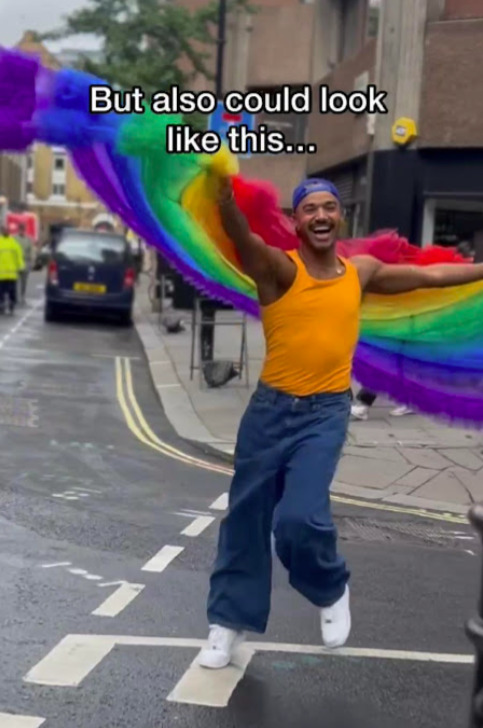
Influencer partnership with @austyn_farrell, credit: Spin Brands
Could you describe a moment when your instincts and the data pointed in different directions? How do you decide and what was your takeaway from the experience?
I would look to the “World without accounts” campaign again. It was deliberately provocative and designed to challenge a stereotype. The data was telling us to play it safe. Stay credible. Don’t take risks. My instinct told me that we needed to try something different. That this was a risk worth taking.
In today’s world, being ignored is actually a far bigger risk than being challenging. I chose to go bold. It landed well and drove engagement. It opened doors for our business development teams with companies that they had been trying to get in front of for a long time.
The takeaway for me from the experience is that data is absolutely essential – but it’s directional, not definitive. If you only follow what’s proven, nobody’s ever going to create anything new.
What question would you like me to ask the next senior marketer when I interview them?
What are you still doing because it used to work, not because it still does? It’s an important question, because we all hold onto things that have delivered in the past without really challenging them. I try to keep asking – is there a better way?
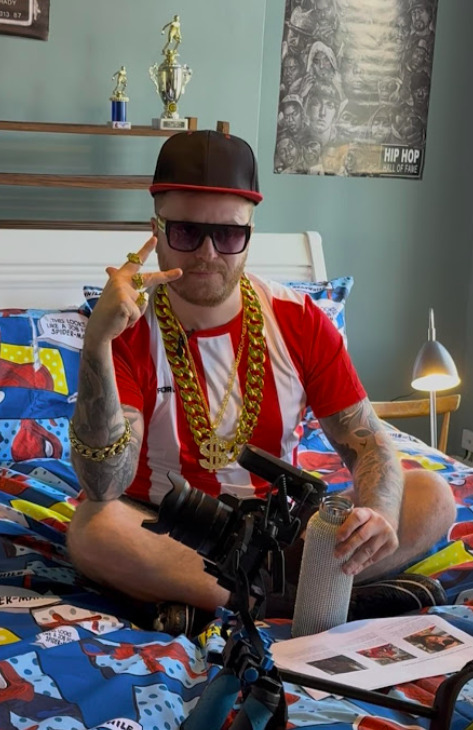
The making of ‘A World Without Accountants’ series 2 with Josh Baulf and Blackbridge Communications.
Your question from a senior, the last senior marker I interviewed is as a marketer, what keeps you awake at night?
Honestly, what keeps me awake at night is all the untapped talent out there – people who never even consider certain careers because they don’t see themselves in them. If no one in your family has been to university or worked in a profession, paths like accountancy or law can feel out of reach, or reserved for those who already have a foot in the door. That gap in perception and access is something I think about a lot.
I see my role as helping to change that by getting more people to consider accountancy as a profession that is genuinely open to all. University is the traditional path, and it works for many, but not for everyone.
I built my career through experience rather than credentials – choosing adventure, taking risks and learning by doing. That’s where I developed judgement, resilience and the confidence to challenge, which is ultimately what leadership demands. So my advice is: don’t feel confined by the ‘right’ path. Carve your own. What might look like a non-traditional route can often give you the perspective and edge that sets you apart.
And don’t wait for permission. The industries most in need of change are often the most resistant to it, so if you’re waiting to be invited in, you’ll be waiting a long time. The people who progress fastest are the ones who push – respectfully, but consistently.
Finally, if you didn’t start with a network, don’t count yourself out. Build resilience, build allies and use your voice, not just to progress your own career, but to open doors for others coming through. Because leadership isn’t just about getting there, it’s about changing who gets there next.
If there’s one thing you know about marketing, it is?
Most perceived marketing problems aren’t actually marketing problems; they’re business problems. Marketing won’t fix a weak proposition or a confused business strategy. No amount of creativity, media spend, clever spin or messaging will fix that.
Too many organisations look straight to the marketing team to compensate for other issues – to make something look better than it is. The role of marketing is not to decorate. It’s to confront. To challenge what doesn’t stack up, to force clarity where it is lacking, and to raise the standard internally. That’s what I aspire to do and what I expect my team to do.
Because if the truth isn’t strong, marketing just amplifies the problem.
This interview is brought to you in partnership with Worth Your While — an independent creative agency based in Copenhagen, working globally. Named one of The Drum’s Indie Agency Top 100, WYW exists on the belief that time is humanity’s most valuable resource, and that the only ideas worth making are ones that earn it. You might die tomorrow. Make today worth your while.
Tim Healey listens, learns, and synthesizes real-world best practices from hundreds of marketing professionals and serves them up in his weekly interviews for The Drum.Tim’s Little Grey Cells Club is a trusted, no-sales, peer-driven network where senior-level marketing directors unite to exchange authentic insights, confront challenges, and drive leadership forward.
This interview has already appeared in The Drum. Discover the best campaigns, industry insights and interviews from world-leading marketers, creatives and more.