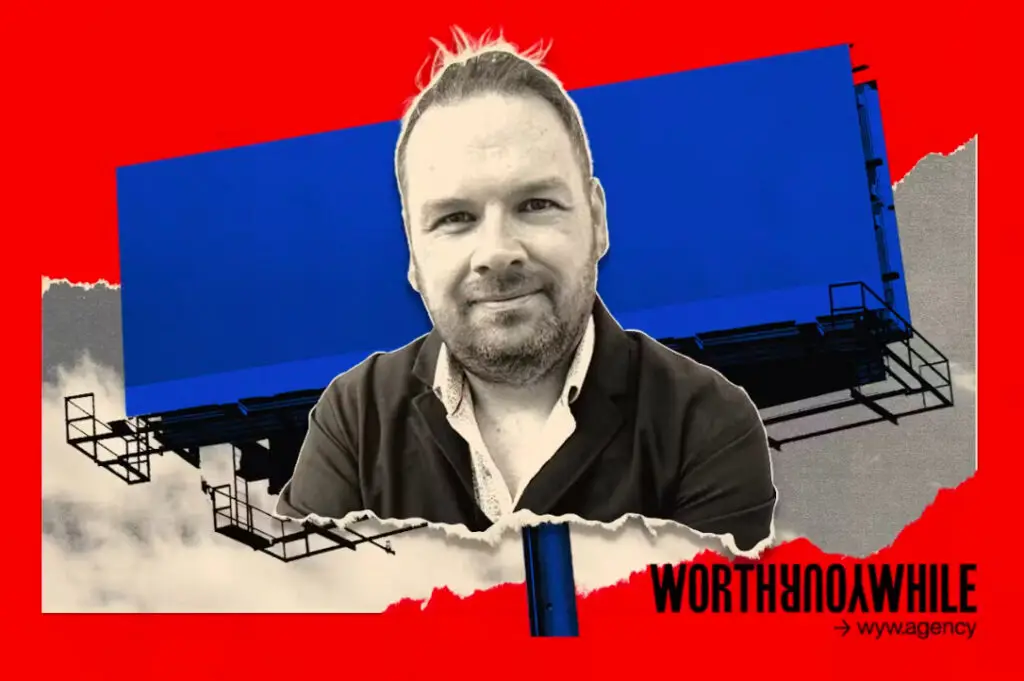
The fintech entrepreneur tells Tim Healey why marketers obsess too much over differentiation, how making credit scores free helped build a 27 million-user business and why being better can matter more than being first.
You founded ClearScore 11 years ago after working across science, FMCG, banking and consumer credit. How did those experiences shape the business?
The business is an amalgam of all of the things that I’ve done in my career.
I was a scientist at university: I got taught how to do experiments, how to add up numbers and how to think about hypotheses.
I then did some voluntary work in South Africa, which is one of the reasons why we have a South African business. I joined Procter & Gamble, where I learned the power of having the best product combined with consistent investment in brand marketing. ClearScore is the best product in our category, and we have consistent investment in brand marketing.
I set my first company up in my 20s, at the height of the ‘dot com’ boom and got deep into the internet. That went very well for a while. And then it went very badly. The business collapsed, and I collapsed with it. Our culture at ClearScore has a real focus on physical and mental health, because I lived through the impact of neglecting both firsthand.
I needed to make some money, so I talked my way into Deutsche Bank, and I pretended to be an investment banker for a few years. I learned how to deal with bankers and financial institutions.
I left Deutsche and I went to Capital One, a credit card company, and I learned all about consumer credit. I saw the power of the credit score and report and how it was very inefficient for lenders and for users. I knew I could do something to help here.
I set up a business called Allow, which was the world’s first personal data brokerage. It was a clever idea, but it was too difficult to describe to people.
I sold that business and set about my next mission: to create a great product that helps people to manage their finances, to stay out of debt, manage debt when they have it, and that can be described in 10 words or less.
Put all of that together, and you come up with ClearScore: your credit score and report for free forever. We shot an ad with a dog in it, and 11 years later, you end up with 27 million users, 600 staff, and operations in five markets in the world.
What is the offer at ClearScore?
Our users get control over a data set that they used to have to pay to get access to and you can stay on top of that and make sure that it accurately reflects you. You can also now, with open banking and employment records, enrich that data.
When you’re interested in shopping for a credit product, you can come into the marketplace, and see all your offers in one place. You get better access to the market, you get better pricing, and you get the best access to credit cards and loans.
We’re a group of companies that take millions of consumers on one side and (with their permission) share their data with lenders and financial institutions on the other side in a marketplace. When that matching happens, the user gets access to better products, the lender gets a good customer, and we get predictable revenue.
So I’m here at the Kroger Precision Marketing suite at Cannes, and I’mPlayUnmute
Loaded: 5.43%
Remaining Time -12:45CaptionsPicture-in-PictureFullscreen
Aisle of the Future: The Store Becomes the Smartest Screen
What’s coming up for ClearScore in the next year?
We’re launching our next version of the platform: ‘CS26’. This version acknowledges our move into mortgages, which is a logical next step for us. We want our users to ‘master their borrowing’, so that they always know that any money that they borrow is via the right product, and at the right price for them. We want to help people feel in control of their borrowing and feel confident managing it with our tools.
We’ve done that really well with credit cards and unsecured personal loans, and we’re pushing into car finance, but the missing piece of our portfolio has been mortgages. A mortgage is typically the largest amount of money that anyone borrows in their lifetime, so helping our customers navigate that is vital.
Next we are introducing our in-app AI called ‘Caisey’. This helps people to understand and to interact with ClearScore. We also want to rewrite the rules around credit broking, making best use of AI in the agentic world, and have launched our Agentic Credit Broking Protocol. A lot of people use LLMs to learn more about credit options and products, but the structure was missing to connect LLMs with credit brokers and with credit product providers.
We want to be able to shape the rules which will allow that to happen in a compliant way. This way you get the right product, the lender gets the right customer, and what we do in the ClearScore space will exist within LLM agents – and we’re very excited about that.
I feel like education around finance is a big missing piece at schools, and arguably a really important lesson that should run alongside the ‘three Rs’. Where are you on the need for school students to understand budgeting and financial products?
I completely and utterly agree with you. I chair a charity called ‘The Money Charity’, that’s the UK financial education charity, and every year we deliver about 1,500 hours of financial education in schools, and about another 450 in communities, all for free.
We’ve been closely involved with the financial inclusion strategy that the government is now implementing. Financial education is now going to be on the curriculum for the first time.
We need to be helping kids to understand how finances work. When I go into a school, one of the exercises we do with students is setting a budget. We ask them how much they think their rent would be aged 18 if they choose to rent a flat. One group will say £50 a month and another group will say £5,000 a month.
It is clear that before we ask them, they haven’t given it too much thought, and why would they? They’re 16. And yet there is this opportunity for better financial education: helping young people understand the financial choices that they’re going to have to make is incredibly important.
At Capital One, you marketed credit to people. At ClearScore, you help them decide whether they should take it. What changed in how you market to a consumer?
During my time at Capital One, we witnessed the rise of the aggregators – Money Supermarket (for example). They really taught consumers to shop around, and that’s a good thing. But paired with the rise of digital marketing, this created an environment where consumers would be applying for products that they weren’t going to get.
At Capital One, for every 10 people that applied for a Capital One card, we would give it to one of them. For the nine who were not successful, it was frustrating and also very costly for the lender, because you’re processing all of those applications that aren’t ever going to turn into a customer.
ClearScore provided a solution to that problem. We use technology and data to help users shop the broader market, so instead of going just to Capital One, Barclaycard or to your bank, you can come in one place and you can have a look at all the different providers, and you can consider the products that are best suited to your needs.
Most of our products are triple locked: that’s a guaranteed interest rate, a guaranteed credit line, and a guaranteed chance of approval. You can quickly see: “Oh, I’m going to get a £3,000 credit line with this much interest, and that’s guaranteed for me.” Then you can make your decision with much more confidence, and so that means that consumers who apply for a product through ClearScore, know that as long as they have told us the right information, they’re going to get the right product.
Credit is a very different type of product: you wouldn’t anticipate walking into electrical appliance store Curry’s, saying “I want that washing machine” and for a member of the Curry’s team to say: “Oh no, you don’t qualify for that washing machine. You’re not allowed that one.” At ClearScore, we’ve tried to make it clearer: to let people know what they will be allowed to borrow.
You’re a marketer who became a CEO. What does marketing prepare you for, and what does it leave you completely unready for in your current role?
The training I was given at Procter & Gamble was excellent. It laid out the fundamentals of marketing. Marketing has changed over the years, but the fundamentals that I learned have not changed: understanding consumer needs; creating an amazing product which meets an unmet consumer need; being able to create a great brand around that; developing a proposition that’s really going to capture that product advantage; bringing that to life through mass marketing; consistently investing over years to win market share.
I still practice that at ClearScore. Even as a startup, when we didn’t have very much money, we constantly considered how much we could afford to build the brand. Obviously that’s built and built and built as the company has been more successful.
Those principles – consistency, product advantage, understanding consumer needs – those are the fundamentals. Understanding that is great training for whatever business you’re in. Understanding and applying them is great training for being a CEO.
The things that it doesn’t prepare you for is that there is so much more data around now. Earlier in my career, you would look at monthly sales reports. Now I look at dashboards where I can see people clicking every second, and we can analyze all of that. I think that analytical edge and how you combine that with much faster decision making on value creation is a huge change.
I also think that marketers can be a little bit too idealistic: “This is the way it should work”. The reality is that when you’re a CEO, you realize that everything is nuance, and you’re always making marginal decisions on a commercial basis. That goes against the way that marketing theory says it works. Marketers that sit within organizations can be too purist and not commercially minded enough and as a result they don’t yield the influence that they would like.

Could you tell us about a challenge you’re facing right now, and what your advice might be for other marketers facing that challenge?
We’ve grown from being new to the market to being pretty well known.
We’re great believers here in Les Binet’s ‘The long and the short of it’ and we’re doing a lot of work at the moment to validate the excess share of voice and really trying to understand what is that dynamic for our category.
Sounds simple, but it’s not. We are trying to work out complex share of voice across multiple channels, where the data is very rarely as clean as it used to be. Just trying to work out the actual share of voice that you’re competing in, and then what should your excess share of voice be versus your market share – these are complex calculations.
During Covid, we were still quite a young business. We managed to do an amazing CPA deal with Sky. A lot of campaigns were being cancelled during the pandemic, and we managed to do a TV-based CPA deal, which has never been done again. It allowed us to continue to spend on Sky against this CPA deal.
If we were signing customers up, we knew that we were going to be able to monetize them, so that allowed us to continue to spend through that part of the cycle. As a result, our brand awareness increased during that period because of the creative commercial deal that we managed to strike with one of the media owners.
Could you tell us about a customer research discovery you’ve made that you found surprising?
In the UK getting on the housing ladder has created this irrational drive for people to engage with short-term financial decisions. We have learned that a certain sub-set of ClearScore users are taking credit cards as a way of showing that they can manage borrowing, in the hope this makes them look good when they decide to apply for a mortgage.
One could feel positive that people are planning ahead and seeing short-term borrowing with a credit card as aspirational. One could also be slightly worried that people are feeling that they have to take short term credit in order to qualify for financial products in the longer term.
As long as they are responsible, they know what they’re doing, and they feel in control of it, that’s going to be a good thing for them. But a certain percentage of people who take out credit can’t handle it, and so they end up harming themselves through that.

What myth about marketing would you most like to bust?
I would like to bust the myth generally that differentiation is a critical thing that you need to succeed. I’m a great believer in great businesses. I believe that great brands can be created just by doing what is being done already but doing it better and more efficiently.
ClearScore was not the first to offer this service. There were other players in the market but people were used to paying £15 for the service. We made it free. We created a great product, cheaper and better than our competitors, and 11 years later we have built a really great business off the back of it.
In my opinion, too many marketers obsess over differentiation. I go back to the young marketers at ClearScore and tell them how, when I was at Procter & Gamble, we were selling branded commodity products. Yes, there were bells and whistles that were different, but at its essence it was ‘white gloop in a bottle.’ Ultimately that is very similar, whatever the brand is.
You’ve still got to win in the market. You’ve got to find a way of opening up the market and connect with a customer when you maybe don’t have as many products, differentiators, and claimable advantages as you would like.
Is there such thing as an ‘AI x human’ sweet spot in your experience? When is it not enough AI? When is it too much?
I hope that there is an ‘AI plus human sweet spot’. I see it in my own work, and in a lot of the work that we do now in ClearScore, where we’re using AI to empower our teams and to increase our productivity and things like that.
Can I see a future where that becomes self-sufficient without the human in it? Yes. I don’t know that that’s a likely future, because the ramifications of that are pretty profound, and I think we will want to avoid some of those ramifications.
If I think about my own work, I’m using AI morning, noon, and night, and it makes me much more productive, it allows me to get through my to-do list much more quickly. It is a ‘super-enabler’. I don’t personally feel threatened by it. It is allowing me to process a lot more than I did six months ago.
What advice might you give your younger self if you could go back in time?
90% of success is about execution and resilience: just keep going. It’s not about the big idea or the great insight. It’s about running up against the brick wall every single day, putting your shoulder to it, and after you’ve done that 365 days a year, eventually it’ll break. You’ve just got to keep going.
What question would you like me to ask the next senior marketer that I interview?
Why do you think that marketing is generally perceived as such a low self-esteem discipline?
Your question from a senior marketer that I interviewed recently is, what has been your biggest brand-related marketing success, and what did that teach you?
It must be the establishment of ClearScore. I was sitting in the men’s FA Cup final this year – we’re a sponsor of the FA Cups – and seeing ClearScore everywhere at Wembley, covering every single display board was a real incredible thrill for something that I created 11 years ago. That was pretty amazing.
If there’s one thing you know about marketing, it is…?
One of the problems with marketing today is that many people have forgotten what it is to market. Everybody is a channel marketer, a product marketer, a CRM marketer, a digital marketer, a specialist in Google, a specialist in Meta.
You are much more powerful and more able to have a strategic conversation with the powers that be if you go back to the principles that we talked about right at the top of the interview: what’s my consumer need? What is my consumer target? How am I going to create? How am I going to connect that unmet consumer need with the product that I have?
If you take that strategic view, you can command that narrative strongly, and I believe that is the way that you end up becoming a senior marketer – a CMO, sitting at the top table. My fear for the discipline is that all of the junior people are being taught these single specialisms and not enough about the value of strategy.
This interview is brought to you in partnership with Worth Your While — an independent creative agency based in Copenhagen, working globally. Named one of The Drum’s Indie Agency Top 100, WYW exists on the belief that time is humanity’s most valuable resource, and that the only ideas
worth making are ones that earn it. You might die tomorrow. Make today worth your while. https://wyw.agency/
This interview has already appeared in The Drum. Discover the best campaigns, industry insights and interviews from world-leading marketers, creatives and more.