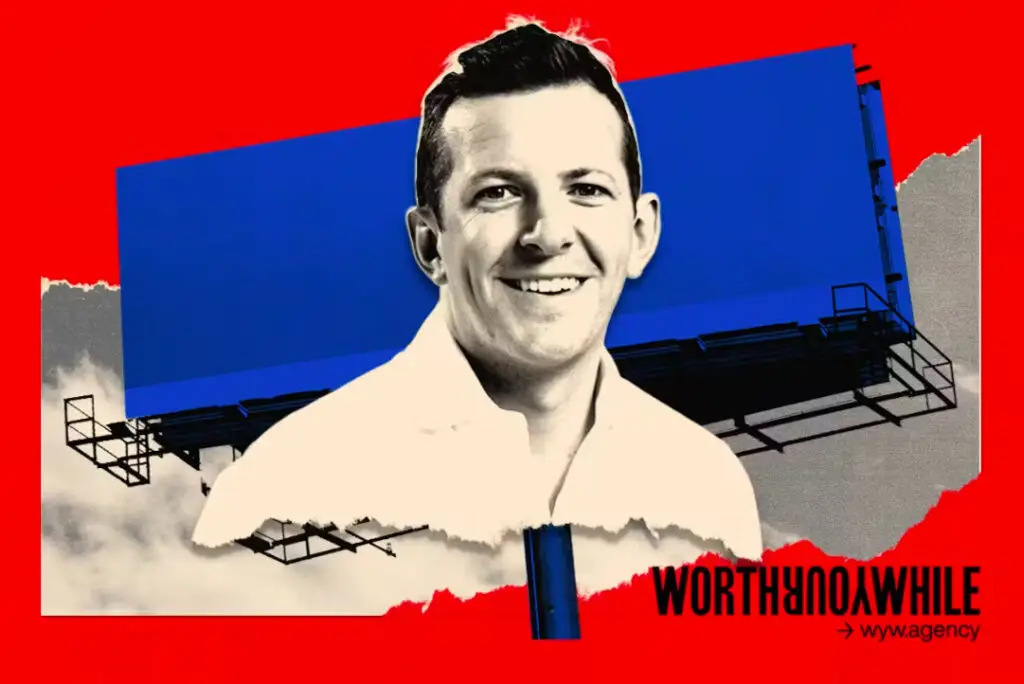
The Campaign Against Living Miserably leader tells Tim Healey how Project 84 transformed the charity’s profile, why hope can drive cultural change and why AI has no place imitating a person in crisis.
Before joining Calm, you worked across music, TV, media and agencies. How did that path lead you here?
My career has been a series of traumatic handbrake turns. Starting in the music business promoting Reading Festival, next I managed record producers, and record producers tend to want to be artists, so they tend to form bands. I worked with bands like Garbage. We made a load of poor to average records and a couple of really good ones – of which ‘MMMbop’ by Hanson was the best.
I jumped out of the record business and went into TV, where I worked for a company that became Virgin Media, doing TV channel work. We had four channels. Then I did another handbrake turn and worked on ‘Who Wants to Be a Millionaire?’ for a couple of years.
The next handbrake led to my time with Yahoo! – when Yahoo! was the biggest media company in the world, I ran their entertainment business. That hurt. They were challenging. And they f*cked the whole thing, by not thinking that two little upstarts in a garage (who were to go on to become Google) would be able to create a better search engine.
From there, I went back to music. I was at EMI Music Group, working across the nine labels, trying to stop people from destroying the record business by stealing music. After Guy Hands bought it, I moved to be marketing director at the BBC for a bit, ending up at BBH for a few years, where I ran their global digital business.
Then I got a phone call from a guy called James Scroggs. He was chair of Campaign Against Living Miserably (Calm). He was looking for somebody to help Calm through its next phase. I agreed to help for a month – and it was immediately something very interesting. At that time, there were only eight employees, less than £1m in revenue, and it hadn’t done any campaigns.
The brand was really interesting. After a month, I said to the board: “It’s all about the brand. We need to turn it into a consumer brand that’s cool”. It was suicide prevention for a male-only audience – however it appeared that it could be perceived of as ‘cool’, which was really unexpected.
Project 84 just exploded everything. We did something that you just can’t do. Project 84 was a powerful mental health campaign and art installation that featured 84 life–size statues perched on top of buildings in central London to show that 84 men die by suicide each week in the UK. This revolutionized what Calm was. We went from being unknown to being very known.
Off the back of this publicity, we successfully called for the creation and appointment of the world’s first minister for suicide prevention. The impact of that campaign was revolutionary. We’re now over 170 employees. We’re 76 in our office in Waterloo and about 100 on our helpline.
It exploded our brand and and our awareness. It also resulted in the biggest search ever for suicide prevention support on Google, and really established our brand as being what I really wanted it to be, which was this challenger. I do not know how to run a charity, but I did have some experience with challenger brands.
Calm communicates with our own sense of identity and purpose. We are not beholden to what anybody else thinks we should be. I got numerous bollockings from the mental health establishment about Project 84, but I guarantee you there are people walking around today because they saw it and reached out for help.

What didn’t they like?
I have a clinical board at Calm, led by a psychiatrist called Ajax Scott. When we were first concepting the campaign, I was concerned that it veered into what we refer to as ‘method’. We would never run a campaign that runs the risk of causing harm to anyone. H e explained that people know there are tall buildings. Placing statues on them isn’t going to put any vulnerable people at risk. He believed, as we did, that the campaign challenged the status quo.
Despite the severe reprimands from other mental health organizations, I know how good it was and I know what it did. That campaign led to a week of suicide prevention on ITV with our helpline live on TV. This completely changed our fortunes. It allowed us to double down on our brand and on the way that we reach people who are not otherwise served.
The establishment brands and communication techniques are clinical: they focus on misery and sadness. One of my early briefs to Adam & Eve was ‘do something borderline illegal, save lives and win us all a few Cannes lions’. We run our campaigns with great responsibility, but we are relentless in that brand identity.
For readers who don’t know it, what does Campaign Against Living Miserably do?
Life-saving change at a societal level: a complete change in human behavior.
What’s next for Calm?
In terms of revenue, we’ve grown thirteen-fold over the last 10 years, and similarly in terms of staff. In terms of reach and saving people’s lives, I think we have had great impact.
With regards to suicide prevention, as a society or as a group of organizations, we tend to stand on the sidelines and say, “You need to sort this out government. You need to sort this out NHS.” Rather than “let’s sort it out ourselves.” It is clear to me that government action will not prevent suicide. We call these the ‘holy shit numbers.’ 6,500 deaths by suicide each year in the UK. One in four people with suicidal thoughts. One in 13 will attempt. Those numbers will not come down if we carry on as we always have.
With homophobia, there was a real cultural shift thanks to TV shows like ‘Will and Grace’ and ‘Queer as Folk’ and rock stars like Freddie Mercury and David Bowie. Similarly, TV personalities like Lenny Henry, bands like Public Enemy and football teams like Arsenal have been the catalysts for real progressive change when it comes to addressing racism in the UK. It’s culture that changes society, not the law, and politics catches up and tries to reflect public opinion.
We did a lot of deep dive work into what is stopping people from wanting to prevent suicide. Our research showed that there’s a lot of talk around de–stigmatizing suicide, and that’s wrong. Suicide is horrible. What we need to de–stigmatize is suicide prevention because that is beautiful.
When you consider the ‘holy shit’ numbers, we have to change the way that a society thinks en masse. We have to rebrand suicide prevention as a beautiful, life–affirming, wonderful, optimistic, and positive obligation.
Over the next 10 years, we will make the UK the first place in the world where we embrace suicide prevention as a lovely thing to do. If one in four people have suicidal thoughts, then we need to help the ‘three in four’ and encourage them to put their arms around that fourth person, so that the one in four will be able to seek the help that the three can provide.
What were the hard truths you got once you arrived at Calm that maybe you hadn’t experienced when working more commercially?
A lot of inertia. A lot of “that’s not how we do things around here.” A lot of conservatism. However, I am blessed to have James Scroggs MBE as chair because James was at MTV before, and so we just understand each other on a very deep level. He and my board have only ever facilitated and improved; they’ve never stood in my way.
When our campaigns are deemed dangerous, in reality, they are not. In 2022, the Last Photo campaign was an installation of photos of smiling people, that was displayed as an outdoor exhibition on the South Bank in London. After a few days, we revealed that the photos are among the last images taken of people who went on to die by suicide.
It was the most -awarded campaign in the world. Calm was the most-awarded brand in the world in 2024. That’s not most-awarded charity – the most-awarded brand. We won the film Grand Prix in Canada, for example. You just don’t do that as a charity.
If you can brief agencies properly and then act positively as a really great client that demands the best but offers respect in return making it a true collaborative effort, then you can do incredible, amazing, wonderful things, and then that flows out into the rest of the organisation.
The Calm HQ is in a railway arch. There’s dogs running around. There’s hip-hop playing. People will walk in and go, “Oh, sorry, I was looking for Calm.” Our suicide prevention charity isn’t sad. It’s positive, beautiful and it’s about life – not about death. People say: “it’s okay not to be okay.” No, it isn’t. It’s not okay. We want to make you happy. If you’re sad, come to us. We want to make you happy. We want you to get to enjoy life.
The Papageno effect – which is a clinical methodology – says that hope is contagious. At Calm we’re going for societal change but based through the lens of hope. When you run a hopeful organization, you can do quite incredible things because you get a momentum and then you can run it as I would and have run a commercial business, only we have a wholly altruistic output. There’s something really lovely about it.

You’ve said mental health marketing usually means ‘a photograph of a sad man on a poster’, and that Calm should never look like that. Why?
On ‘The Last Photo’, the strapline was ‘suicidal doesn’t always look suicidal’ and that wasn’t based on a clinical insight. We were talking about how the pathologization of mental distress creates a persona which isn’t recognizable to many of us. The ‘one in four’ number means it’s our mums, sisters, wives, kids, dads, brothers, friends and colleagues.
Building campaigns around a hypothetical ‘sad lad’ who sits on the end of his bed with his hands in his head is limiting our reach and our brand identity. Suicide is a wholly unpredictable thing. It is not linear. It can come very quickly with a conclusion, or it can take years and years with the most meandering route. We operate across the thing that we call the continuum of need, and our focus is on what is in the movable middle.
So if you’re at point of crisis, our helpline is there, and that’s staffed by paid and trained professionals, so we can really intervene. But for most people, we’re around the middle, we can have really good days. We can have kind of normal days. We can have really bad days. We lean into life.
Sometimes we talk about suicide, but mostly we shout about life and we shout about the alternative. There are beautiful things which might resonate with you. There is a principle called the ticket in the draw, which we know that people will hesitate from taking their own lives because they’ve got a ticket to see a great concert or a football match – it ’s the knowledge that something good is coming.
The future can be better than the present and the past. You don’t sell that principle by showing somebody sad. You sell that principle by showing people who may have got to a point of crisis – but they got past it because the vast majority of us do.
You might say that the best outcome of your work is ‘a life that carries on quietly’, which is quite difficult to measure. How do you judge whether a campaign has worked?
One is trusting in our messaging. Trust in the product that we made. We made a product called the C.A.R.E Kit, which is a suicide prevention kit, initially designed for trusted adults to look after kids. We now have 75,000 people using the care kits – that is 75,000 informed and potentially active suicide preventers. That’s a result. We don’t know what they’re doing, but we know that they’re capable of doing it if they’ve called upon.
We also acquired and then redeveloped a mental health maintenance app called Calmzone. We set ambitious targets which we’ve beaten based on performance marketing. We absolutely trust our key messaging to be effective, whether that’s through ‘the invisible opponent’ campaign that we did with AMV, whether it’s through the Calmzone or the work that we’ve done with Adam & Eve.
When we get that huge reach and we can have suicidal prevention front and center in the nation’s cultural crosshairs, we know that we’re doing good because we trust our messaging. We trust that changing a dialogue is the right thing.
How important is creative risk taking when marketing Calm?
It’s what we have always done, but it’s measured and it’s on guardrails of the highest tensile steel to make sure that from an actual clinical and academic perspective we will have impact. The risk comes in the tonality, the creative execution and the partnerships.
Where is the AI-human sweet spot?
We are very cautious when it comes to AI in clinical suicide prevention. What a person in crisis needs is a person – not a machine imitating a person. It has no place, AI is a narcissistic fool. We shall give it to no truck. It butters no parsnips. But, we are in terested in how we use it to optimize our services – how can it enhance our human-powered digital products? And there’s huge potential in using it to measure the actual impact these services are having.
In the running of a business, AI is immensely useful. In production, it’s immensely useful. For Calm, we are focusing on the human.
When people didn’t like Project 84, my clinical advisor said to me at the time you’re not talking to academics, you’re talking to humans. And right now, with regards to AI, because of what we do, because of our product, we are holding the reins incredibly tightly.

What marketing challenge are you facing right now, and what advice would you give others facing the same issue?
Platform specificity. We have really great connections into traditional media. I have a temptation for being something of an old git and to think ‘that that’s the way we want to go’. But actual reach, actual interest groups are not where they used to be.
A challenge for us is to engage deeply with the right interest-based communities, that’s where brands can get real visibility. If we can identify what we’re doing with a group of people already doing something together, that’s a challenge for us, but one that we embrace.
What customer research discovery has surprised you?
What’s interesting about our focus groups – and we run many of them – is that for those who don’t have that direct lived experience with suicide, they will tell us again and again that Calm should be like other organizations. They will tell us that what we’re doing is too extreme, too radical, and that our work won’t engage with people. It will frighten people. They won’t like it. They won’t understand. We should be more like the other organizations, which are safer.
That’s what part of the data says, and it really is true that humans, when asked, want a faster horse – they would never have conceived of ‘the automobile’. But for those who have been impacted by suicide – who have lost someone, or been there themselves – they consistently tell us that Calm is exactly what they need.
It’s the thought leadership of getting to the edge of what people think we should be doing and positioning ourselves, and then going a bit further, and bringing them with us, so that we’re the goose at the front of the V.

What has your career taught you about building a great team?
Strong and bold leadership, setting standards, taking risk with massive guardrails, especially given what Calm does. You must have a deeply intimate relationship with the brand from top to bottom and back the f*ck up again.
We’ve got to live and breathe it; understand it intrinsically and instinctively. You have to demonstrate it all the time. There’s 76 of us in that office. I think I very rarely hear something completely out of order. It’s not a cult, but it’s a very tight, informed, mutually supportive community that really understands what we’re trying to achieve.
Your question from the last senior marketer I interviewed: When budgets tighten, what should marketers protect at all costs?
Brand integrity. Don’t compromise, don’t do the wrong partnerships, police it and protect it. And good people. Look after them through the tough times, communicate honestly.
What question would you like me to ask the next senior marketer when I interview them?
Who’s going to win the league next season?
If there’s one thing you know about marketing, it is?
It is science, but we’re dealing with humans, and emotion and truth, levers that are going to get you to change people’s behaviors so that they do what you want them to do.
This interview is brought to you in partnership with Worth Your While – an independent creative agency based in Copenhagen, working globally. Named one of The Drum’s Indie Agency Top 100, WYW exists on the belief that time is humanity’s most valuable resource, and that the only ideas worth making are ones that earn it. You might die tomorrow. Make today worth your while. https://wyw.agency/
This interview has already appeared in The Drum. Discover the best campaigns, industry insights and interviews from world-leading marketers, creatives and more.