When the industry becomes the target audience.
There’s a particular type of advertising campaign that marketing people absolutely love.
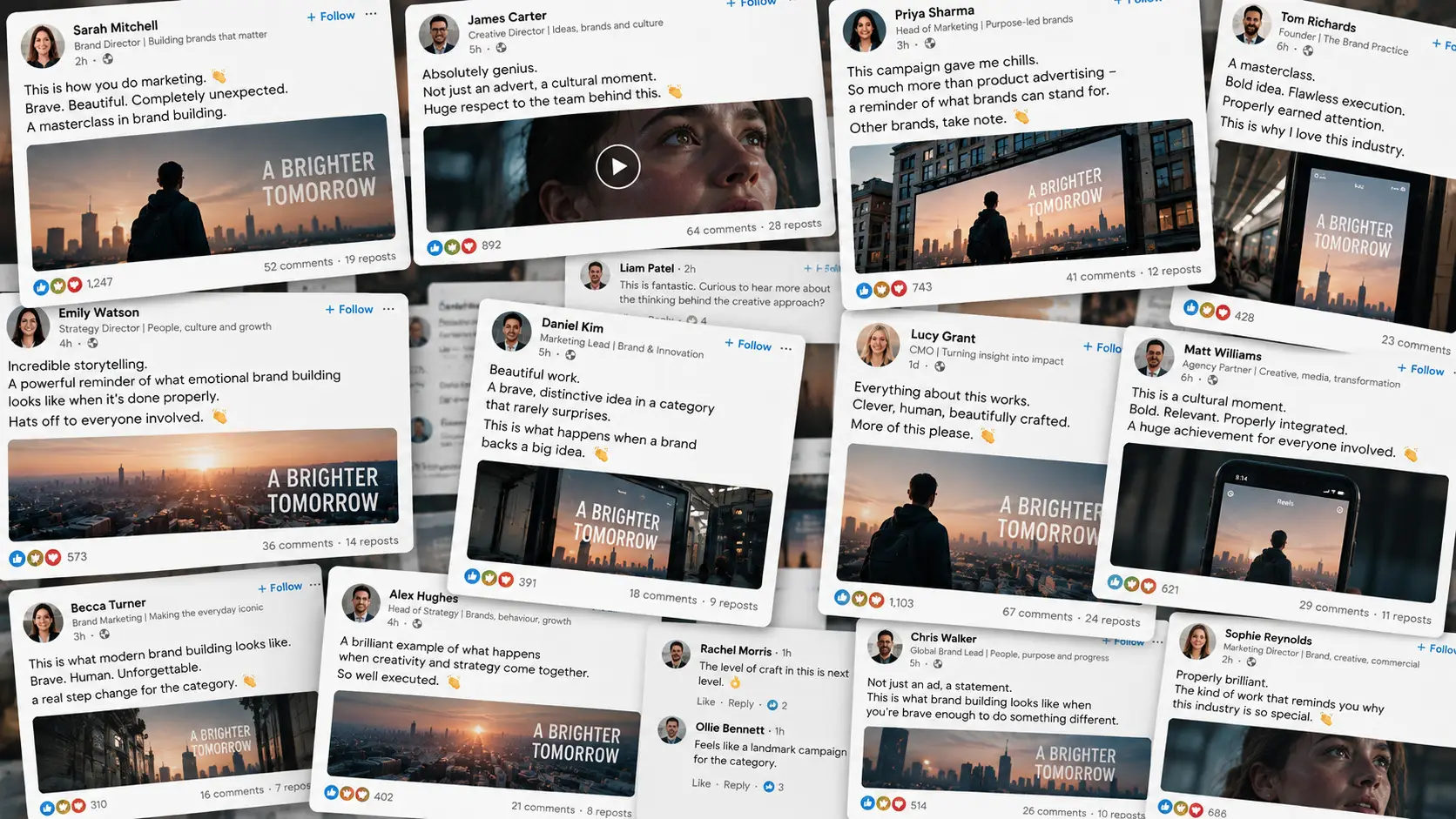
It’s unexpected, beautifully executed. And within approximately seventeen minutes of launching, it’s all over LinkedIn with more uninformed opinions than a certain Premier League cheating scandal.
“THIS is how you do marketing.”
“Absolutely genius.”
“Other brands take note.”
By lunchtime, the marketing industry has collectively decided it’s the best campaign of the year. Which is impressive, considering nobody has the faintest idea whether it’s actually worked. But never mind that. The important thing is that we’ve all agreed – it’s brilliant.
Marketing for marketers.
An audience that wasn’t in the brief, or was it?
Most campaigns begin with a fairly sensible ambition. There’s a customer we’re trying to reach and something we want them to understand, feel or do. Perhaps we want more people to consider the brand, buy the product or stop choosing the competition. There might even be some research involved.
All very reasonable.
But somewhere between the initial brief and the final creative presentation, another audience occasionally makes an appearance. Us.
Other marketers, agency people, creative directors and industry commentators. The people whose work we admire and whose opinions we value. Nobody writes “impress the marketing industry” into the objectives. No wait, some people do literally write that. But I wonder how often it becomes an unofficial consideration.
Will people talk about it? Will it get shared? Will it be seen as bold? Could it win something?
None of those are necessarily bad questions. Industry attention can be useful, particularly if it helps a campaign reach more people. But there is one question that feels more important.
Will the people we’re actually trying to influence give a shit?
Not simply appreciate the creative craft or admire the thinking behind it, but care enough to notice, remember or do something differently.
Because the two aren’t always the same thing.
It’s very clever. Apparently.
One of my favourite things about marketing is our ability to explain why something is brilliant.
A campaign launches and, before long, someone has written a detailed analysis of the creative strategy. The insight is beautifully nuanced, the execution cleverly subverts category conventions and the cultural reference demonstrates an exceptional understanding of the audience.
And I’m sure some of it is absolutely right.
But there’s something amusing about an advert that needs a 600-word LinkedIn post to explain why it’s good.
Most customers won’t be reading the explanation. They’ll be on the bus, watching television, standing in a supermarket or scrolling through their phone while pretending to listen to somebody. They haven’t seen the creative brief, don’t know how difficult the idea was to sell internally and probably aren’t particularly interested in the fact that the campaign challenges traditional category codes.
They just see an advert. For a few seconds, if we’re lucky.
Which makes me wonder whether we occasionally confuse an idea that’s interesting to analyse with one that’s effective at communicating.
The brilliance of a campaign cannot be measured by the raptures of applause from the sycophants.
The LinkedIn standing ovation
It is fascinating how quickly the industry reaches a verdict.
A brand launches something unusual and, within hours, a few influential voices have praised it. Their approval is shared, repeated and expanded upon until the campaign acquires a reputation for being brilliant. The whole thing begins to feel like an established fact rather than a collection of opinions. And perhaps it is brilliant.
But how many people have stopped to ask what it was supposed to achieve?
Because there’s a fairly important difference between a campaign being widely admired and a campaign being effective. Sometimes those things go together. A great creative idea can generate attention, build recognition, change perceptions and drive commercial results. Sometimes, though, the relationship is less straightforward.
And we should probably acknowledge that before declaring every clever execution a marketing masterclass. After all, we wouldn’t celebrate a sales team purely because their presentation looked fantastic. We’d probably want to know whether they sold anything.
Marketing deserves a little more sophistication than that comparison, of course. Not every campaign is designed to produce immediate sales. But whatever the objective, surely it’s worth asking whether the work helped achieve it.
The customer has other things to do
Part of the problem is that marketers spend a fair amount of time thinking about marketing. Which, to be fair, is what we’re paid to do.
We notice campaigns, study brands, discuss creative ideas and read industry publications. We understand the references, appreciate the execution and know when someone has done something different.
Customers, meanwhile, have other things to do.
They’re trying to get to work, wondering why the weekly shop now costs approximately the same as a short holiday, or comparing two products to work out whether the expensive one is actually any better. They might notice an advert, remember it or even buy something because of it, but they’re unlikely to spend the afternoon discussing creative excellence.
And I think that’s worth remembering. Because what feels fresh and exciting to someone who looks at advertising all day might be completely unremarkable to someone who doesn’t. Equally, something we consider fairly ordinary might be exactly what a customer needs to hear.
A clear benefit, a compelling reason to choose the product or an answer to a question they actually have. Not necessarily groundbreaking, but useful.
And sometimes useful is underrated.
Let’s not make everything boring
Before anyone starts, I’m not arguing that marketing should become a procession of functional product messages.
I like creative advertising. I like work that surprises people, makes them laugh, entertains, brings back all the feels. And I think creativity can be one of the most powerful commercial advantages a business has.
An original idea can help people remember something they’d otherwise ignore and make a relatively ordinary product feel distinctive.
That’s valuable. But creativity has to be doing something. Not just demonstrating how creative the people behind it are. There’s a difference between creating something that makes other marketers say, “I wish I’d thought of that,” and creating something that makes customers think, “I might actually buy that.”
The best work can do both, and when it does, it’s worth celebrating. But if we had to choose, I suspect the business paying for the campaign would have a preference.
We’re asking the wrong people for validation
We should celebrate great marketing. Sometimes a campaign really is as good as everyone says it is. But we should be a little more cautious about treating industry enthusiasm as proof of success.
Because the people whose opinions matter most aren’t necessarily the ones commenting beneath the campaign announcement. They’re the people it was designed to reach, who haven’t read the strategy, don’t know the agency, haven’t watched the BTS video and have absolutely no interest in how it was produced.
If the campaign manages to cut through all that indifference and influence what they think or do, then that’s genuinely impressive.
And another thing…
The next time the marketing industry collectively loses its mind over a campaign, perhaps we should ask one additional question.
Brilliant for whom?
Because impressing other marketers is a perfectly respectable achievement. But hopefully not your only achievement.
Thanks for reading. And Another Thing… is a weekly look at the strange things marketers believe, the peculiar things we do, and the uncomfortable questions we probably ought to ask.
A bit of curiosity, the occasional unpopular opinion, and hopefully something worth thinking about.
If you enjoyed this, subscribe for more. And if you disagreed, even better. That’s what the comments are for.