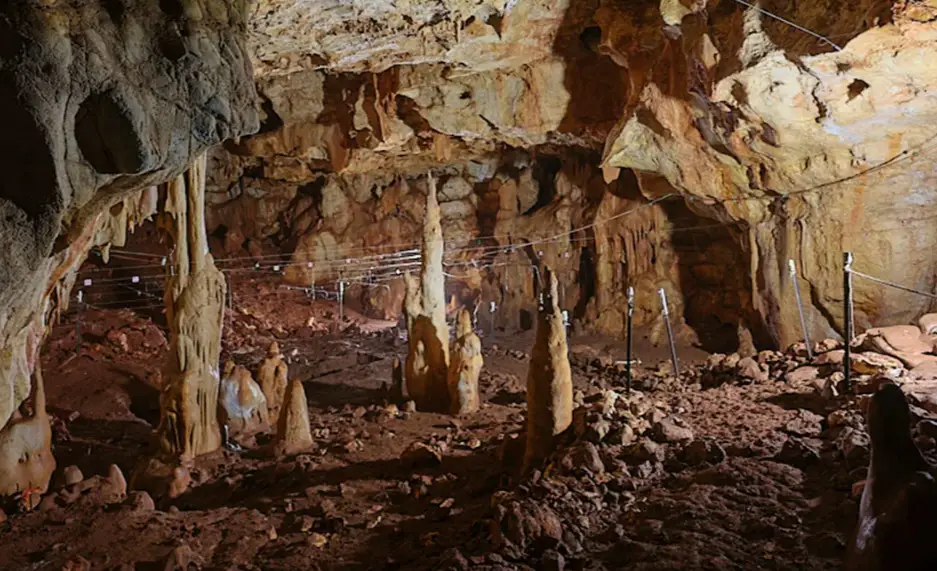
There’s a longstanding joke among archeologists that whenever they uncover a site or a building they don’t really understand, they call it a ritual site. A stone-lined Neolithic pathway. A dug-out cave. A massive stone complex of circular rings and giant T-shaped pillars, like Göbekli Tepe. Eleven interconnected mounds in Louisiana, like Watson Brake. This cry “we don’t know, but probably a ritual site” can sound like a cop-out, to you and me. It’s just the hole-digger’s fancy way of saying: we don’t know.
Why do we feel like this? You and I live in what Max Weber called a “disenchanted world.” He argued that rationalisation and the rise of science had stripped the world of magic and mystery, leaving us able to measure and calculate functionally excellent, but fundamentally drained of meaning. This is a strong thread that runs through our culture.
Yet all around us in our own lives and in the lives of those we study magic is strong. In the online astrology accounts that make some app developers fortunes. In the supreme satisfaction of fantasy films and books from Harry Potter to Buffy the Vampire slayer, Spiderman to the BBC’s effortlessly naff supposed investigations of haunting, Uncanny.
And it’s ritual that brings the magic back into our lives, at key moments in the of calendar. Back into the space between us. Take the Eisteddfod, the Welsh national festival of music, poetry and culture, running across a week in Pembrokeshire right now: ritual behaviour by the bucket load, robes, swords, poets declaiming to a critical crowd, even if the druidic apparatus is younger than it looks (one man’s invention in 1792, not performed until 1819 in Carmarthen). It closes Saturday if you fancy a look or a singsong.
Right now Cowes Week is bringing its own glitzy rituals to the Isle of Wight, along with the yachts and their owners. And the old London Season the marriage market that ran England’s aristocratic summer for two centuries or more is winding down towards the date every tweed-wearer in the country has circled: the Glorious Twelfth, the start of grouse season, next Wednesday.
Ritual, and the magic it brings, is everywhere. Which means everywhere is (or can be) a ritual site. Wherever there are humans. Everywhere.
The thing is, it doesn’t just spring up out of the ground or fall from the sky. It’s always us who smuggle in the magic, the ritual mindset to routines and repeated behaviours, to the hard moments in a life, to transitions and thresholds, to becomings and declinings, to hellos and goodbyes, to supermarkets and to football matches.
Soon the summer will be gone and the kids will be back at school. The French call it la rentrée, loaded with its own small rituals (mine is a stationery binge). Americans mark the same turn with Labor Day the last cookout, the no-white-after rule though the day began as something else altogether: an 1894 federal response to the labour movement, not a seasonal marker at all. The reason’s gone. The slot in the calendar kept its grip.
Which means the archaeologists were right all along.
Next time: how different generations read and remake the same ritual differently.
Watch
The Time Team Official channel and clock the exact moment “we don’t know” turns into “so it must be spooky.” That leap is instant, and it happens before anyone’s had time to think.
Try this
On Monday start a meeting without the two minutes of how was your weekend. Nothing on the agenda changes. It just stops feeling like a meeting with these people. With this group.
That’s not small talk doing the work. That’s ritual. And we’re the ones who bring it.
References
Weber, M. (1917/1919). “Science as a Vocation.”
Gorsedd Cymru, founded by Iolo Morganwg, 1792; first performed at the Carmarthen Eisteddfod, 1819.
National Eisteddfod of Wales 2026, Eisteddfod y Garreg Las, Pembrokeshire, 1–8 August.
US Labor Day, established 1894, following the Pullman Strike.