There is a recurring fantasy that particularly affects those who focus on human behaviour. It goes like this: if you can just get far enough back, stay quiet enough, keep yourself out of it — you will see the thing you study as it really is. Uncontaminated. Objective. True.
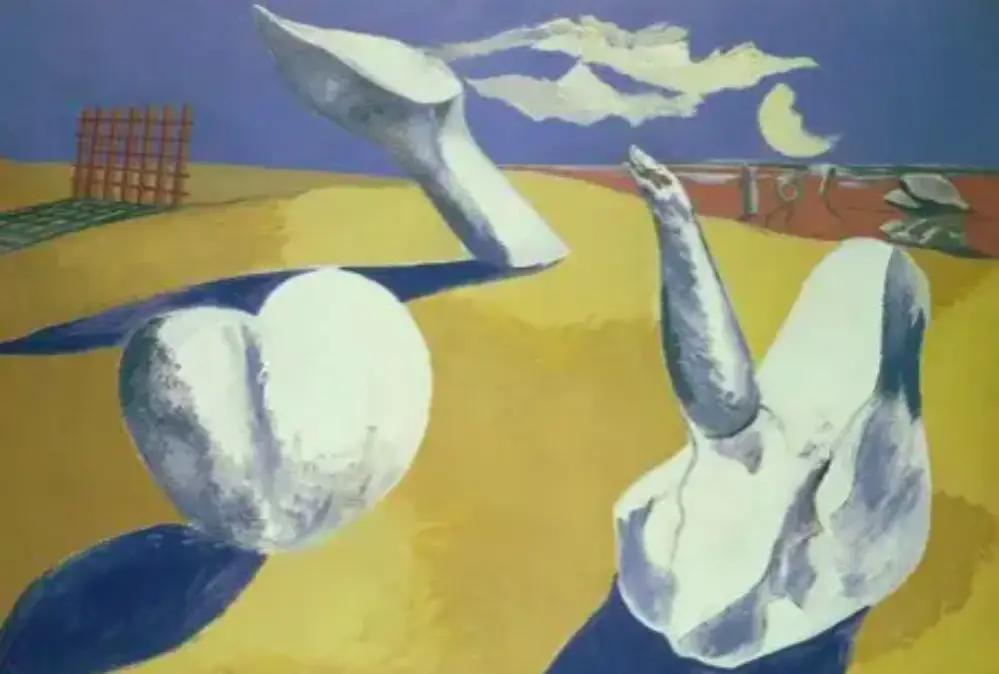
The landscape artist Paul Nash thought this was nonsense. In May 1938, the painter published a short piece in (of all places) Country Life called “Unseen Landscapes.” His argument was simple but was much misunderstood at the time. The landscapes he had in mind, he wrote, “are not part of the unseen world in a psychic sense, nor are they part of the Unconscious. They belong to the world that lies, visibly, about us. They are unseen merely because they are not perceived.”
Not hidden or inaccessible. Not spookily shrouded. Just unperceived and unseen.
His solution was equally simple. Place an object in the landscape (a found thing, a bleached bone, a standing stone) and suddenly the landscape – the field – becomes legible. Like a chair or a table or a rug that pulls a room together. Suddenly the whole thing makes real sesnse. The object doesn’t distort what’s there. It makes what’s there available to see. Without it, you’re just walking through grass.
This is more radical than it sounds when you apply it to our attempts to understand the world around us and in particular the people who populate it. Nash wasn’t arguing for closer attention, or simply more time outdoors, or better eyesight. He was arguing that perception itself requires a helping hand. That the neutral observer — the one who stands back to take it all in, uncontaminated by presupposition — isn’t seeing more clearly. They’re seeing less. The landscape remains unseen.
Which is precisely the problem when we try to understand the human behaviour at scale: when we go HERDspotting.
Groups, communities and tribes are not aggregates. They are not collections of individuals whose private opinions, when averaged, yield a true picture of the group. They are social landscapes — shaped by who watches whom, who copies whom, what the group makes visible and what it buries. You cannot see any of that from a distance, you cannot survey it right off the bat and you cannot extract the juice with a questionnaire sent from outside the field.
You have to go in. And you have to bring something with you.
The cultural anthropologist Grant McCracken understands this. In (his shockingly undervalued book) Culturematic he described the practice of throwing a small device (I’m think of a 1950s space probe) into the culture — a provocation, a hypothesis made physical maybe — and watching what came back. Not surveying from a safe distance and drawing inferences. Putting something in. Letting the herd react. The reaction is the data – data you cannot get any other way.[1]
The market research Steven Lacey (whom I mentioned a couple of weeks ago) goes further, following a very immersive model first championed by the Chicago Sociologists of the first part of the 20th Century. His research into the disadvantaged working class communities in towns like Boston, Bolton and Feltham didn’t involve questionnaires sent from a distance. He went in — to the betting shops, the cafes, the social clubs — with an orienting question about trust in experts and stayed until the landscape showed him something. What it showed him was that the experts hadn’t become untrustworthy. They’d simply left. The GP, the solicitor, the bank manager — physically gone from the community, and with them any lived experience of what expertise actually felt like. No survey had caught this. No view from nowhere had seen it.
This is what HERDspotting actually demands. Not detachment but presence. Not the absence of a frame but rather a frame chosen deliberately and carried in. The question, the provocation, the orienting idea — these are Nash’s standing stones. They don’t impose a meaning on the Herd. They make the Herd’s own meaning visible as well as the mechanics shaping everything.
The framework isn’t the cage. It’s the stone that makes the field legible.
So, the next time someone tells you they’re going to research the market, understand the customer, get a read on the culture — ask them where they’re going and what they’re taking in with them. Not to contaminate the data but in order to see anything at all.
References
Paul Nash (1938) Unseen Landscapes, Country life Magazine, May
Grant McCracken (2012) Culturematic: How Reality TV, John Cheever, a Pie Lab, Julia Child Fantasy Football . . . Will Help You Create and Execute Breakthrough Ideas, Harvard Business
HERDspotting tips
Watch for the researcher who comes back from the field having confirmed exactly what they went in expecting. No object was placed. Nothing was disturbed. The herd remained unseen — and the researcher mistook the silence for agreement.
Listen for the difference between a question that opens something up and one that merely collects. The first is Nash’s stone. The second is a clipboard at the edge of a field, counting heads.
Reflect on what you take into a situation. Not to impose it — to see with it. People are already doing something. Your job is to place something in the landscape that makes what they’re doing visible.