Comedian Al Murray, AKA the Pub Landlord, used to tell a pair of related xenophobic gags: where would we be without rules? France. And where would we be with too many? Germany. As if, the comedy spoof bigot suggests, we British live in some Nirvana in which we have just the right amount of rules governing our lives. Particularly about queuing. A Panglossian Paradise, even.
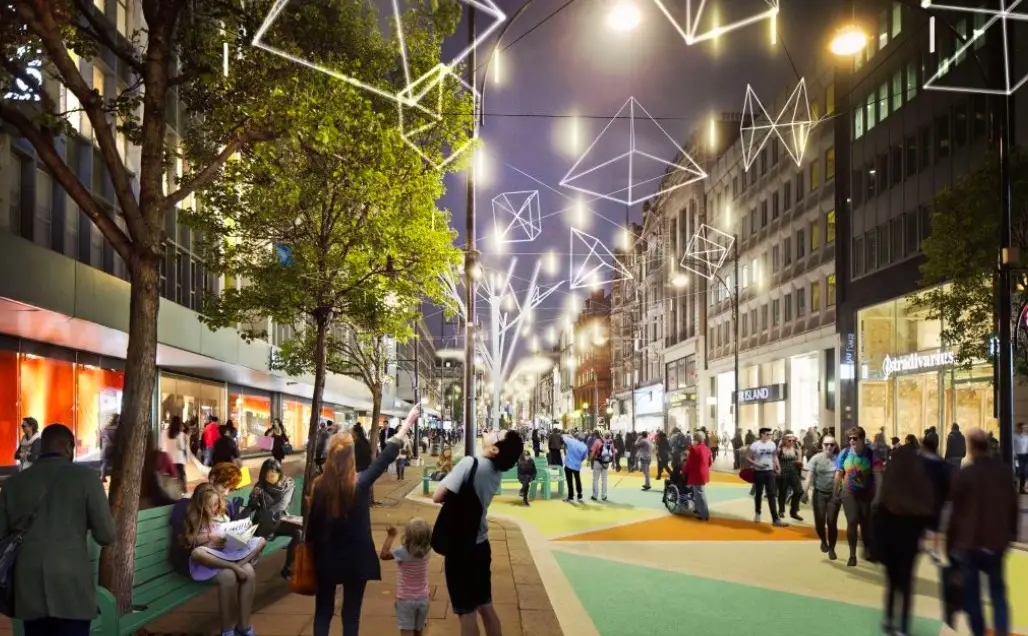
I thought of this routine this last week as London’s mayor opened (or rather, closed) the western end of Oxford Street. Some 1 km is now free of cars, cabs and buses. And bikes, supposedly. But more of that in a moment.
What has interested me is how the people involved, the pedestrians who now have untrammelled access to this broad boulevard, have reacted. And what it tells us about the importance of sharing rules so that we can share space.
We’d like to imagine that they took to their newfound freedoms with alacrity: wandering across the road, from pavement to pavement, like animals being returned to their natural state in a toothsome wildlife film. Run, run, little human: be wild and be free!
The reality seems to have been rather different. First, most people followed the rules of how to occupy such a space that they’ve learned previously, from other people. They kept to the pavement. Some started to step out into what had previously been the domain of buses and taxis but this deviance from accepted safe practice seemed to unsettle others who clung ever more tightly to the old pavement paths. What served to confuse matters most was the refusal of a large number of cyclists to abide by the changes. A significant number of these two-wheeled firebrands chose to ignore the signs and the security staff and just plough on through the crowds. As a result, a number of what can only be described as somewhat entitled interviewees have appeared on news channels and in print (there is something about the urban cyclist as renegade which is both appealing and annoying in equal measure). But far from the chaos that many observers and lobbyists might have desired, we seem to have largely worked our way through things, as crowds mostly do.
But it is moments like these (the turning points, the moments of change in a system’s software) in which the rules we carry around with us are revealed. The shared rules that enable us to live our lives safely in the company of strangers.
For all our culture’s love of the heroic individual, it is essential for the collective navigation of such public spaces that each of us can expect others to follow (more or less) the same rules. In general, I need to know that if I’m driving my car down my own street, another vehicle isn’t going to come barrelling out of a side road. That the driver will look left and right and left again (in the UK at least) before pulling out. I’ll still be watching for the possibility of something like this as I sit behind the wheel (as the trainer on a recent Met Police safety course reminded me), but now I can reliably drive forward in the confidence that any other driver I happen to meet will also follow these same rules as I do. Probably.
The same kind of confidence in others makes the transition itself from a traffic-bound to traffic-free Oxford Street a performance of social cooperation that can be trusted: in addition to seeing other people meander the full width of the boulevard safely, each of us also needs to feel that drivers of cars and buses and, yes, you cyclists are also following the same rules as the rest of us and keeping away from our newfound consumerist savannah (it’s all about the shopping). The insistence of some cyclists on Oxford Street in the first few days after pedestrianisation created uncertainty for many in the crowd. Which forces us to think more consciously about the rules and compliance with them in the strangers we encounter. That’s not how we are made to live our lives. We’d rather not think, because frankly that’s what other people are for.
Postscript
The speed of it is proof of how easily we can adjust ourselves to new rules of interaction. To paraphrase the great Thomas Schelling: I learn from you and you learn from those people in front of us, who in turn learn from those who were marching gaily across the tarmac, way before the rest of us got to the place. In a blink, this has become how we do things round here.
After a while it hardly seems possible that it was ever otherwise.
Watch / Listen / Reflect
Watch: Find news footage of Oxford Street in its first days without traffic, but ignore the people at the front. Watch the ones at the edges, and note who steps off the kerb only after somebody else has. That delay is the rule being copied in real time. For a comparison, look for film of Times Square in the summer of 2009, when Broadway was closed to cars with little more than paint, movable barriers and lawn chairs. Watch how long it takes for a crowd to treat the road as a place to stand.
Listen: Next time you are in a crowded street, close your eyes for ten seconds near a crossing. Listen for the moment the crowd decides to go: the footsteps do not start with the signal, they start with the first confident walker. Notice how quickly the rest follow.
Reflect: Think of a rule in your own organisation that nobody ever wrote down, such as who speaks first in a meeting, where people sit, or when a reply is expected. Now imagine it changed overnight. Who would keep to the old path, who would step out, and who would carry on regardless? How long would the new rule take to become “how we do things round here”?
Sources
The scene
Murray, A. (the Pub Landlord), “Where would we be without rules? France!” routine. See review of Al Murray at Stafford Gatehouse, Express & Star, 20 June 2011: https://expressandstar.com/news/2011/06/20/review-al-murray-at-stafford-gatehouse
City AM (26 October 2026), “‘You can walk in the road!’: Inside Oxford Street’s first day without traffic”: https://www.cityam.com/?p=2471578
LBC, “Cyclists ignore ‘dismount’ calls on Oxford Street” (cyclists riding past barriers and security staff in the first days): https://www.lbc.co.uk/article/cyclists-dismout-oxford-street-pedestrianisation-5HjdkSG_2/
Time Out London (26 October 2026), “First look: Oxford Street is officially traffic-free”: https://www.timeout.com/london/news/first-look-oxford-street-pedestrianisation-102626
BikeRadar, “Oxford Street is now pedestrianised, but where are cyclists supposed to go?”: https://www.bikeradar.com/news/oxford-street-is-now-pedestrianised-but-where-are-cyclists-supposed-to-go
Times Square
Associated Press (25 May 2009), “NYC’s Times Square remade for walking” (Broadway closed to cars from 47th to 42nd Street): https://6abc.com/archive/6830078
NBC New York (February 2010), “Broadway Pedestrian Plaza Here to Stay” (the eight-month pilot made permanent): https://www.nbcnewyork.com/news/local/broadway-plaza-is-here-to-stay/1874204/
Sadik-Khan, J. and Solomonow, S. (2016), Streetfight: Handbook for an Urban Revolution, Viking.
Ideas behind it
Schelling, T. (1960), The Strategy of Conflict, Harvard University Press (focal points and shared expectations). Schelling, T. (1978), Micromotives and Macrobehavior, W. W. Norton (individual choices shaped by what others around us do).
Bicchieri, C. (2006), The Grammar of Society: The Nature and Dynamics of Social Norms, Cambridge University Press.
Goffman, E. (1971), Relations in Public: Microstudies of the Public Order, Basic Books (civil inattention and the rules of being among strangers).
Jacobs, J. (1961), The Death and Life of Great American Cities, Random House (the “sidewalk ballet” of strangers).
Moussaïd, M., Helbing, D., Garnier, S., Johansson, A., Combe, M. and Theraulaz, G. (2009), “Experimental study of the behavioural mechanisms underlying self-organization in human crowds”, Proceedings of the Royal Society B, 276(1668), 2755 to 2762. doi:10.1098/rspb.2009.0405
Further reading
Earls, M. (2007), HERD: How to Change Mass Behaviour by Harnessing Our True Nature, Wiley; Earls, M., Copy, Copy, Copy; Bentley, R. A., Earls, M. and O’Brien, M. J. (2011), I’ll Have What She’s Having: Mapping Social Behavior, MIT Press.