It’s that time of year when many organisations – still grappling with the vicissitudes of delivering the current plan – turn to strategising next year’s activity. It’s less the season of mists and mellow fruitfulness and more the season of spreadsheet macros and PowerPoint. So if you find yourself in that mode, this might be for you.
Whether you’re wrestling with getting your customers and prospects to step up and do their part in your personal remuneration programme – buy, buy, buy – or whether it’s about persuading your colleagues and your management to do things differently next year, you need to be wary of Semmelweis Syndrome.
Ignaz Semmelweis was a Hungarian doctor, a brilliant provincial child of the Habsburg empire, who found himself working at the most famous Viennese maternity clinic in the 1840s. Right in the middle of an epidemic of puerperal or childbed fever (what we now know as an infection of the womb or birth canal). At the peak, as many as 1 in 10 mothers were dying of this fever; according to some studies, sometimes 1 in 5.
Semmelweis noted what many of his patients already knew: patients in the midwife-run clinics had a much higher survival rate than those in the doctor-run clinics. No wonder pregnant women preferred the care of the midwifery team; some begged not to be examined by doctors. However, it wasn’t until one of Semmelweis’ colleagues died of very similar symptoms (following a cut received in the dissecting room) that he joined the dots: doctors were regularly examining patients straight after taking part in a dissection. Ignaz found a solution: making the doctors wash their hands (in chlorinated lime) before any examination. Death rates in the doctors’ clinics dropped like a stone.
But his superiors and many of his colleagues remained unimpressed. Semmelweis had the evidence, he had a proven intervention, yet they still ignored his recommendation to make this standard practice across this – and all of the other hospitals – in the Empire. However well-argued his case, however fulsome his evidence, however passionate his pleas, both his peers and the authorities rejected his recommendations.
The usual explanation of this is that the doctors in charge were arrogant or stupid or politically biased (Semmelweis was not just from the Hungarian hinterlands and now challenging the heart of the Habsburg empire, but was also a known supporter of the progressive social ideas of the 1848 revolutions which challenged the Old Order across Europe). But his audience were none of these things: they were just not making what we call a “Considered Decision” at all, weighing the options and the evidence rationally. They were doing what doctors do (and any of us would do): they were following what their professors did, what their profession and their broader culture told them to do. A gentleman (and they all considered themselves gentlemen) had clean hands: how could they bring disease to patients? How dare you, sir!
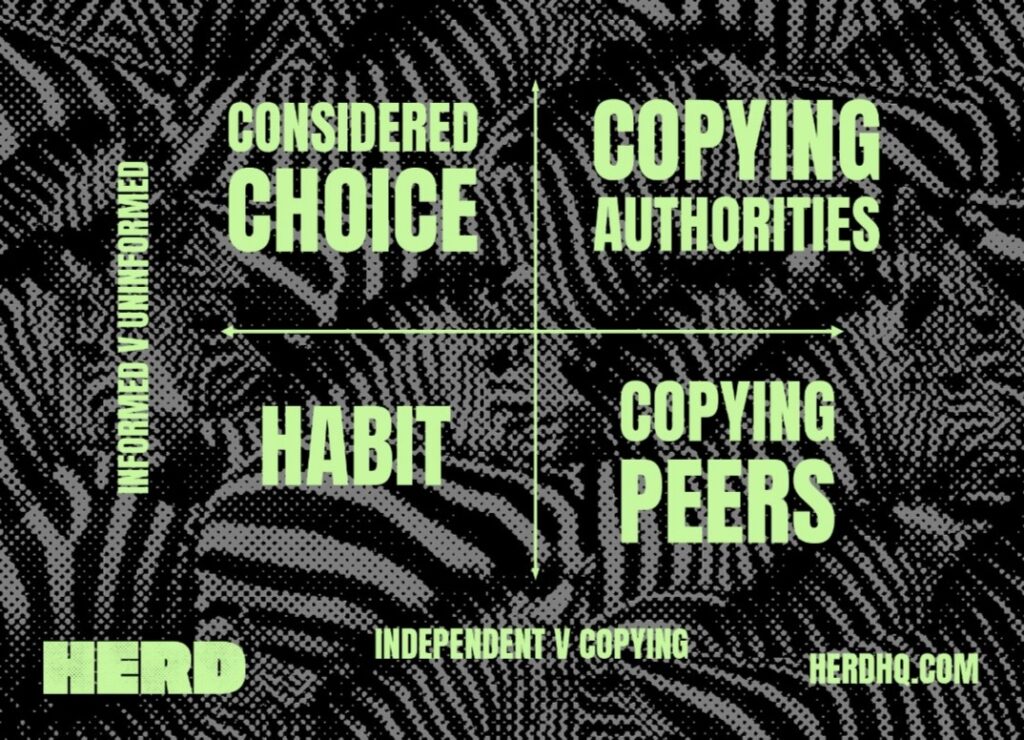
For those who know our map of human choice styles, this is more like a style of decision we call Copying Experts and Authorities: following authority and tradition rather than objective facts. Of course, doctors like to believe that they are supremely rational creatures, making considered decisions based on a careful weighing up of facts and figures.
But this is often an illusion, as Thomas Kuhn showed more than a century later: a way of seeing things, a “paradigm”, is community property. It doesn’t exist in isolation as objective fact: it is owned by the group. Indeed this kind of idea often becomes an identity marker and a price of entry to that group. It is learned by copying exemplars in textbooks and labs and reinforced by an endless stream of smaller studies and publications. And above all by the consensus which plays out every day in nods of tacit acceptance. Results that do not fit this way of seeing things are quietly put aside and forgotten. Does that sound familiar in your organisation?
So how do things change? How do these world-views and accepted notions of quality and best practice shift? The great physicist Max Planck was blunt: new ideas win when the opposition dies (or the group who depend on the status quo). Studies have since shown Planck was at least partly right: when a star scientist dies, outsiders often move into the field. Science advances, at least sometimes, one funeral at a time.
Few of us are working to this kind of timeline: most of us, especially at this time of year, are arguing for change next quarter (or the quarter after that). We load up the evidence and the rational case for change. The research studies and the test cases. The data. The data. The data. Very Semmelweis.
Kuhn offers a quicker, more hopeful route to winning the argument. He explains, for example, that Copernicus’s sun-centred universe did not win out on proof: for decades it was no more accurate than the old earth-centred system. But it did win converts who found it useful for their own problems, from better astronomical tables to calendar reform, or who simply found it more elegant. New ideas spread when they serve somebody’s – somebody else’s – agenda. When they fit with other, pre-existing ideas. With other problems or challenges. When they are useful, not just when they are right.
In Vienna, Semmelweis was arguing at cross purposes with his audience1: making the case for a Considered Decision to people who were Copying Experts and Authorities.
So when you argue with your leadership over next year’s plans, don’t be like Semmelweis. Look instead for how your proposal serves the way they are making their decision. If, as is very often the case, it is not actually a Considered choice, how might you tweak the pitch to serve their agenda, not as individuals but as a group? Who do they look to and what would let those people go first?
Don’t fall foul of Semmelweis syndrome: mistaking being right for being persuasive.
HERDspotting Tips
Watch: Next time a proposal gets waved through in a meeting, watch the nods. Who nodded first, and who were the others looking at when they nodded? Then ask whether anyone mentioned the evidence at all. And which number gets requoted or scribbled in moleskins by those justifying their decision?
Listen: for the signatures of different kind of decision making. Are your audience actually making a Considered Decision? Or, are they merely pretending to? Are they playing the game of Considered Decisioning?
Reflect: Take the proposal you care most about in next year’s plan. Count the slides of evidence. Now write one line on what it does for the group you need to persuade, and name who in that group would have to go first. Which took longer?
References
Azoulay, P., Fons-Rosen, C. and Graff Zivin, J. (2019) Does science advance one funeral at a time? American Economic Review, 109(8).
Bentley, R. A., Earls, M. and O’Brien, M. J. (2011) I’ll Have What She’s Having: Mapping Social Behavior. MIT Press.
Great Lives on BBC Radio 4, where the neurosurgeon Henry Marsh nominates Semmelweis, joined by Stephen Brown, co-writer with Mark Rylance of the play Dr Semmelweis. Presented by Matthew Parris.
Kuhn, T. (1957) The Copernican Revolution. Harvard University Press.
Kuhn, T. (1962) The Structure of Scientific Revolutions. University of Chicago Press.
Nuland, S. B. (2003) The Doctors’ Plague: Germs, Childbed Fever, and the Strange Story of Ignác Semmelweis. W. W. Norton.
Planck, M. (1950) Scientific Autobiography and Other Papers. Williams & Norgate.
Fleeing Vienna, Ignaz returned to Hungary, to the twin city of Pest, where his outsider status and his liberal politics were less of a problem to the authorities. Here, his recommendations were rapidly adopted. He, sadly, died in an insane asylum, of the very same infection he had spent the best part of his professional life fighting.