We are, as the award-winning novelist Elif Shafak reminded us this week at Future Forum UK, a story species: a story-telling, a story-feeling species, a story-making species. Stories shape us and our behaviour. We can’t stop telling them, to ourselves and to each other. It’s become fashionable to think about story telling: we’re told we need to get our story sharp and relevant, to get better at telling it, to own the room. We’re plagued with talk of story arcs and archetypes, plot structures, narrative devices, breath work and good old-fashioned performance. Yet amongst all the story mania, I think we are missing probably the most important piece: the retelling of stories and how, through the work of many hands, the story changes as it spreads.
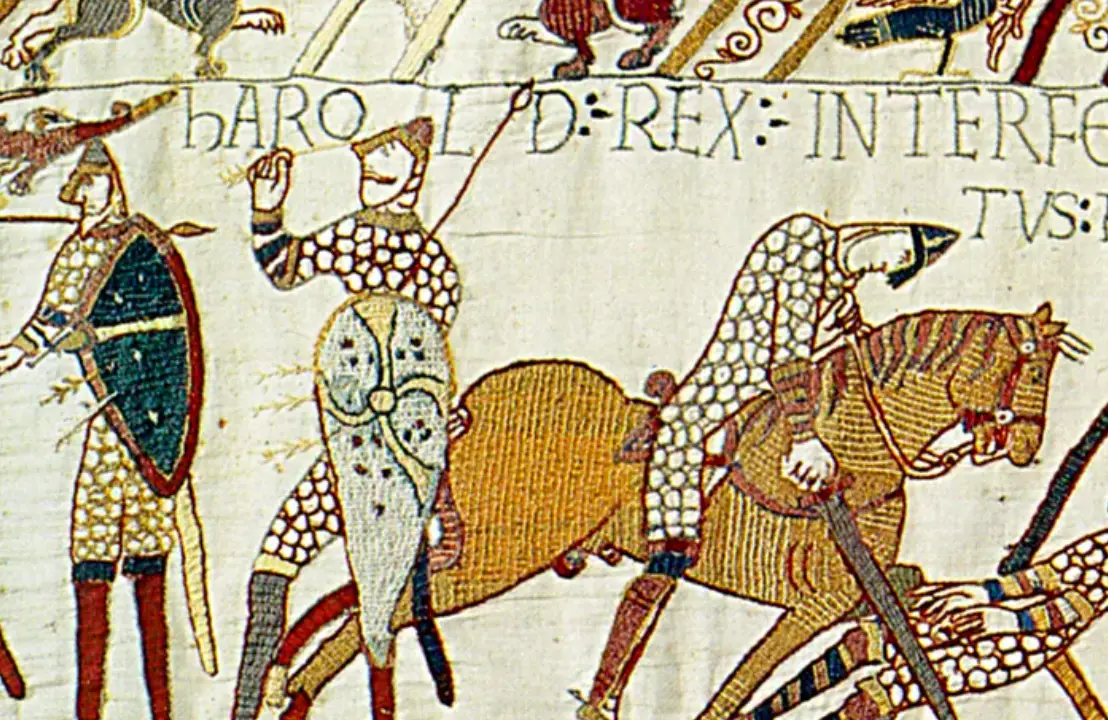
On Monday I spent forty minutes, shuffling the length of the incredible Bayeux Tapestry: from left to right for 70 metres, in the company of hordes of middle-aged, middle-class Londoners and in the half dark of the British Museum. Despite the hype, the experience was a revelation to me in a number of ways, although my old Latin master, Mr Sadler, would have winced at a number of my volunteered mistranslations of the piece’s sewn-in captions.
I came away with a story that was different from the one I remembered. The plot starts earlier than I recalled, way back in the court of Edward the Confessor, who sends one of his leading nobles, Harold of Wessex, across the Channel to Normandy for some reason or other. There’s a whole backstory to understand, including a shipwreck and some banditry. Right, right, we go, ogling the pictures as we might a whodunnit or a manga comic laid out on one long roll.
It’s only some way in, that the key plot point of the oath lands: Harold’s hands are placed on holy relics, which seems to suggest he’s swearing something to Duke William (the future William the Conqueror). Norman writers say he went to pledge loyalty to his host, while one English chronicler at least suggests he went to free prisoners.
These two interpretations are clear even in the object. Consider for a moment who made this cloth. Probably the well-regarded English embroiderers, probably in Canterbury, probably for the Norman Bishop Odo (he plays a starring role in a couple of scenes and the tapestry hung for centuries in his Bayeux cathedral). The fact that it is not clear what Harold was swearing to hints at these two different stories and the traditions that will develop from them: that of the Norman invaders and that of the Anglo-Saxons who were to go on to lose the battle at Hastings. While the victors proverbially get to write the history, the losers’ story doesn’t just die. At least, it doesn’t if you keep telling it.
In my head, the version I’d assembled from schooldays and some visits to Bayeux decades ago was simpler. The opening, the initial diplomatic mission to William, wasn’t part of it. The real story, the only story fragment that mattered, the only story fragment that travelled to me, was that Harold promised something that he then welched on. Which is why it is ok that the Normans invaded and why Harold’s army had to be (deserved to be) defeated.
Nobody told me the full story, or rather, I didn’t listen to it. And no one even hinted at the ambiguity of the pivotal oath scene. If I had to retell the story before my visit, I’d have started with the oath, and focused on Harold’s breaking of it and then the invasion.
Back in the story again
Storytelling today isn’t a matter of cutesy bedtime teddy bears and big bad wolves. We take stories and storytelling seriously. We study stories, their structure and their beats; we wrestle with the narrative and owning it. We dig out our Aristotle or Joseph Campbell and our hero’s journey and hope they will help us storify better. We study the telling: the rhetoric, the voice, the craft, how it all lands in the room. We even learn how to breathe properly and how to stand. Remember the power poses, made famous by Amy Cuddy, that so bewitched politicians in the 2010s?
But we rarely study the retelling.
Which is unfortunate, because retelling is how stories spread. Where the real value of storytelling lies.
It’s not your story. Or mine. Even if your wrote it down, Virginia Woolf-style, after a no-nonsense walk around the park. Even if you posted it to yourself. As soon as the story is told, it is no longer yours. It is now the audience’s. If it spreads, it can only do so by passing through the ears and mouth of first one, then another, then another reteller. Each of these repackages the story in their own way and for their own reasons. And in the audience will be someone who retells the story again, in their own way and for their own reasons. And so on, if the story gets lucky and keeps spreading. And in every retelling the story changes: slowly, slowly, and then sometimes suddenly and radically (as Hemingway is supposed to have said about bankruptcy).
This isn’t decay. It isn’t error: it’s storytelling properly at work. Frederic Bartlett saw this nearly a hundred years ago. He had people retell a folk tale, and he saw how the retellings drifted, growing more rationalised and more distorted as the gap lengthened. A replication of Bartlett’s work in 1999 found a similar pattern.
Anthropologist Jamie Tehrani’s fascinating work shows how it happens. His family tree of Little Red Riding Hood, built with tools from evolutionary biology, shows tales branching and blending over centuries: African versions look like cousins of The Wolf and the Kids. Alberto Acerbi’s experiments suggest some of the mechanics: when people have to remember and retell a story, threatening content does best. When they only choose whether to share a story, that advantage disappears.
So here’s my problem: when we talk about storytelling today, we’re worrying about telling the right story, the optimal story, the winning story. We sweat over the best way of telling it: the best delivery, the best slides, the best way to stand, the best way to breathe.
We’ve forgotten that the best stories are the ones our audience tells each other, long after our telling is done. When the room we’ve told our story in has long gone.
Let’s build stories for the journey, for the reteller and the retelling.
Let’s build stories to fly and not to land.
Watch
Go see the Bayeux Tapestry itself, at the British Museum (book a slot). Don’t just follow the plot (although it is a ripper and the story zips along). Look at the borders above and below the scenes, which some think comment on the action, and ask who each version of the story is for.
Listen
Marina Warner and the storyteller Mara Menzies on whether modernising fairy tales protects or spoils their magic (BBC Radio Scotland, Sunday Morning with Cathy Macdonald, 13 December 2020): https://www.bbc.co.uk/programmes/m000qb4x. Listen for who they think owns a tale that has been retold for centuries.
Reflect
Pick a story your organisation tells about itself: how a famous decision was made, or why a founder did something. Ask someone who joined this year to tell it to you, then ask someone who heard their version. Where did it drift? What was added, and what dropped out? Who is each version for? Then do it again with a different pair, because one chain tells you about one chain. You can also try it on any story you want to tell – inside the organisation or outside. (more next time).
References
Acerbi, A. (2022). From storytelling to Facebook: content biases when retelling or sharing a story. Human Nature, 33(2). https://doi.org/10.1007/s12110-022-09423-1
Aristotle, Poetics. (Penguin)
Bartlett, F. C. (1932). Remembering: A Study in Experimental and Social Psychology. Cambridge: Cambridge University Press.
Bergman, E. T. and Roediger, H. L. (1999). Can Bartlett’s repeated reproduction experiments be replicated? Memory and Cognition, 27(6), 937-947. https://doi.org/10.3758/BF03201224
British Museum. Bayeux Tapestry exhibition page. https://www.britishmuseum.org/exhibitions/bayeux-tapestry
Campbell, J. (1949). The Hero with a Thousand Faces. New York: Pantheon Books.
Cuddy, A. (2012). Your body language may shape who you are. TED talk. https://www.ted.com/talks/amy_cuddy_your_body_language_shapes_who_you_are
Hemingway, E. (1926). The Sun Also Rises. New York: Scribner.
Tehrani, J. J. (2013). The phylogeny of Little Red Riding Hood. PLoS ONE, 8(11), e78871. https://doi.org/10.1371/journal.pone.0078871