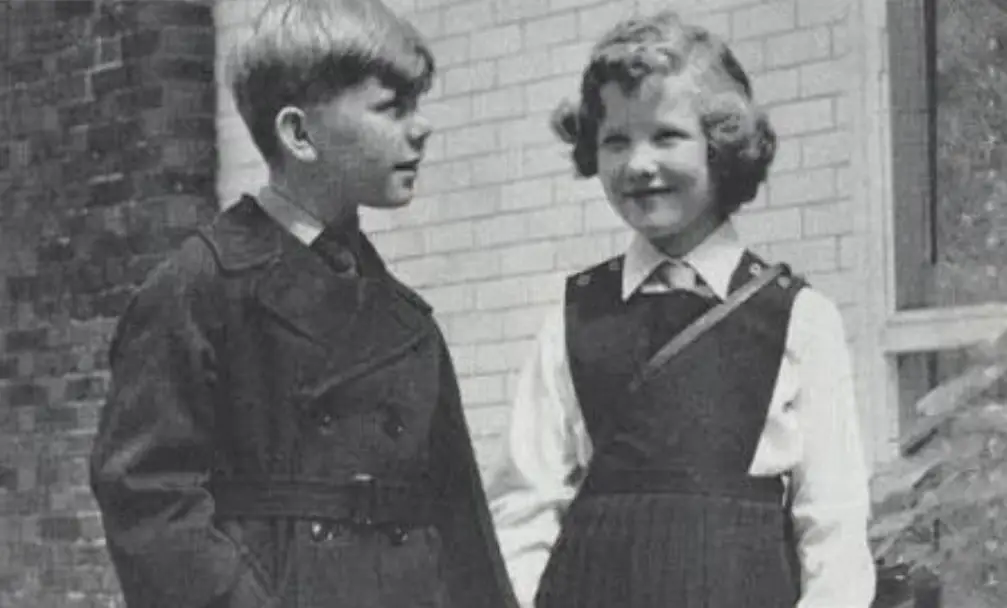
The last few weeks have seen two groups of British citizens don crisp new uniforms. First there are the schoolboys and schoolgirls, back from the summer break and clothed in newly minted uniforms. They fill the social feeds of their mums and dads, cutely posed for the camera on the doorstep, heading for buses and trains, hungry for the new school year, in uniforms that echo all those previous generations of schoolchildren: those of their parents and their grandparents. So far, so sweet.
Then there are the self-styled patriots. Men of a certain age. Men of a certain rage. Marching and chanting outside hotels and courtrooms and along beaches, about boats and Islam and protecting our womenfolk. Dressed in black from head to toe, t-shirt and shorts, white socks, black shoes (as Ian Dury has it in Sweet Gene Vincent), darkly muffled and muzzled with masks and balaclavas that hide their faces. Not so sweet.
Put aside the politics for a moment and it’s clear that the blazer and the balaclava are doing the same job, for the people inside them and for the rest of us who watch them.
First, a uniform is a costume of belonging. Whether you’re 13 or 30, it shows you’re part of the gang. It draws a very visible line between Us and Them, and helps you recognise who is Us and who is not. As the social psychologist Henri Tajfel argued, we take a good part of who we are from the groups we belong to, and a uniform makes that membership visible immediately. It’s another example of how belonging makes us feel safe. Think of football “firms” or street gangs. (The Patriot tendency must surely be aware of the irony that today’s uniform for street gangs of every stripe in the UK is plain black sportswear: black joggers, black North Face jackets, black scarves or face masks?)1
Second, it’s a costume of disguise. It helps you disappear into the crowd; to lose your own identity, and with it your inhibition and your responsibility in equal measure. To escape when things are dangerous, or when you want to make them so. Philip Zimbardo – the psychologist behind the Stanford Prison Experiments called this deindividuation: hide the face, dress everyone alike, and people stop feeling like themselves, and stop answering for themselves. Like the schoolkids I hung around with as a boy, making mischief on the Metropolitan line. Like the youths who shoal around my neighbourhood today on their push bikes: the “Lippy Kids” Guy Garvey sings about in the song of the same name. The balaclava is simply another disguise.
Third, the uniform is a costume of display. It helps you play the role of… whatever role you want to play. Erving Goffman would call it part of your “front”: the costume and props that tell the audience what part you’re playing, and how they should treat you. And it helps us, the audience, see the group and feel its physicality: the power and the potential of them. A dozen men in their own clothes are a queue; a dozen men in matching black, top, bottom and face, are a group.
Which is where the old Gang of Four line comes in. “I love a man in uniform” and “I’m frightened of men in uniform” are the same instinctive emotional response, wearing different faces. We’re not responding to the man at all, but to what the uniform promises (protection, competence, menace), depending on which side of the line we’re standing.
It’s tempting to think all this is about schoolkids and footsoldiers. But we’re all at it, all of the time. Since 1994 the Rotterdam photographer Ari Versluis and his collaborator, the self-styled “profiler” Ellie Uyttenbroek, have been collecting the evidence. It started, of all things, as a PTT Telecom commission on youth culture, with Rotterdam’s shaven-headed gabber ravers as the subject of the first series.
Versluis and Uyttenbroek’s method is simple and relentless: walk the streets until you spot a type (a look, a way of standing, a particular combination of jacket, trainers and haircut), then find a dozen people who share it and photograph each one the same way, same pose, same plain white background. Lay the twelve out side by side in a grid and give them a name and a number. The pair call this rolling project Exactitudes: exact plus attitude. Every one of their subjects got dressed that morning believing they were expressing themselves; every one is wearing, very nearly, the same outfit as eleven strangers. Nobody issued a dress code. Nobody made it compulsory. Uniform isn’t only something done to us by armies, schools and movements. It’s something we do to ourselves, every morning, without noticing.
Watch / Listen / Reflect
Watch: Browse the Exactitudes archive online and try to find your own grid. If you can’t, ask a friend: they’ll find it for you in seconds.
Listen: Gang of Four, “I Love a Man in Uniform” (1982): not the cliché but a sour little song about signing up because there’s nothing else on offer. Then Elbow’s “Lippy Kids” (2011), for the tenderer version of the same instinct.
Reflect: Next time the men in black appear on the news, set aside what they’re chanting and ask what the kit does for them. For some it may be the first uniform they’ve been offered in years: no regiment, no works team, no union banner, no Sunday league side. Pull on the balaclava and you’re instantly part of something, instantly visible, instantly bigger than you were at breakfast. That tells us something about their politics, but perhaps more about what they’re missing, and about what the rest of us have stopped offering.
And closer to home: look in your own wardrobe. What’s in there you’d never have chosen if nobody around you wore it? What does it feel like to don the garb?
References
Earls, M. (2007) Herd: How to Change Mass Behaviour by Harnessing Our True Nature. Chichester: Wiley.
Elbow (2011) “Lippy Kids”, Build a Rocket Boys! Fiction/Polydor.
Gang of Four (1982) “I Love a Man in Uniform”, Songs of the Free. EMI.
Goffman, E. (1959) The Presentation of Self in Everyday Life. New York: Doubleday.
Tajfel, H. and Turner, J.C. (1979) “An integrative theory of intergroup conflict”, in W.G. Austin and S. Worchel (eds) The Social Psychology of Intergroup Relations. Monterey, CA: Brooks/Cole.
Versluis, A. and Uyttenbroek, E. (2015) Exactitudes. 20th anniversary edition. Rotterdam: nai010 publishers. Online archive: exactitudes.com.
Zimbardo, P.G. (1969) “The human choice: individuation, reason, and order versus deindividuation, impulse, and chaos”, Nebraska Symposium on Motivation, 17, pp. 237-307.
Also Wodehouse’s take on home grown fascism, the “blackshorts”